Paterson, New Jersey
Alexander Hamilton had a problem. The young republic he helped create was economically dependent on the very British manufacturers it had just fought to escape. His solution, conceived in 1791, was audacious: harness the 77-foot Great Falls of the Passaic River to power a planned industrial city that would manufacture America's way to self-sufficiency. He called the venture the Society for Establishing Useful Manufactures, and he named the city after New Jersey Governor William Paterson, who signed its charter. Pierre L'Enfant, fresh from drafting the plans for Washington, D.C., drew up the initial designs. Hamilton's experiment worked -- perhaps too well. Paterson became the cradle of American industrialization, and then it became something more complicated.
The Looms That Built a City
The water raceways channeling the Great Falls' power drove Paterson's mills until 1914, and in that time the city cycled through identities like fabric on a loom. Cotton came first, then firearms -- Samuel Colt began manufacturing guns here in 1836 before decamping to Hartford, Connecticut. Irish-American inventor John Philip Holland tested early submarine prototypes in the Passaic River; two of his models survive in the Paterson Museum, housed in the former Rogers Locomotive and Machine Works. But silk was the industry that stamped the city's character. By the latter half of the nineteenth century, Italian weavers from Piedmont and Naples had transformed Paterson into America's silk capital, earning it the nickname that stuck: Silk City. The wealth was real but unevenly distributed, and in 1913, silk workers launched a six-month strike demanding an eight-hour day. Led by IWW organizers Big Bill Haywood, Elizabeth Gurley Flynn, and Carlo Tresca, the strike ultimately failed -- workers returned without winning a single concession -- but it etched Paterson into the history of American labor.
A City Hall Modeled on Lyon
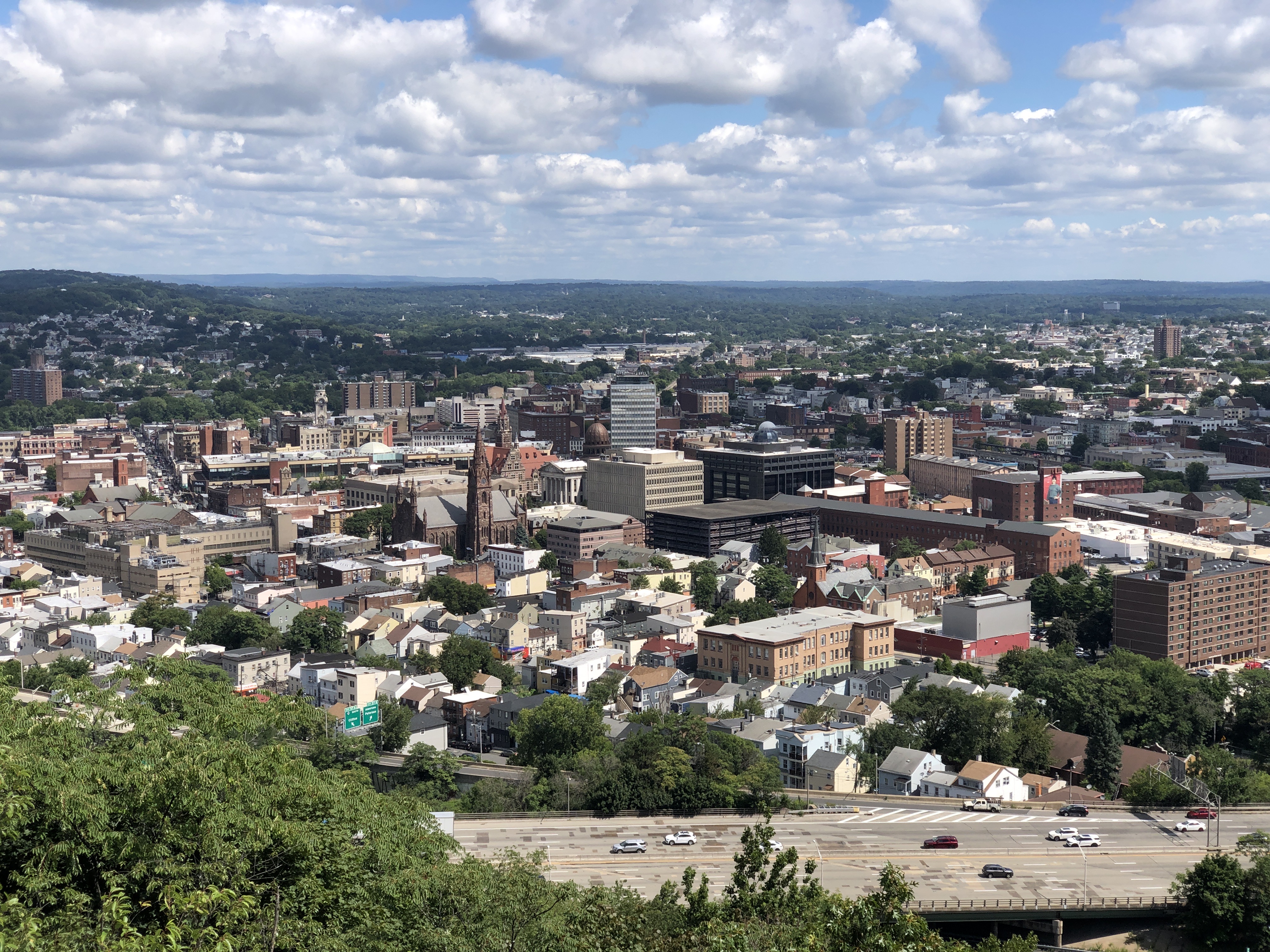
Walk through downtown Paterson today and you walk through the aftermath of ambition. After a devastating fire in 1902, the city rebuilt its commercial core in massive Beaux-Arts style, with buildings four to seven stories tall that still anchor the streetscape. City Hall, designed by Carrere and Hastings in 1894, was modeled on the Hotel de Ville in Lyon, France -- the capital of the European silk industry. The choice was deliberate: Paterson saw itself as Lyon's American counterpart. Eastside Park, once home to the city's industrial barons, preserves a thousand homes in styles ranging from Tudor to Italianate villa, though the neighborhood's fortunes have risen and fallen with the city's. The Great Falls themselves became a national historical park, the thundering cascade still visible from the bridges and walkways where Hamilton once envisioned a nation's economic independence.
Crossroads of the World
If Hamilton built Paterson for manufacturing, the twenty-first-century city runs on something different: the energy of immigration. With a population of nearly 160,000, it is New Jersey's third-largest city and one of the most ethnically diverse places in America. South Paterson, known to residents as Little Istanbul or Little Ramallah, hums with halal meat markets and Arabic shop signs, home to significant Turkish, Jordanian, Palestinian, and Syrian communities. Paterson has the nation's second-largest per capita Muslim population. The former Orpheum Theatre on Van Houten Street is now Masjid Jalalabad, an Islamic center accommodating 1,500 worshippers. Twenty-First Avenue, or "La Veinte y uno," pulses with Colombian and other Latin American businesses. Bengali grocery stores cluster along Union Avenue in the Totowa Section. Each neighborhood carries its own accent, its own cuisine, its own version of the American story.
Resilience and Ruin
Paterson has never had an easy time of it. Deindustrialization gutted the city after World War II, and by 1983 it ranked as the fifth-poorest city in the United States. White flight hollowed out entire neighborhoods. Fires kept coming -- the 1991 blaze consumed nearly a city block downtown, killing firefighter John A. Nicosia and destroying the Meyer Brothers department store. Hurricane Irene in 2011 pushed the Passaic River to levels unseen in a century, displacing thousands. Homeland Security Secretary Janet Napolitano, surveying the damage, called it the worst she had seen across eight affected states. Yet Paterson persists, as it always has. New houses rise in neighborhoods where vacant lots once dominated. Gentrification has begun creeping into the Eastside Park Historic District. The Great Falls still roar, indifferent to the fortunes of the city they powered into existence.
From the Air
Located at 40.916N, 74.172W in Passaic County, New Jersey. The Great Falls of the Passaic River is the signature visual landmark -- a 77-foot waterfall visible from low altitude as a break in the urban fabric. Look for the canyon of the Passaic River winding through the city's industrial district. Interstate 80 cuts through the city east-west. Nearest airports: Teterboro (KTEB) 10nm southeast, Essex County (KCDW) 6nm southwest. Best viewed at 2,000-3,000 ft AGL. The Beaux-Arts downtown and Eastside Park are visible northeast of the falls.