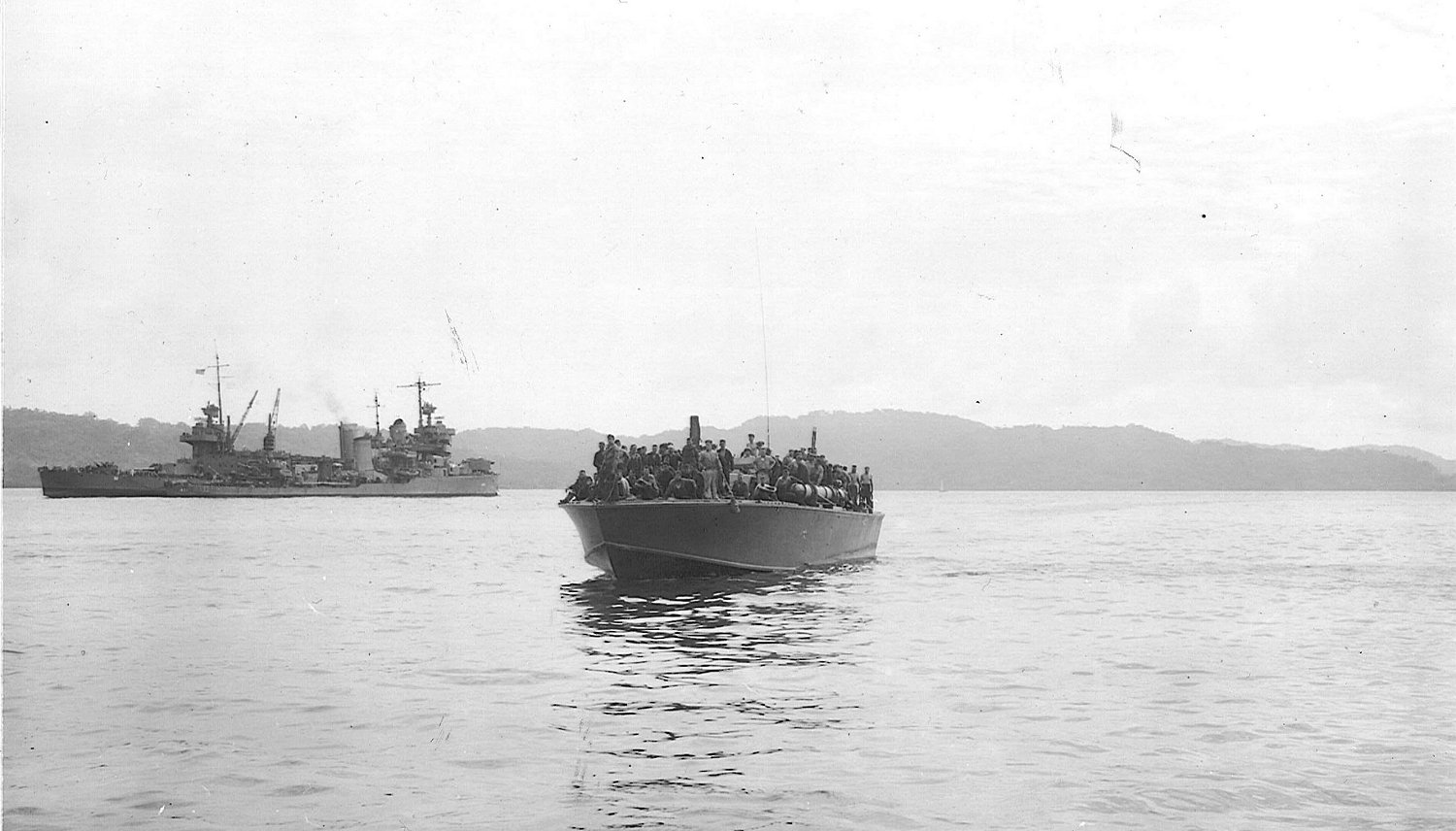
Patrol Torpedo Boat PT-109
Andrew Jackson Kirksey had told anyone who would listen that he was going to die on his next patrol. The 25-year-old torpedoman from Reynolds, Georgia had a wife and a young son waiting for him, and he could not shake a premonition. On the moonless night of 1 August 1943, as PT-109 idled on one engine in the Blackett Strait southwest of Kolombangara, a 2,000-ton Japanese destroyer called Amagiri emerged from the fog at 23 knots. The collision took less than ten seconds. Kirksey died where he stood. Harold William Marney, a 19-year-old motor machinist's mate from Springfield, Massachusetts, was manning the turret nearest the impact point. He died instantly too. The eleven men who survived the fireball would spend the next week trying to get home.
An 80-Foot Wooden Boat
PT-109 was an Elco motor torpedo boat, 80 feet long and 40 tons, one of hundreds built in Bayonne, New Jersey between 1942 and 1945. Her hull was two layers of mahogany planking an inch thick. Three 1,500-horsepower Packard gasoline engines, marinized aircraft powerplants, could push her to 41 knots in calm water, but her Mark 8 torpedoes were notoriously unreliable - slow, inaccurate, and prone to failing at the moment of impact. The Japanese Type 93 Long Lance, by contrast, ran faster, farther, harder, and actually detonated. The boats were designed to dart in close to Japanese ships and fire torpedoes, but in practice they were outgunned by everything they might find. Her skipper on 1 August was a Boston lieutenant named John F. Kennedy, 26 years old, with a chronically bad back that had twice disqualified him from military service until his father pulled strings to get him in anyway.
The Battle of Blackett Strait
On the night of 1-2 August 1943, fifteen PT boats set out from the base on Rendova to intercept a Tokyo Express supply run - four Japanese destroyers bringing troops and provisions to Vila Plantation on Kolombangara's southern tip. The plan was a failure from the start. Communication orders came by radio from forty miles away. Only four of the PT boats carried radar, and those four fired their torpedoes first and were ordered back to base, leaving the radarless boats blind in the fog. Of the thirty torpedoes fired that night, not one hit a destroyer. The only confirmed results of the engagement, as the Navy historian Captain Robert Bulkley drily summarized it, were the loss of PT-109 and damage to the Japanese destroyer that struck her. Kennedy had his engines throttled down to hide his phosphorescent wake from Japanese aircraft. He had less than ten seconds to react when the Amagiri's silhouette emerged from the darkness.
Four Miles to Plum Pudding
PT-109 was sliced on her starboard side at a 20-degree angle. An aviation-fuel fireball rose a hundred feet. The forward section stayed afloat because of watertight compartments. Motor machinist Patrick McMahon, the only man in the engine room, was badly burned but alive; the other nine survivors clustered around him on the drifting bow. No other PT boat came back to check for survivors. Kennedy, a Harvard swim team alumnus, took a strap of McMahon's life vest between his teeth and towed the burned man 3.5 miles to Plum Pudding Island - a coral speck only 100 yards across - while the rest of the crew kicked a timber float that had been part of the 37mm anti-tank gun mount Kennedy had lashed to the bow the day before. The crossing took five hours. The island had no food and no water. The next night Kennedy swam out alone into Ferguson Passage trying to hail a passing American boat. None came.
Gasa and Kumana
The survivors eventually made longer swims, first to Olasana, which had coconuts but still no fresh water, then to Naru, where Kennedy found a small canoe, some Japanese crackers and candy, and a barrel of drinkable water abandoned by retreating troops. It was on Olasana that Kennedy first spoke with Biuku Gasa and Eroni Kumana, two Solomon Islanders who were working as scouts for the Australian coastwatcher on Mount Veve. Gasa and Kumana had almost paddled past - they initially took Kennedy for a Japanese soldier, given his beard and sunburn. Kennedy handed them a coconut husk with a message carved into it. Ensign Leonard Thom wrote out a penciled note. The two Solomon Islanders paddled through 38 nautical miles of Japanese-patrolled waters - across rough open sea, overnight - to deliver those messages to the base at Rendova. They did more than pass information along. They chose to risk their own lives in a war that was not theirs, for men they had never met, and without their choice the eleven men on Olasana would have died there.
The Rescue and the Politics of Memory
On the night of 8 August 1943, PT-157, commanded by Kennedy's friend Lieutenant William Liebenow, slipped into Gomu Island, collected Kennedy, and brought the crew home. The New York Times headline the next day read KENNEDY'S SON IS HERO IN PACIFIC AS DESTROYER SPLITS HIS BOAT. Kennedy's father Joseph Sr. made sure the story traveled widely. Kennedy was awarded the Navy and Marine Corps Medal and a Purple Heart. The back injury he sustained in the collision plagued him for the rest of his life. The coconut husk with his rescue message sat in a glass paperweight on the Oval Office desk during his presidency; it is now at the John F. Kennedy Library in Boston. Gasa and Kumana were invited to the 1961 inauguration but were intercepted at the Honiara airport by Solomon Island officials who decided their pidgin English and appearance would embarrass the country; local dignitaries went in their place. In 2002, Robert Ballard's National Geographic expedition found the wreck of PT-109 at a depth of 1,200 feet. Gasa died in August 2005; his death was noted in one blog post. The last of the surviving crew members, Gerard Zinser, had died four years earlier in Florida.
From the Air
PT-109 was rammed at approximately 8.07 S, 156.97 E in the Blackett Strait between Kolombangara and Gizo in the Solomon Islands' Western Province. The waters here are 500-1,000 meters deep between steep volcanic islands; the wreck lies at about 1,200 feet. Best viewing altitude 4,000-5,000 feet to take in the strait, Plum Pudding Island (now called Kasolo), Olasana, and Naru Islands where the crew survived. Munda International Airport (AGGM) is about 20 nm east; Gizo airport (AGGN) is 5 nm west. Tropical weather and frequent squalls.