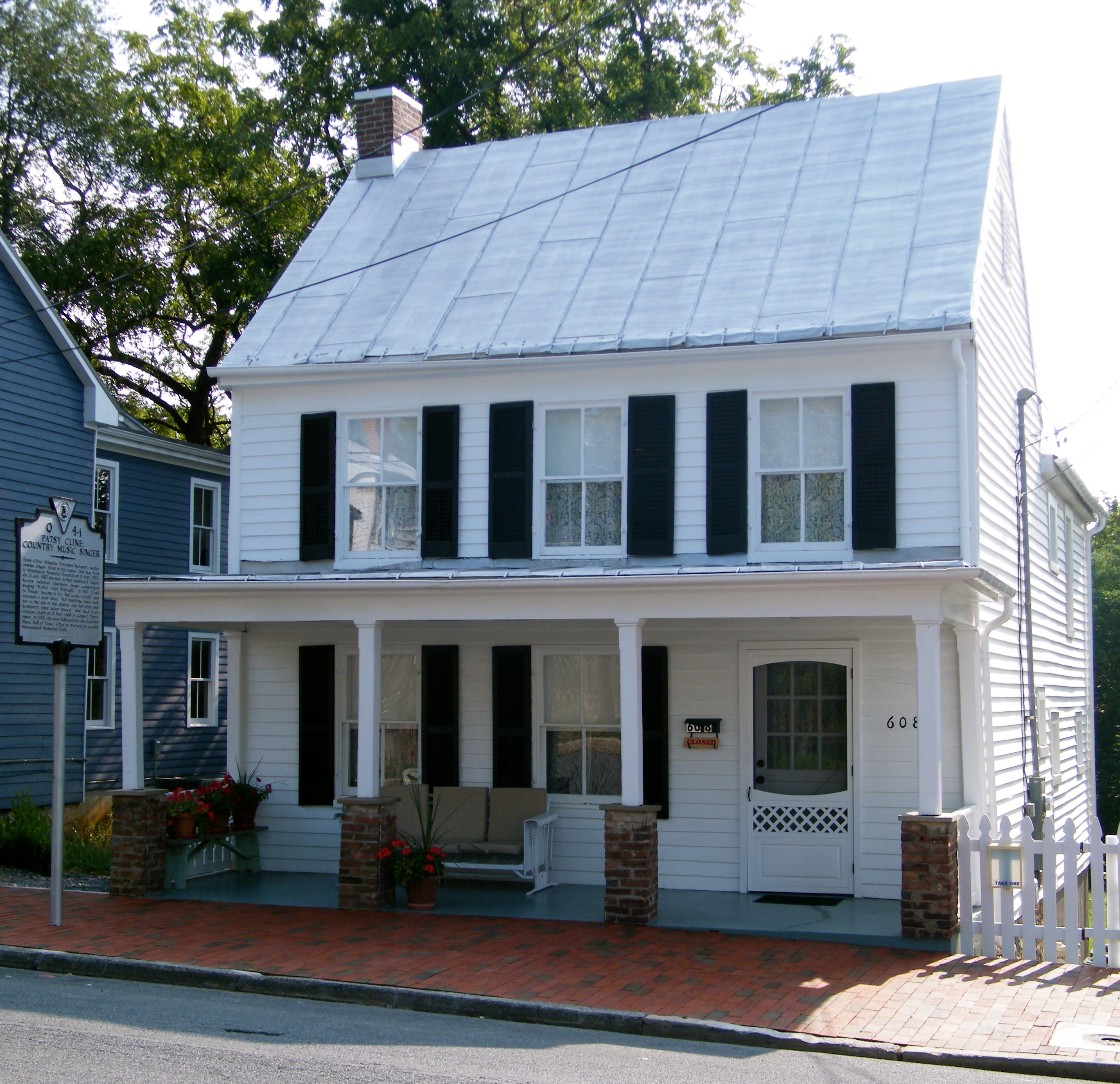
Patsy Cline House
The sole bedroom is upstairs, about a thousand square feet of space for a family of four. At 608 South Kent Street in Winchester, Virginia, the house is a log cabin built in the mid-19th century, covered with siding and topped with a tin roof -- the kind of place you drive past without noticing. But between 1948 and 1953, this was the most important address in the history of country music, because this is where Virginia Patterson Hensley became Patsy Cline. Her mother sewed her first stage costumes at the kitchen table. Her first radio performance was rehearsed within these walls. Every rhinestone-studded beginning started here.
A Seamstress and Her Daughter
Hilda Hensley moved into the small house on Kent Street with her three children after separating from her husband. She worked as a seamstress, renting the house at first, then scraping together enough to buy it. The family was poor. To help pay bills, Patsy dropped out of school at 16 and worked as a waitress, a soda jerk, and whatever else she could find. But music pulled at her relentlessly. At thirteen, she had survived a serious bout of rheumatic fever, and she later credited the illness with giving her voice its distinctive deep, throaty quality -- the ache that would one day make millions of listeners feel understood. She started singing at every opportunity, and her mother, bent over a sewing machine in the downstairs room, stitched the flashy Western costumes that would become Patsy's signature on stage.
The Sunday Morning That Changed Everything
Patsy's break came through a local radio station. She began performing on Joltin' Jim McCoy's Sunday morning show on WINC-AM in Winchester, singing country and gospel numbers with the raw conviction of someone who had nothing to lose. Gospel singer Wally Fowler, who led the Oak Ridge Quartet, heard her voice and was so impressed he traveled to the house on Kent Street to meet her family and try to launch her professional career. In the early 1950s, she joined a local band led by Bill Peer, who gave her the stage name Patsy. She signed her first recording contract with 4 Star Records in 1954. For two years, nothing charted. Then in January 1957, she appeared on Arthur Godfrey's Talent Scouts, a national television program, and sang "Walkin' After Midnight." The audience went wild. The single hit number two on the country charts and crossed over to the pop charts. Patsy Cline had arrived.
A Voice That Broke Every Barrier
What followed was a career that redefined country music. In 1961, "I Fall to Pieces" became her first number one hit. That same year, she recorded "Crazy," written by a young Nashville songwriter named Willie Nelson. The song reached number two and became one of the most played jukebox songs of all time. "She's Got You" gave her another chart-topper. Cline's voice had a quality that transcended genre -- pop audiences loved her, country purists claimed her, and her emotional delivery influenced generations of singers from Loretta Lynn to k.d. lang. She was inducted posthumously into the Country Music Hall of Fame in 1973. All of it -- every note, every heartbreak anthem -- traces back to a working-class house in Winchester where a teenage girl sang for tips and her mother sewed costumes by lamplight.
The House That Remembers
Patsy married Gerald Cline at 21 and moved out, though she returned intermittently. On March 5, 1963, at the age of 30, she was killed in a plane crash near Camden, Tennessee, along with fellow country stars Hawkshaw Hawkins and Cowboy Copas. She is buried a few miles south of the Kent Street house in Shenandoah Memorial Park. The house itself fell into obscurity for decades. In 2005, it was placed on both the Virginia Landmarks Register and the National Register of Historic Places. A nonprofit purchased it in 2006 and opened it as a museum in 2011 after extensive renovations. Today visitors walk through the small rooms and see the cramped quarters where America's greatest country voice was forged -- not in a Nashville studio, but in a working-class neighborhood where talent was the only way out.
From the Air
The Patsy Cline House sits at 39.178N, 78.165W in Winchester, Virginia, in the northern Shenandoah Valley. Winchester is a compact historic city visible as a cluster of development along I-81 and US-11. The house is in a residential neighborhood south of the downtown core. Look for Shenandoah Memorial Park, where Patsy Cline is buried, a few miles south of the city. Winchester Regional Airport (KOKV) is approximately 3nm southeast of the house. The Blue Ridge Mountains form a dramatic eastern backdrop. At lower altitudes, the grid of Winchester's working-class south side neighborhoods is clearly visible.