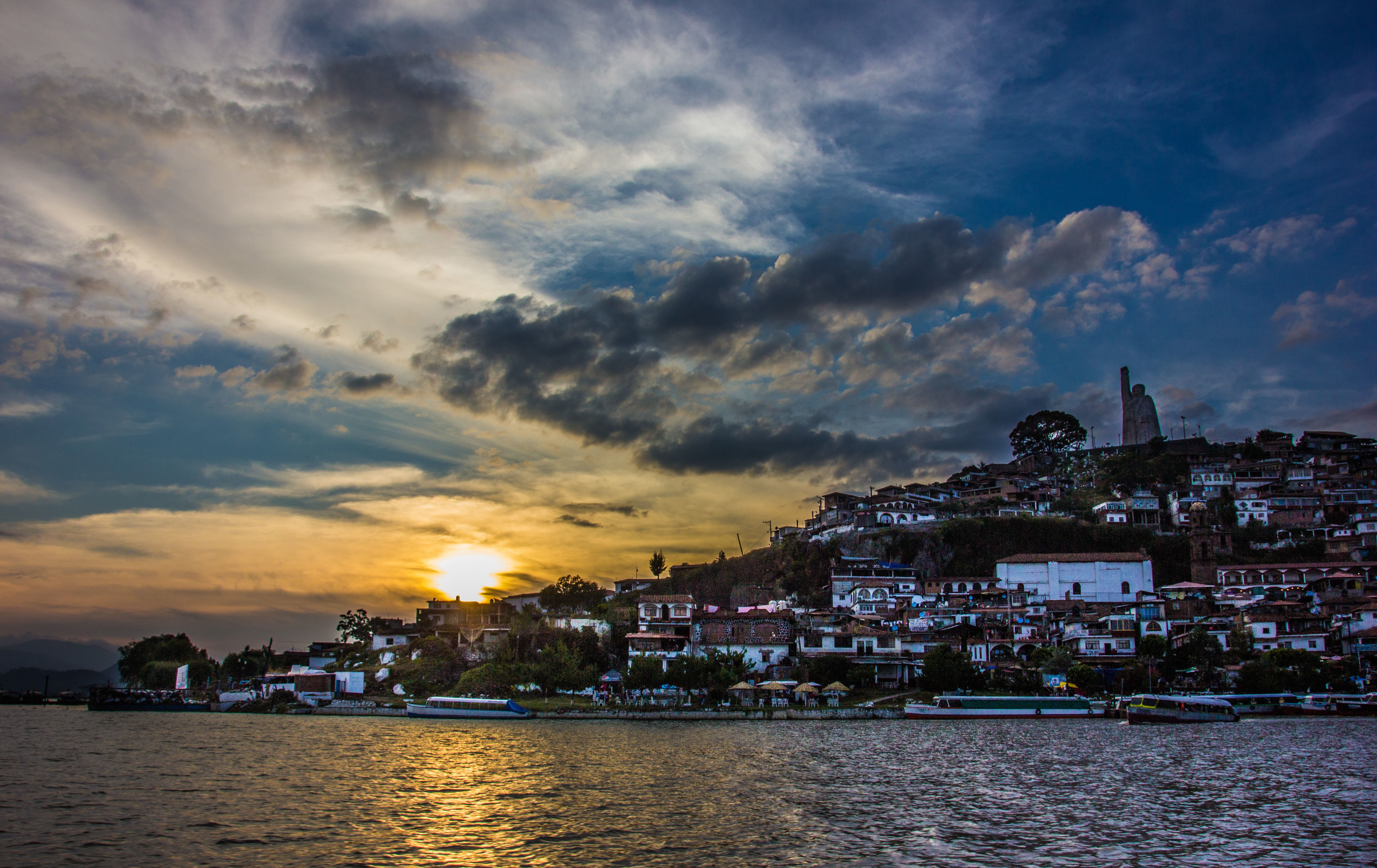
Pátzcuaro
Every November 1st, in the village of Tzintzuntzan just up the lakeshore, a ball is set on fire. Players armed with sticks like hockey clubs chase it across an ancient Purépecha ball court called Las Yácatas, reenacting a game that predates the Spanish conquest by centuries. The flaming ball is one of dozens of Day of the Dead traditions that converge on the Lake Pátzcuaro region each autumn -- traditions that make this area one of Mexico's most celebrated destinations for the holiday. At the center of it all sits Pátzcuaro, a city founded in the 1320s, whose cobblestone streets, colonial mansions, and persistent indigenous identity earned it a place among Mexico's Pueblos Mágicos program.
Seat of Temples, Place of Foundations
The name Pátzcuaro has at least six possible meanings in Purépecha and related languages: "place dyed in black," "place of foundations," "place of bullrushes," "place of weasel," "happy place," and "seat of temples." That last one suits it best. The city began as the capital of the Purépecha Empire, a state that rivaled the Aztecs and controlled vast territory across what is now Michoacán, Guanajuato, Guerrero, and parts of Jalisco. After the Spanish arrived, Bishop Vasco de Quiroga made Pátzcuaro the capital of the new province of Michoacán in 1538 and set about an ambitious rebuilding. He convinced displaced indigenous people to return, brought in Spanish families, and dreamed of a cathedral with five naves surrounding a cupola. The Spanish Crown thought the project inappropriate and allowed only one nave to be built -- over the ruins of a temple dedicated to the goddess Cueráppari. That single nave still stands. After Quiroga's death, the capital moved to nearby Valladolid, today's Morelia, but Pátzcuaro kept its character.
A Plaza Unlike Any Other
The Plaza Vasco de Quiroga -- the Plaza Grande -- is unusually large for a town of Pátzcuaro's size. In 1964, a fountain was installed at its center bearing a bronze statue of the bishop, sculpted by Costa Rican artist Francisco Zúñiga. Stately ash trees shade the perimeter, and colonial-era mansions with round arches and flower-filled courtyards line the edges. In a break from Mexican convention, the main church does not face the plaza. Instead, the Basilica sits nearby, built by Quiroga over a pre-Hispanic ceremonial site. The Jesuits later took over the compound, founding the College of Santa Catarina, and over the years they expanded it by purchasing adjacent houses until the complex held eleven courtyards. Today only five remain, and the adjoining building serves as the Casa de Cultura. Since the Mexican Revolution, Pátzcuaro has deliberately preserved its hybrid colonial-indigenous appearance -- cobblestone streets running downhill to the lake, bright craft vendors lining every block, the smell of uchepos and tarasca soup drifting from market stalls.
When the Dead Come Home
Day of the Dead is not merely observed in Pátzcuaro. It is performed. In the early morning of November 1, families gather in local cemeteries for the velación de los angelitos -- the wake for the little angels -- to honor children who died during the previous year. Meanwhile, other children participate in the teruscan, running through town "stealing" ears of corn, squash, and chayotes from the rooftops of neighbors' houses. The stolen food is carried to the community center, cooked, and shared by everyone. The preparations begin well before the holiday: families clean and repair cemeteries, and flowered arches of cempasúchil -- Mexican marigold -- are built at the gates of church atriums. At 9 PM on November 1, the Basilica of Pátzcuaro hosts a concert, while in Erongarícuaro the classic play Don Juan Tenorio is staged. The celebrations draw visitors from across Mexico and around the world, but they remain rooted in community ritual rather than tourist spectacle.
The Craft Hub of Michoacán
Pátzcuaro functions as the commercial heart of a network of artisan villages, each with its own specialty. Copperware arrives from Santa Clara del Cobre. Black pottery, musical instruments, and woven baskets come from surrounding communities. The town's own markets overflow with textiles, ironwork, jewelry, religious figures, and furniture. Local cuisine draws from both the lake and the land: tamales and uchepos filled with fish, red pozole, trout dishes, atole, and cold corn-based drinks. Fishing continues in Lake Pátzcuaro, though the lake's environmental decline has strained this centuries-old livelihood. Tourism now anchors much of the local economy, centered on the town's colonial architecture and the nearby archaeological sites of Ihuatzio and Tzintzuntzan. Mountain biking and paragliding have been introduced in recent years, adding contemporary activities to a place where the deeper attractions remain decidedly ancient. Charles V of Spain granted Pátzcuaro its coat of arms in 1553, and the city has been collecting layers of history ever since.
From the Air
Located at 19.516N, 101.610W on the southeastern shore of Lake Pátzcuaro in Michoacán, Mexico, at approximately 2,035 meters elevation. The town's colonial center is visible as a compact cluster of terracotta rooftops adjacent to the lakeshore. Lake Pátzcuaro itself is the dominant visual landmark, with islands including Janitzio (recognizable by its hilltop statue) visible in the water. Nearest major airport is Morelia International Airport (ICAO: MMMM), roughly 55 km east. The surrounding terrain includes volcanic peaks reaching 2,900 meters, requiring caution at lower altitudes. Afternoon convective weather is common in this section of the Trans-Mexican Volcanic Belt.