Paul Gauguin Interpretation Centre
Paul Gauguin came to Martinique to escape. In June 1887, broke and restless after leaving his wife and five children in Copenhagen, he arrived on the island with his friend and fellow painter Charles Laval. They had intended to go to Panama, and they did, briefly, but the reality of digging the canal for wages did not match the tropical fantasy. Martinique was the fallback, and it turned out to be the pivot. In roughly six months at Le Carbet on the Caribbean coast, Gauguin painted a dozen canvases that broke decisively with Impressionism and set him on the path toward the bold color and flattened forms that would define his later work in Tahiti.
Six Months at Anse Turin
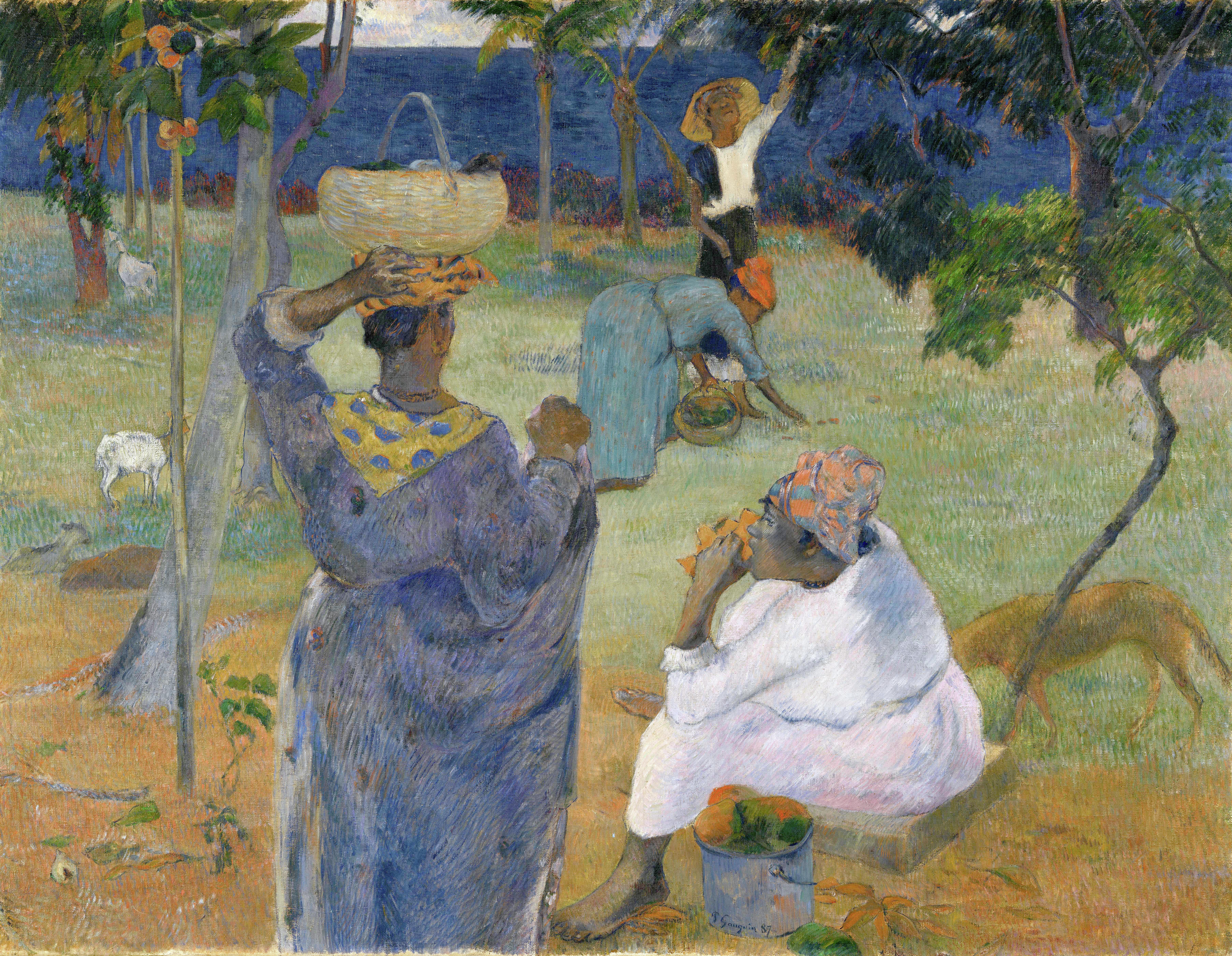
Gauguin and Laval settled near Anse Turin, a beach at Le Carbet where the lush vegetation met the sea. Gauguin later wrote that four of the paintings he produced in Martinique were 'far superior to my Pont-Aven period,' a significant admission from an artist not given to modesty. The Martinique canvases, including Tropical Vegetation, now at the Scottish National Gallery, and Among the Mangoes, at the Van Gogh Museum in Amsterdam, show Gauguin absorbing the saturated greens and heavy light of the tropics. The compositions are looser than his Brittany work, the palette warmer, the subject matter drawn from the daily life he observed around him. Women talking, fruit being gathered, the dense canopy of trees pressing in from every direction. It was the beginning of the exoticism that would consume the rest of his career.
A Museum Born from Devotion
In 1969, a group of local organizers founded the Association for the Creation of a Museum Paul Gauguin, determined to mark the painter's connection to Martinique before it faded entirely from memory. Four years later, in 1973, the association acquired land at Anse Turin, near where Gauguin had lived, and established the Centre d'Art Musee Paul Gauguin. Maiotte Dauphite became the association's president and dedicated her life to the institution. The museum displayed reproductions of Gauguin's Martinican paintings, along with reproductions of his Tahitian work interpreted by a painter named Scopas. It also held a genealogy of Gauguin, reproductions of his letters to his wife and friends, copies of sketches, lithograph prints of nineteenth-century Martinique, and ceramics from Saint-Pierre dating to before the catastrophic Mont Pelee eruption of 1902.
From Museum to Interpretation Centre
In 2011, the Communaute des Communes du Nord de la Martinique decided to close the museum temporarily for a thorough renovation. When it reopened, it had been reimagined as an interpretation centre rather than a traditional museum. The renovated facility features four pavilions arranged around a central courtyard. Multimedia and interactive displays now guide visitors through Gauguin's life, his time on the island, and the broader Martinican heritage of the nineteenth and early twentieth centuries. The courtyard itself serves as a walking route where visitors can identify the exotic fruit trees that appear in the backgrounds of Gauguin's paintings, still growing in the same soil. The centre also documents other Europeans present on the island during Gauguin's stay, particularly Laval and the writer Lafcadio Hearn, whose own accounts of Martinique remain essential reading.
Caribbean Art in Gauguin's Shadow
The interpretation centre does something that Gauguin himself never considered: it gives space to Caribbean artists. A dedicated area displays the work of modern regional painters and sculptors, placing their creations alongside the history of a European artist who used the Caribbean as raw material for his own vision. Gauguin left Martinique in November 1887, ill with dysentery and malaria, and he never returned. His Martinican paintings scattered across the world, from private collections in Paris and Dallas to public museums in Edinburgh and Amsterdam. None remain on the island where they were made. The centre at Le Carbet exists in that absence, telling the story of a brief, transformative encounter between an artist and a place, while insisting that the place has its own artistic life that neither began nor ended with Gauguin's visit.
From the Air
The Paul Gauguin Interpretation Centre sits at 14.728N, 61.179W at Le Carbet on the Caribbean coast of Martinique, beneath the western slope of Mount Pelee. From the air, Le Carbet is a small coastal settlement between Saint-Pierre to the north and Fort-de-France to the south. The centre is near Anse Turin beach. Aime Cesaire International Airport (TFFF) at Fort-de-France is approximately 25 km to the south. Mount Pelee (1,397 m) dominates the skyline to the northeast. Approach from the west over the Caribbean Sea for the most dramatic view of the volcanic coastline.