Pawon: The Jewel Between Two Giants
Pawon means "kitchen" in Javanese, derived from the root word awu - dust. It is an odd name for a temple, and that oddness has consumed scholars for over a century. The connection to dust suggests this elegant little building may have been a mortuary temple: per-awu-an, a place that contains the ashes of a cremated king. If so, it is the most beautiful royal tomb on Java, and no one knows whose remains it once held. The local name offers a different etymology entirely. Villagers call it Bajranalan, from the Sanskrit vajra (thunder, or a Buddhist ceremonial implement) and anala (fire, flame). Kitchen, dusthouse, thunderfire - the names circle the same mystery without solving it.
The Middle of the Line
Pawon sits 1.75 kilometers southwest of Borobudur and 1.15 kilometers northeast of Mendut, and the three temples form a perfectly straight line across the Kedu Plain. This alignment is not accidental. All three were built during the Sailendra dynasty in the 8th and 9th centuries, and the carving style of Pawon suggests it may be slightly older than Borobudur itself. Scholars Yazir Marzuki and Toeti Heraty offered what has become the prevailing interpretation: "Between Mendut and Borobudur stands Pawon temple, a jewel of Javanese temple architecture. Most probably, this temple served to purify the mind before ascending Borobudur." The sequence makes spiritual sense. Begin at Mendut, where three colossal statues address the karma of body, speech, and thought. Walk northeast to Pawon, where purification occurs in a simpler, more intimate space. Then continue to Borobudur, where the journey from the earthly realm to nirvana plays out across ten ascending levels of carved stone. Pawon is the breath between two great statements.
Architecture of Restraint
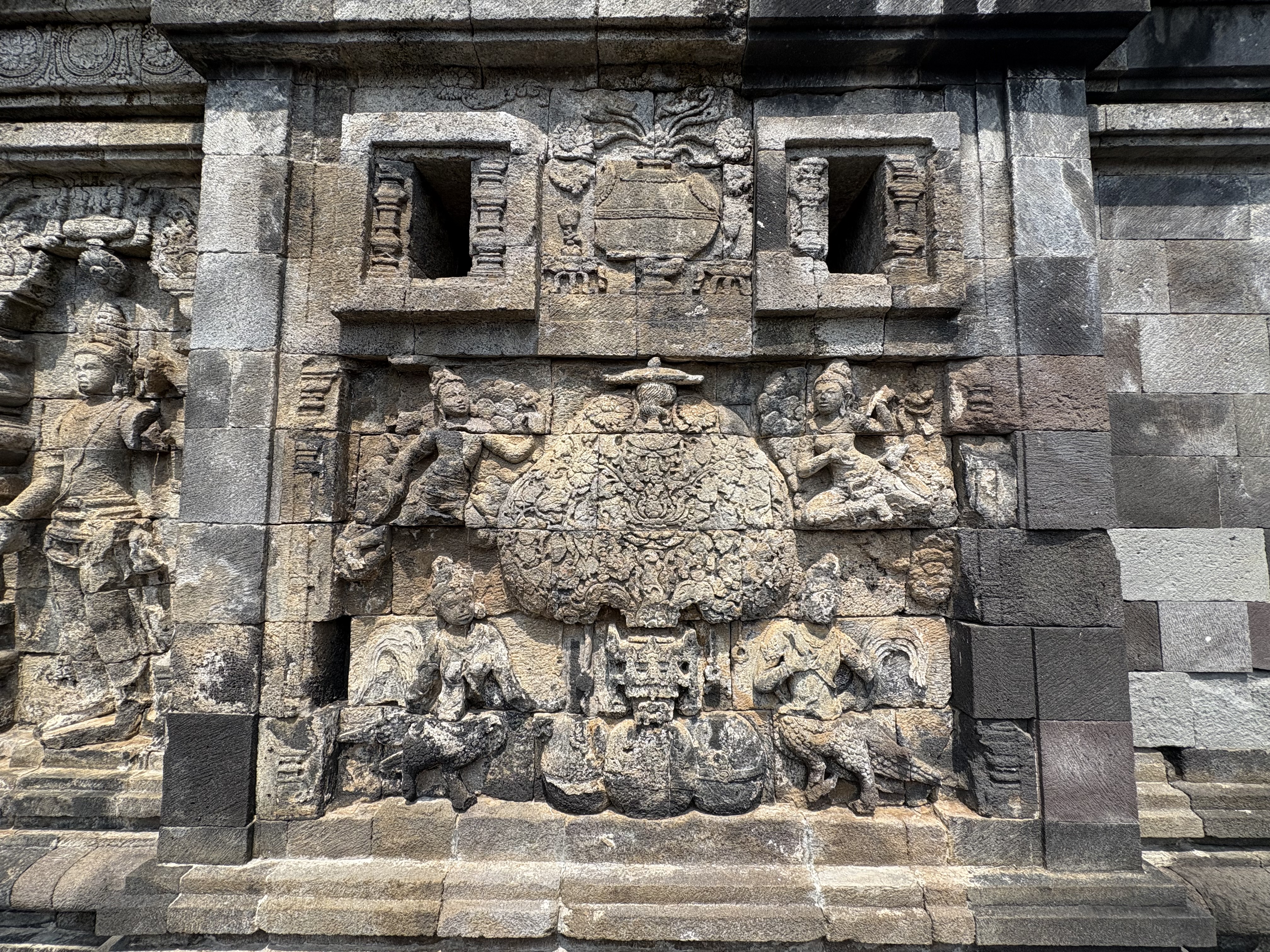
Where Borobudur overwhelms with scale and Mendut impresses with its monumental statuary, Pawon achieves its effect through proportion. The temple faces slightly northwest and stands on a square base, its stairs flanked by the Kala-Makara carvings typical of classical Javanese temple architecture. The outer walls carry reliefs of Bodhisattvas and Taras - female Buddhist deities associated with compassion and liberation. Kalpataru, the mythical tree of life, appears flanked by Kinnara-Kinnari, the half-human, half-bird beings of Buddhist and Hindu mythology. The roof is crowned with five small stupas and four small ratnas, creating a silhouette of balanced, deliberate simplicity. Inside, the single square chamber is empty. A square basin sits in the center of the floor, its original contents and purpose unknown. Small rectangular windows pierce the walls, probably for ventilation. It is this restraint - the refusal to compete with its larger neighbors - that earned Pawon its reputation as a jewel. Historians specifically contrast its harmony with the tall, slender style of later East Javanese temples from the Singhasari and Majapahit periods.
A King's Ashes, or Something Else
The mortuary hypothesis remains the most intriguing unsolved question about Pawon. If the temple was built to house the cremated remains of a Sailendra king, it would explain both the name (per-awu-an, place of dust) and the empty basin inside the chamber. Cremation was practiced among Javanese royalty, and mortuary temples were part of the broader Hindu-Buddhist architectural tradition across Southeast Asia. But the theory raises as many questions as it answers. Which king? The Sailendra dynasty produced multiple rulers during the period of construction, and no inscription has been found at Pawon to identify the honoree. The alternative reading - that Bajranalan points to a vajra-related ritual function rather than a burial site - would align Pawon more closely with its role as a purification station between Mendut and Borobudur. The empty chamber holds its secret.
Walking Toward Borobudur
Every year during the full moon in May or June, the ancient pilgrimage route comes back to life. Indonesian Buddhists observing Vesak (known locally as Waisak) gather at Mendut, then walk northeast through Pawon to Borobudur. The procession is the largest annual Buddhist gathering in Indonesia, and the walk between the three temples recreates a ritual journey that is at least twelve hundred years old. Passing through Pawon during the procession, participants move from the intimate scale of the small temple to the vast terraced mandala of Borobudur rising ahead. The shift in scale is dramatic and deliberate - like walking from a chapel into a cathedral, except the cathedral is open to the sky. All three temples are inscribed as UNESCO World Heritage Sites under the Borobudur Temple Compounds designation, recognizing not just the individual monuments but the spatial and spiritual relationship among them.
Small Stone, Long Shadow
Pawon would be easy to overlook. It lacks Borobudur's staggering mass and Mendut's towering interior statues. From the air, it is a modest stone rectangle surrounded by trees, barely distinguishable from the surrounding landscape. But its position tells the story. Set precisely on the line between its two companions, it transforms three separate temples into a single pilgrimage, a single idea expressed in graduated architectural terms. The Sailendra builders understood something about sacred space that transcends any single monument: sometimes the most important part of a journey is not where you begin or where you arrive, but the threshold you cross between them.
From the Air
Pawon temple (7.61S, 110.22E) is located between Mendut and Borobudur in the Kedu Plain of Central Java, Indonesia. It sits 1.75km southwest of Borobudur and 1.15km northeast of Mendut. Adisucipto International Airport (WARJ) is approximately 40km to the southeast. From the air, Pawon is a small structure difficult to spot individually, but the straight-line alignment of the three temples (Mendut-Pawon-Borobudur) is visible from 3,000-5,000 feet AGL. The Progo River runs west of the temple. Look for Borobudur first, then trace the line southwest to find Pawon and Mendut. Tropical climate; dry season (May-September) provides the best visibility.