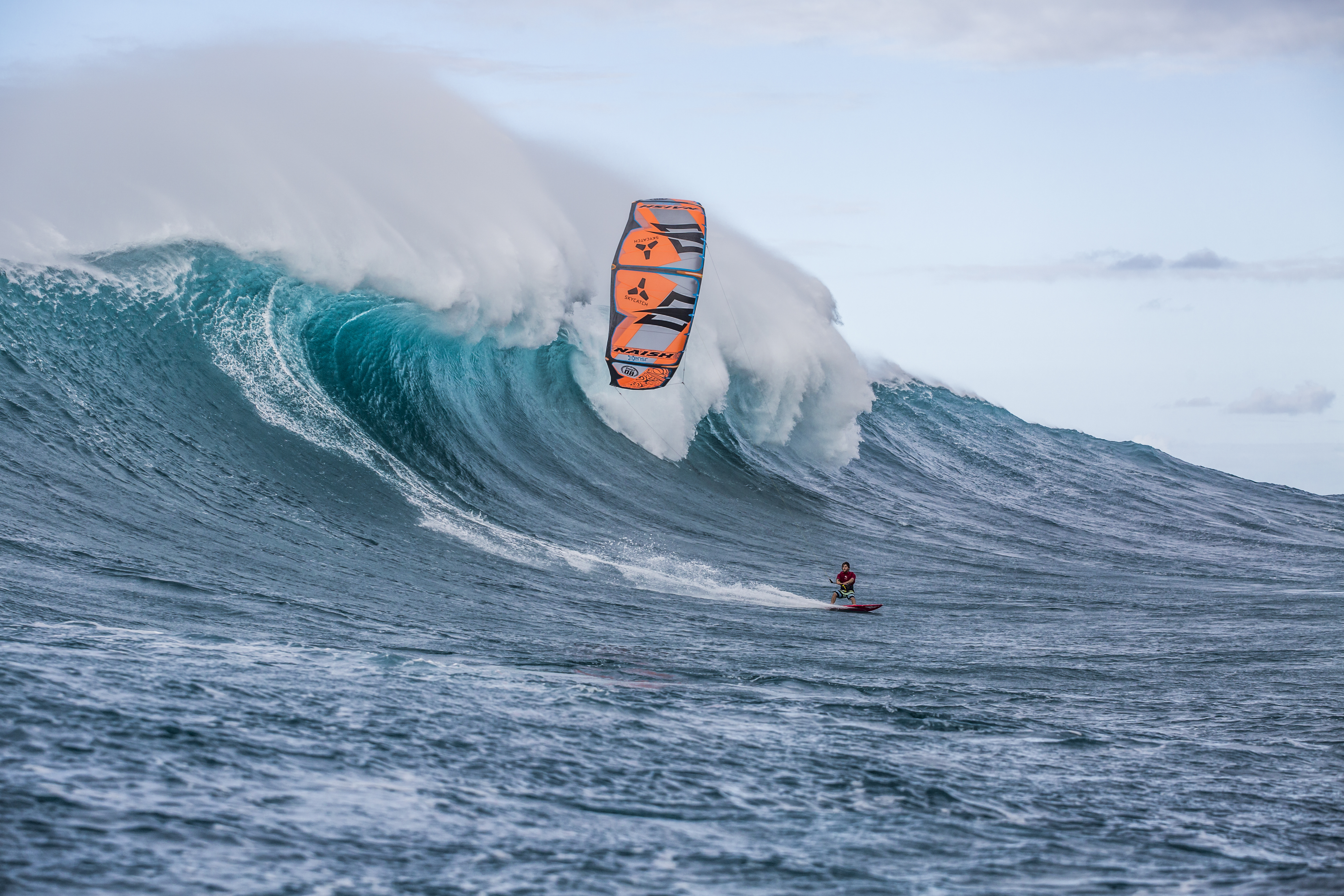
Pe'ahi (Jaws)
Three surfers named John were riding a break on Maui's north shore in 1975 when the ocean changed its mind. What had been manageable waves suddenly transformed into something enormous, unpredictable, and terrifying. John Roberson, John Lemus, and John Potterick scrambled for safety, and when they made it to shore they gave the break a nickname borrowed from the movie that was scaring audiences that same summer: Jaws. The name was a joke at first, a surfer's way of processing a near-death experience. It became literal. Pe'ahi, as the place is properly called in Hawaiian -- a word meaning "wave" in the sense of a beckoning hand -- produces some of the largest rideable waves on Earth, faces exceeding 60 feet that break over an underwater ridge roughly three miles east of the town of Pa'ia.
The Beckoning Hand
The name Pe'ahi originally belonged to an ahupua'a, one of the ancient Hawaiian land divisions that ran from the slopes of Haleakala down to the sea. The Hawaiian word means a fanning or beckoning motion, and the name for the surf break is an English-language play on that ancient place name -- since the Hawaiians had other words, like nalu, for ocean waves. The break itself sits a few hundred feet off 100-foot-tall sea cliffs on the north shore, where no beaches exist and the only access is a rutted dirt road off the Hana Highway between mile markers 13 and 14. When the surf is up, four-wheel drive is recommended. Otherwise it is a mile-and-a-half walk to the Pe'ahi Overlook, where spectators stand on the cliff edge and watch surfers below who appear, from that height, as specks on moving walls of water.
Inventing a Way In
For years after its discovery, Jaws was considered unrideable. The waves were too big, too fast, and too far from any launch point for traditional paddle-in surfing. That changed in the early 1990s when Laird Hamilton, Dave Kalama, Darrick Doerner, and Buzzy Kerbox developed tow-in surfing, a technique that uses personal watercraft to slingshot surfers into waves moving too fast to catch by arm power alone. Jaws was their proving ground, and the footage that emerged -- tiny human figures carving across mountain-sized walls of blue water -- redefined what big-wave surfing could be. Hamilton and Kalama later appeared as stunt doubles in the opening sequence of the James Bond film Die Another Day, filmed at Jaws in 2001. National Geographic published a feature on the break in November 1998, and National Geographic Adventure followed in July 2002. The publicity transformed Jaws from a local secret into a global destination, and by 2004 overcrowding had become a serious concern on the narrow cliff-top viewing area.
Paddling Back Into the Giant
Tow-in surfing opened Jaws, but a new generation of riders decided to close the gap between technology and raw human capability. In 2001, South African Chris Bertish became the first person to paddle into giant surf at Pe'ahi without jet ski assistance. In 2007, Brazilian surfers Danilo Couto, Marcio Freire, and Yuri Soledade -- collectively known as the "Mad Dogs" -- paddled into Jaws on a big day without jet ski support, rescue teams, or life jackets. Their documentary showed it was possible to enter these waves the old-fashioned way, with nothing between the surfer and the break but a board and two arms. On January 4, 2012, a who's-who of big-wave surfing converged on Pe'ahi for a historic paddle-in session. Australian Jeff Rowley rode a wave exceeding 50 feet, the first Australian to paddle into a wave of that size at Jaws. The ride earned him a finalist spot in the Billabong XXL Big Wave Awards. Even experienced riders pay a price for attempting Jaws: serious injuries are common, and the remote location makes helicopter rescue the only viable extraction method.
The Break That Sets Its Own Schedule
Jaws does not perform on command. The massive swells that produce rideable waves arrive from the North Pacific between December and March, generated by storms thousands of miles away. Whether those swells hit the underwater ridge at the right angle and with the right period to produce clean, open faces rather than chaotic closeouts depends on factors that forecasters can predict only a few days in advance. This unpredictability is why the World Cup of Tow-in Surfing and the Red Bull Jaws invitational have operated on waiting-period formats, with contest windows spanning months and events called on short notice when conditions align. The 2013 Red Bull contest invited 21 of the world's best big-wave surfers, including Jeff Rowley, Albee Layer, Greg Long, Shane Dorian, and John John Florence, to wait for the right day between December 8 and March 15. When Jaws breaks, word travels fast. Photographers charter helicopters, spectators clog the dirt road, and the cliff-top overlook fills with people staring down at something that is, by any measure, one of the most violent and beautiful natural phenomena in the ocean.
From the Air
Located at 20.94N, 156.26W on the north shore of Maui, roughly 3 miles east of Pa'ia. The break is offshore of steep sea cliffs with no beaches. When the surf is up (December-March), the massive whitewater and wave faces are visible from considerable altitude. The dirt access road and cliff-top overlook may show parked vehicles and spectators during big swells. Ho'okipa Beach is visible about 3 miles to the west. Nearest airport: Kahului Airport (PHOG, approximately 9 miles west). Best viewed at 2,000-5,000 feet AGL to appreciate wave scale. Helicopter traffic is common during major swells.