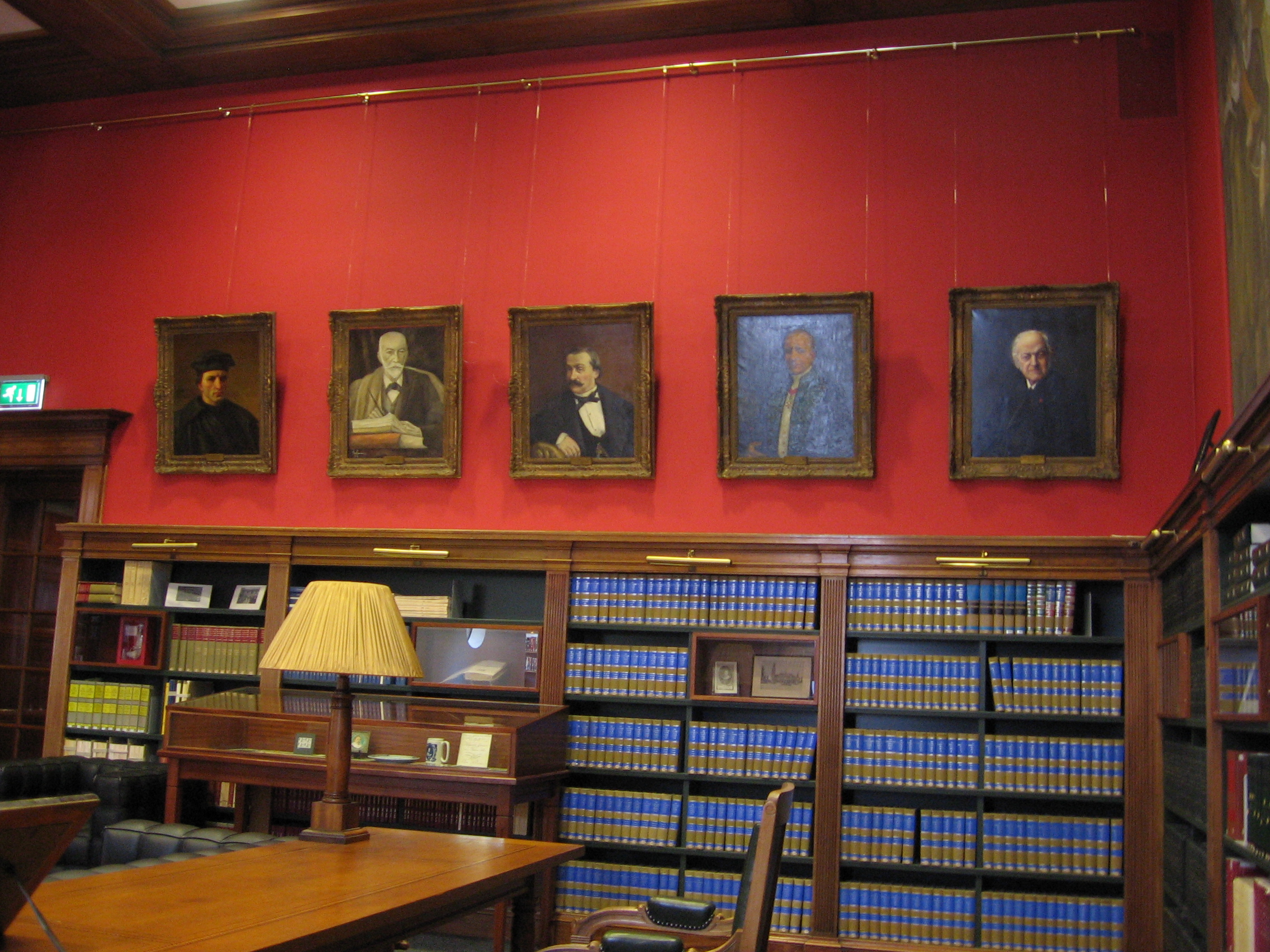
Peace Palace Library
Carnegie said he would pay for the books. He was less sure about the courthouse. When the American diplomat Andrew Dickson White first put the idea of the Peace Palace to him in 1900, Andrew Carnegie's instinct was to bankroll a library on international law and stop there - libraries were dignified, useful, and unlikely to embarrass their donor. White talked him into the building too. But what Carnegie really cared about was the books. The Peace Palace Library is what survives of that original instinct, and the rare books on its shelves include some of the foundation stones of the entire idea of law between nations.
Hugo Grotius and the Idea That Started It
If international law has a single founding text, it is Hugo Grotius's De Iure Belli ac Pacis - On the Law of War and Peace - published in 1625 by a Dutch jurist who had spent two years in a Dutch prison and escaped, famously, hidden in a book chest. Grotius argued that even in war, states are bound by natural law and the law of nations; that there are things a sovereign may not do to its enemy without crossing a line that exists independently of any human ruler's permission. It was a radical claim in 1625. It became, eventually, the entire intellectual scaffolding of modern international law - the Geneva Conventions, the Nuremberg trials, the prohibition on torture, the laws of occupation. The Peace Palace Library holds the world's largest collection of Grotius's works, including a rare early edition of De Iure Belli ac Pacis. It is appropriate that they are kept here. Carnegie's gift built the library; Grotius's book is the reason there is anything for the library to be about.
What a Million Volumes Looks Like
Since opening in 1913, the library has accumulated over a million titles, almost all of them about how states deal - or should deal - with one another. State responsibility, human rights, the law of armed conflict, international criminal law, the law of international organisations, European law, private international law, international commercial and bankruptcy law. The library tries to keep faith with the classification system designed in 1916 by Elsa Oppenheim - daughter of the Dutch constitutional law professor Jacques Oppenheim - while layering on a modern keyword system with around 4,500 subject tags. The catalogue is online and searchable from anywhere. The physical shelves are not always open to anyone who wanders in: the primary mission is to serve the institutions in the Peace Palace - the International Court of Justice, the Permanent Court of Arbitration, the Hague Academy of International Law - but the library accepts scholars and students of international law from around the world.
The Special Collections
Two collections within the library are particularly prized. The Grotius Collection - already mentioned - has been built up steadily for over a century. The Peace Movement collection traces the long and frequently disappointed history of efforts to abolish or constrain war: pacifist pamphlets, conference proceedings, the papers of organisations long since dissolved, the correspondence of Nobel laureates who believed, like Carnegie, that the problem was finally solvable. During the library's centenary celebrations in 2013, the collection acquired a 1499 edition of the Institutes of Gaius - a 2nd-century Roman legal textbook that laid down the categorical framework (persons, things, actions) still used by civil law systems today. A 525-year-old book about 1,800-year-old law, sitting next to a database compiled in 2012 on the proposed crime of ecocide. The library's range, in other words, runs from the Roman Empire to whatever international lawyers are arguing about this week.
The Move Across the Bridge
From 1913 until 2007, the library lived inside the main Peace Palace itself, in a wing that grew steadily more cramped as the collection swelled. When the Permanent Court of International Justice was added in 1922, the library was squeezed even further. In 2007, Queen Beatrix opened a new Academy and Library Building behind the original palace, connected to it by a glass bridge - and the books moved. The new building, designed by the British architect Michael Wilford, houses the entire catalogue, a lecture hall, and a reading room on the bridge itself, so a researcher can sit with a 17th-century book in their lap and look across the gardens at the brickwork Carnegie paid for. A visitors centre was added in 2012, by the same architect. The palace, the gardens, the library, and the academy now form a single working campus dedicated to one stubborn proposition: that disputes between countries can be resolved by argument rather than by armies.
The Quiet Work
The library is open to scholars and students of international law from anywhere in the world. Its head librarian and small permanent staff produce research guides, a blog, and a news service tracking what is happening in international law in real time. None of this is glamorous. Most of the people who use the library are graduate students, working judges' clerks, government legal advisors, NGO researchers. The work they do is slow. It involves long mornings with footnotes. It does not, on any given day, end a war. But it builds the body of writing and argument that the lawyers in the courtrooms next door rely on, and that body of writing is - quietly, accretively - the closest thing the world has to a shared language for working out what it owes itself. Carnegie's original instinct was right. The library is the foundation. The rest of the palace is what gets built on top.
From the Air
Coordinates 52.0866°N, 4.2955°E, on the grounds of the Peace Palace in the Zorgvliet district of The Hague. The library and Hague Academy of International Law occupy a modern building behind the main Peace Palace, connected by a glass walkway. From the air, look for the formal gardens and the tall clock tower of the main palace; the library complex is the lower modern building immediately behind. Recommended viewing altitude 2,000-3,000 ft. Nearest airport: Rotterdam The Hague (EHRD), about 11 nm south.