Peace Palace
Andrew Carnegie did not really want to do it. When the American diplomat Andrew Dickson White first approached him in 1900 about funding a permanent home for international arbitration, the Pittsburgh steel magnate said he would happily pay for a library on the subject - a library, that was civilised - but not a courthouse. White wrote him a letter. He described a temple of peace with its doors thrown open, in deliberate contrast to the Roman Temple of Janus, whose doors were closed in peacetime and open in war. He told Carnegie that men would make pilgrimages to such a building. Carnegie eventually wrote a cheque for $1.5 million. In 1913, the year before the world went to pieces, the Peace Palace opened its doors.
The Cheque and the Gamble
Carnegie's first instinct was to send the money directly to Queen Wilhelmina and have her build it. The lawyers said that would not work, and in November 1903 the Carnegie Stichting - the Carnegie Foundation - was established in the Netherlands to manage the project. It still owns and runs the palace today. The foundation announced an open international architecture competition. The winner, in a field of more than two hundred entries, was the French architect Louis Cordonnier, working in a Neo-Renaissance style with twin bell towers in front, twin smaller towers in the back, and a separate library building beside the main hall. To fit the budget, Cordonnier and his Dutch partner J.A.G. van der Steur cut three of the four towers and folded the library into the main building. What got built was the compromise. What got photographed - and is photographed still - was a brick-and-stone palace with one tall tower like a finger raised in mid-sentence.
Gifts From the World
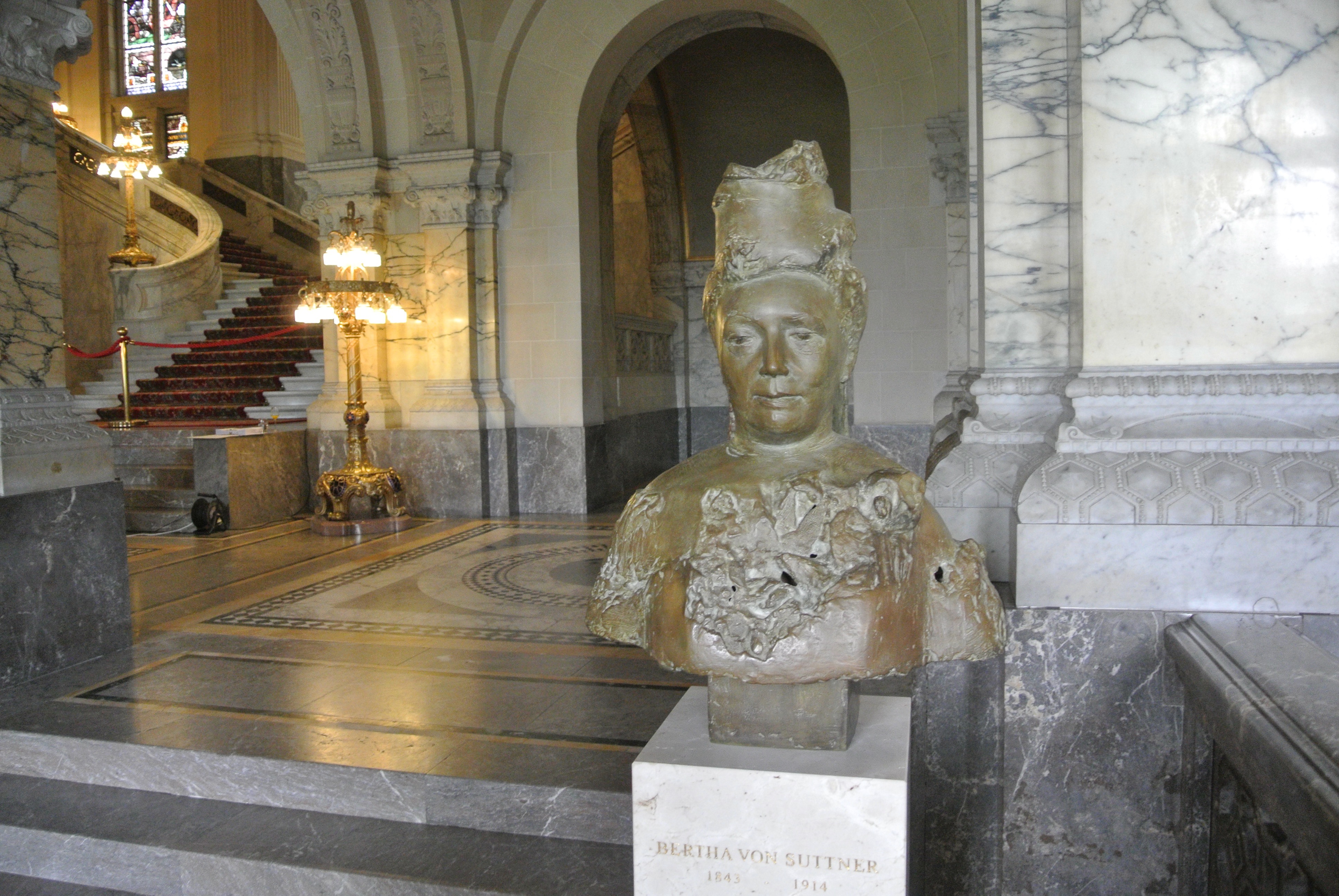
Because the building was meant to belong to all nations, all nations were invited to contribute. The list of gifts reads like a customs manifest for an unusually optimistic year: a 3.2-ton jasper vase from Russia, the entrance doors from Belgium, marble from Italy, a fountain from Denmark, woven wall hangings from Japan, the clock for the clock tower from Switzerland, Persian rugs from Persia, exotic woods from Malaysia, Indonesia, Brazil, and the United States, wrought-iron fences from Germany. Walk through the entrance hall today and you are walking through a museum of pre-war international goodwill. The vase came from Tsar Nicholas II. The fences came from Kaiser Wilhelm II. Both men would, within a decade, preside over the largest war anyone had ever imagined.
Carnegie's Prediction
On 28 August 1913, Andrew Carnegie stood at the inauguration and predicted that the end of war was "as certain to come, and come soon, as day follows night." Eleven months later, in July 1914, an archduke was shot in Sarajevo. By August the great powers of Europe were in the trenches. The Peace Palace remained open. The Permanent Court of Arbitration met when it could. The library kept acquiring books. But the optimism of 1913 - the genuine belief among educated men and women in capitals across Europe that civilisation had finally outgrown organised slaughter - died in the mud of the Somme. The building did not. After the war, the League of Nations established the Permanent Court of International Justice and gave it a home in the palace. After the next war, the United Nations replaced the League and the International Court of Justice replaced its predecessor. Same building. Different paperwork.
The International Court of Justice
Since 1946, the principal judicial organ of the United Nations has sat here. The ICJ - the World Court - hears cases between states. Disputes over borders, fisheries, embassies, war crimes brought by one country against another. Fifteen judges from fifteen countries serve nine-year terms. The judgments are not always obeyed - a court has no army - but they are read, weighed, cited, and frequently followed. The palace also still houses the Permanent Court of Arbitration that Carnegie originally paid for, plus the Hague Academy of International Law (founded 1923, funded by another Carnegie endowment) and the Peace Palace Library, which holds Hugo Grotius's original works on the law of war and peace - the 17th-century Dutch foundations of the whole project. The big Hague tribunals on the former Yugoslavia and the International Criminal Court are housed elsewhere in the city. The Peace Palace is the cathedral. The other courts are the parishes.
The Flame at the Gate
In 2002 an eternal peace flame was installed in front of the palace gates - a small steel basin where a propane jet burns day and night, surrounded by stones donated from around the world. School groups visit it. Tourists touch the stones. The flame has been burning continuously for over two decades. It is, as monuments go, a modest one. The Peace Palace itself does not pretend that war has ended or that diplomacy is winning. The judges sit, the briefs are filed, the bell tower chimes the hours. White wrote to Carnegie in 1902 that the building would become a kind of holy place to which the minds of men would turn naturally in times of crisis. He was - in his way, slightly - right. The crises did not stop. Neither, since 1913, has the work.
From the Air
Coordinates 52.0866°N, 4.2955°E, in the Zorgvliet district of The Hague, west of the city centre. The Peace Palace is unmistakable from the air - a large Neo-Renaissance complex with one tall square clock tower (about 80 m), one smaller tower, and a steep slate roof, set in formal gardens behind a wrought-iron fence. The Scheveningen Bos forest is just north. Recommended viewing altitude 2,000-3,000 ft. Nearest airport: Rotterdam The Hague (EHRD), about 11 nm south.