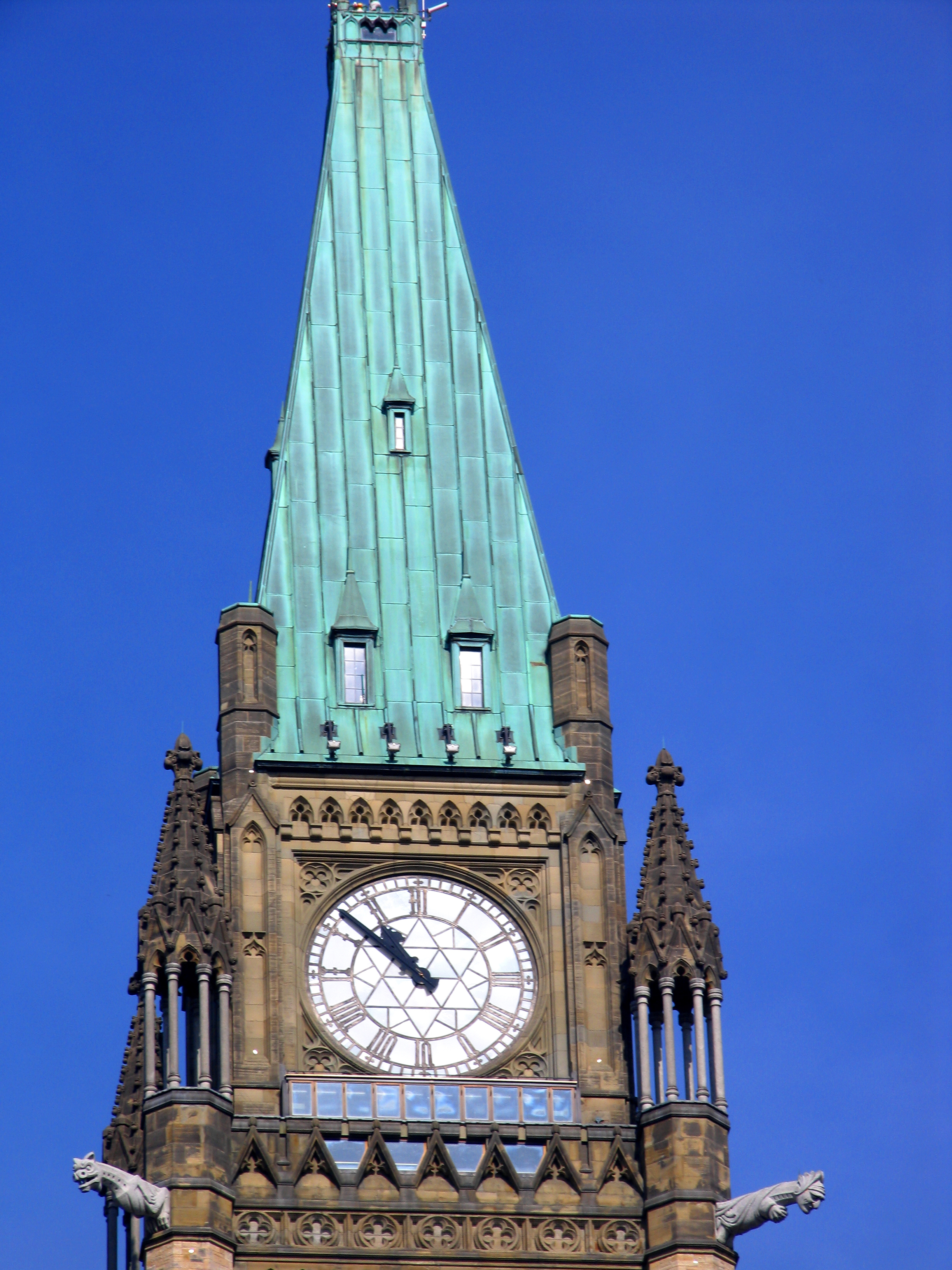
Peace Tower
If you request a Canadian flag that has flown atop the Peace Tower, be prepared to wait. The Department of Public Works changes the flag daily, then mails retired flags free of charge to citizens on a waiting list. By 2014, the backlog had reached 42 years. That single detail captures something essential about the tower itself: the Peace Tower is not a relic but an active, living symbol, one that Canadians engage with so persistently that even its discarded flags have a decades-long queue. Standing 92.2 meters above Parliament Hill, adorned with approximately 370 gargoyles and grotesques, its four clock faces measuring nearly five meters across, the tower has dominated Ottawa's skyline since its official opening in 1928 and once graced the Canadian twenty-dollar bill beside the portrait of Queen Elizabeth II.
Born from Ashes
The Peace Tower exists because its predecessor was destroyed. On February 3, 1916, fire swept through the Centre Block of Canada's Parliament, consuming everything except the Library of Parliament, which was saved by the quick closing of its iron doors. The old Victoria Tower collapsed in the blaze, its bell falling to the ground at a canted angle in which it was later memorialized on the Hill's grounds. Prime Minister Robert Borden dedicated the site of the replacement tower on July 1, 1917, declaring it would serve as a memorial to the valor of Canadians who fought for the liberties of Canada, the Empire, and humanity. Two years later, the Prince of Wales laid the cornerstone on September 1, 1919, calling it the Tower of Victory and Peace. The structure was topped out in 1922, and architects Jean Omer Marchand and John A. Pearson designed it as a campanile in the Victorian High Gothic style, its walls built of Nepean sandstone with a roof of reinforced concrete clad in copper.
A Chamber of Battlefield Stone
The tower's most sacred space is the Memorial Chamber, a vaulted room measuring 7.3 meters square, situated directly above the porte-cochere at the tower's base. What makes the chamber extraordinary is its materials: the stone itself was quarried from the battlefields of Europe. Hoptonwood limestone came from the United Kingdom. Black marble for the wall plinths and altar steps, along with St. Anne marble for the clustered columns supporting the fan vault ceiling, came from Belgium. Chateau-Gaillard stone for the walls and vault came from France, supplemented by stone from Flanders' fields. Under the direction of sculptor Ira Lake, these materials were worked into 700 carved elements that tell the story of Canadian military service stretching back to the 17th-century regime of New France.
The Tunnellers' Friends
Among the Memorial Chamber's most poignant details is a carved tympanum above the antechamber arch depicting animals that served during the First World War: reindeer, pack mules, carrier pigeons, horses, dogs, canaries, and mice. The inscription reads, "The tunnellers' friends, the humble beasts that served and died." Flanking the entrance, two stone lions bear shields -- the left showing the Dragon of Destruction with the date 1914, the right displaying the Dove of Peace perched on a crown with the date 1918. At the opposite end of the entrance passage, architect John Pearson arranged carved beetles, spiders, lizards, butterflies, rats, hares, bats, birds, frogs, and bees to represent the flora and fauna of Canada. Every surface tells a story: the 17 wall niches carry badges and insignia of Canada's 178 pre-1914 militia regiments, while marble panels chronicle engagements from the Fenian Raids to the Korean War.
Light Through Stained Glass
Three stained glass windows, each seven meters tall and three and a half meters wide, fill the Memorial Chamber with allegorical light. Designed by Frank S.J. Hollister of Toronto and approved in 1925, they bear titles that trace an arc from conflict to hope: The Call to Arms, The Assembly of Remembrance, and The Dawn of Peace. The Call to Arms depicts Victory, Labour, Progress, and Science above crowds of citizens answering the call, with Biblical inscriptions from Corinthians and the Psalms woven throughout. The Assembly of Remembrance shows the archangel Michael, Lady Justice with her scales, and the heroic figure of Canada wearing armor but gazing mournfully at the Book of Remembrance, flanked by figures of Canadian motherhood and First Nations. The Dawn of Peace presents Victory of Peace, Prosperity, Progress, and Plenty, with Industry, Agriculture, Honour, and Motherhood assembling below, led by Honour carrying a torch inscribed with words from John McCrae's In Flanders Fields: "Be the torch yours to hold it high."
Fifty-Three Bells Across Four Octaves
The Peace Tower's 53-bell carillon was conceived by an act of parliament to commemorate the 1918 armistice and was inaugurated on Canada Day, July 1, 1927, the 60th anniversary of Confederation. All 53 bells were cast and tuned by Gillett and Johnston, a bell foundry in Croydon, England. They span four and a half octaves, from the massive bourdon bell to the smallest, each struck by an internal clapper mechanically linked to the carillon keyboard. The instrument plays like a piano, allowing the carillonneur to shape sound through the force and manner of keystrokes. In the summer of 1925, before the carillon's completion, a ceremony in the Memorial Chamber brought together the Governor General, the Prime Minister, the Leader of the Opposition, and the Earl Haig, Commander-in-Chief of the British forces during the Great War, to lay the base stones of the marble columns supporting the fan vault ceiling. Beginning in 2022, the carillon fell silent for a planned five-year dismantling and restoration, with chimes expected to return around 2027.
From the Air
Located at 45.425N, 75.700W atop Parliament Hill on the Ottawa River's south bank. The Peace Tower rises 92.2 meters (302 feet) and is the most prominent vertical landmark in downtown Ottawa, easily identifiable from altitude by its Gothic spire and copper roof. It anchors the Centre Block between the East and West Blocks. The Rideau Canal runs northeast, and the Ottawa River lies immediately to the north. Nearby airports include Ottawa/Macdonald-Cartier International (CYOW, 10 km south) and Gatineau-Ottawa Executive (CYND, 8 km north). The tower is best spotted from the north where it rises dramatically above the river bluffs.