Pearl Harbor
At 7:55 AM on December 7, 1941, the first Japanese bombs fell on Pearl Harbor, ending twenty years of American isolationism in ninety minutes of fire and death. Two waves of aircraft - 353 planes launched from six carriers positioned 230 miles north of Oahu - struck the Pacific Fleet as sailors slept, ate breakfast, and prepared for church services. When the smoke cleared, eight battleships had been sunk or damaged, 188 aircraft destroyed, and 2,403 Americans killed. The attack was a tactical masterpiece and a strategic catastrophe: Japan had awakened the industrial giant it hoped to intimidate into negotiation. Within four years, that giant would drop atomic bombs on two Japanese cities and occupy the empire. Today, the USS Arizona Memorial floats above the sunken battleship where 1,177 sailors remain entombed, their ship still leaking oil into the harbor where they died defending a nation suddenly at war.
Waters of Pearl
Hawaiians called this harbor Wai Momi - 'Waters of Pearl' - for the oysters that once lined its shallow bottom. The shark goddess Kaahupahau was said to make her home in its waters. American interest began with whaling and trade; by 1887, the United States had secured exclusive rights to develop the harbor as a coaling and repair station. The shallow entrance initially limited naval use, but dredging created one of the Pacific's finest natural harbors. After Hawaii's annexation in 1898, Pearl Harbor became the cornerstone of American Pacific strategy. By 1941, it headquartered the Pacific Fleet - seven battleships, dozens of cruisers and destroyers, and hundreds of aircraft stationed at adjacent airfields. Japanese military planners saw the fleet as the obstacle to their expansion into Southeast Asia's oil and resources. Removing that obstacle became Admiral Isoroku Yamamoto's obsession.
The Attack
Japanese carriers launched their aircraft in darkness on December 7, achieving complete surprise despite multiple warning signs that American commanders failed to heed. Radar operators detected the incoming wave but were told to ignore it - a flight of B-17s was expected from the mainland. The first bombs struck at 7:55 AM. Within minutes, 'Battleship Row' along Ford Island was a scene of apocalypse. USS Arizona exploded when a bomb detonated its forward magazine, killing 1,177 men and sinking the ship in nine minutes. USS Oklahoma capsized, trapping hundreds below decks. USS California and West Virginia settled into the harbor mud. Japanese aircraft strafed airfields, destroying planes parked wingtip to wingtip. A second wave struck at 8:54 AM, meeting stiffer resistance as dazed Americans manned guns. By 9:45 AM it was over. Japan had lost only 29 aircraft and 64 men.
What Was Saved
For all its devastation, the attack missed several crucial targets that would prove decisive in the war to come. The Pacific Fleet's three aircraft carriers - Enterprise, Lexington, and Saratoga - were not at Pearl Harbor: Enterprise and Lexington were at sea delivering aircraft to Wake and Midway, while Saratoga had just arrived in San Diego from an overhaul. These carriers would fight at Midway six months later and turn the tide of the Pacific war. The Japanese also ignored the fuel storage facilities, where 4.5 million barrels of oil sat vulnerable to bombing; destroying them would have forced the fleet to retreat to the mainland for months. The submarine base survived, as did the repair facilities that would restore several of the damaged battleships to service. And the attack united a divided nation. On December 8, Congress declared war with only one dissenting vote. 'I fear all we have done is to awaken a sleeping giant,' Yamamoto reportedly said, 'and fill him with a terrible resolve.'
Aftermath and Memory
The attack's immediate aftermath brought chaos and recrimination. Lieutenant General Walter Short and Admiral Husband Kimmel, the local commanders, were relieved of duty and demoted, becoming scapegoats for broader intelligence and communication failures. Martial law descended on Hawaii. Fear of Japanese invasion prompted the internment of 120,000 Japanese Americans on the mainland - a constitutional violation that remains a stain on American history. The sunken battleships became underwater tombs. USS Arizona was never raised; its rusted hulk still rests on the harbor bottom, oil still seeping from its tanks more than eighty years later. The other battleships were mostly salvaged and returned to service, though by war's end carriers had made battleships obsolete. In 1962, the USS Arizona Memorial opened above the wreck - a white structure spanning the sunken ship, designed by Alfred Preis.
The Memorial Today
Pearl Harbor National Memorial receives over 1.8 million visitors annually, making it Hawaii's most-visited attraction. The experience centers on the USS Arizona Memorial, reached by Navy boats from the visitor center on Ford Island. Tickets are free but must be reserved in advance during busy seasons. The 75-minute program includes a documentary film and time at the memorial, where visitors can peer down at the sunken hull and read the names of the 1,177 entombed sailors. Nearby, the Battleship Missouri Memorial - where Japan surrendered in 1945 - offers tours of the preserved battleship. The USS Bowfin Submarine Museum and the Pacific Aviation Museum complete the Pearl Harbor Historic Sites complex. In 2016, Japanese Prime Minister Shinzo Abe visited alongside President Barack Obama - the first sitting Japanese leader to visit the site. The harbor remains an active naval base, headquarters of the Pacific Fleet.
From the Air
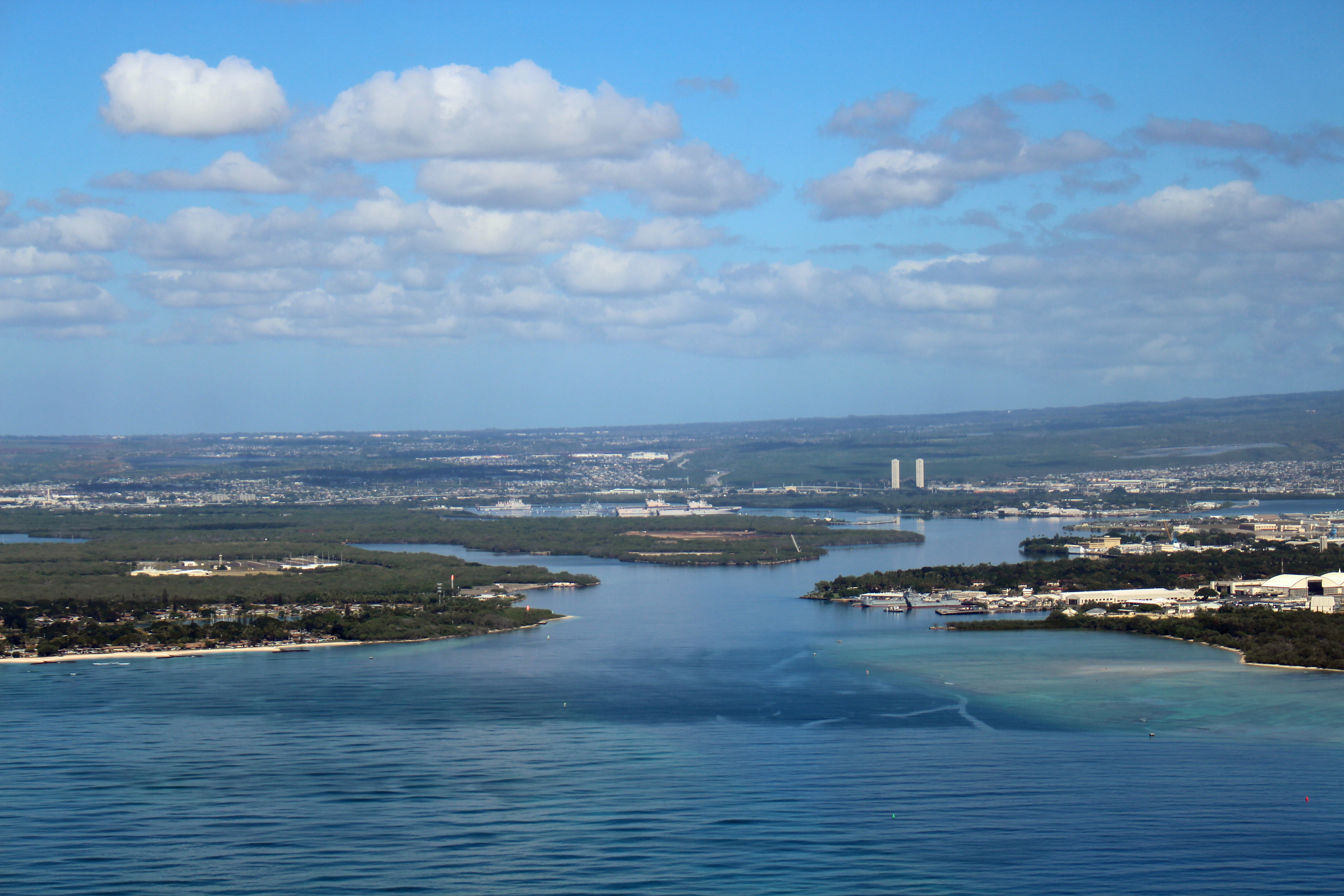
Located at 21.37°N, 157.98°W on Oahu's south shore, west of Honolulu. Pearl Harbor is visible from altitude as a distinctive lagoon harbor with Ford Island in the center. The white USS Arizona Memorial is visible from low altitude floating above the sunken ship. The Battleship Missouri is docked near Ford Island. Hickam Air Force Base adjoins the harbor. Honolulu International Airport (HNL) is immediately southeast of the harbor.