Pearl Harbor: The Day That Woke a Sleeping Giant
The oil still rises. More than eighty years after the attack, the USS Arizona leaks up to nine quarts of fuel oil per day, rising in iridescent slicks from its underwater tomb. The ship sank in less than nine minutes after a bomb pierced its forward magazine; 1,177 sailors and Marines went down with it, most still entombed within. Above the wreck floats the white memorial, straddling the sunken hull, allowing visitors to see what remains below. Pearl Harbor was not just an attack but a transformation - the moment America's isolationism ended, the moment the 20th century's defining conflict began in earnest for the nation that would win it. December 7, 1941, remains what Roosevelt called it: a date which will live in infamy.
The Attack
They came from the north, 353 Japanese aircraft in two waves, launched from carriers that had crossed the Pacific undetected. The first bombs fell at 7:48 AM Hawaiian time. By 9:45 AM, it was over. Eight battleships damaged or destroyed; 188 aircraft lost; 2,403 Americans dead. The USS Arizona exploded when a bomb ignited its forward magazine. The USS Oklahoma capsized, trapping sailors who would beat on the hull for days before dying. The USS Utah, a training ship, sank with 58 men. The raid achieved tactical surprise but strategic failure - the aircraft carriers were at sea and survived, the submarine base was untouched, and the oil tank farms that would fuel the Pacific war were ignored.
The Response
Roosevelt's address to Congress the next day lasted six minutes. Within an hour, the United States declared war on Japan; Germany and Italy declared war on the United States three days later. The isolationism that had kept America out of European and Asian conflicts evaporated in the smoke over Pearl Harbor. Industrial mobilization followed - ships, planes, tanks, ammunition in quantities that would overwhelm the Axis powers. The attack that Admiral Yamamoto feared would 'awaken a sleeping giant' did exactly that. Pearl Harbor unified a divided nation into a war machine that would produce more military equipment than all other combatants combined.
The Memorial
The USS Arizona Memorial was dedicated in 1962, designed by architect Alfred Preis, himself an Austrian immigrant detained after the attack. The white structure spans the sunken battleship without touching it - sag in the middle representing initial defeat, elevated ends representing ultimate victory. Visitors reach it by Navy boat, walking above the clearly visible outline of the ship below. The names of the 1,177 dead are inscribed on a marble wall. The memorial is a tomb; Navy divers periodically inter cremated remains of Arizona survivors who request to rejoin their shipmates. The black oil continues to rise, called by some 'the tears of the Arizona.'
The Complex
Pearl Harbor today encompasses multiple memorials and museums. The Battleship Missouri, site of Japan's surrender in 1945, is moored nearby - bookending the Pacific War from infamy to victory. The USS Oklahoma Memorial marks each of its 429 dead with a marble column. The Pacific Aviation Museum occupies hangars that still bear bullet holes. Ford Island, restricted for decades, now allows limited access. The visitor center interprets the attack through artifacts and oral histories. The experience is solemn; National Park Service rangers request quiet and reflection. Most visitors report being moved regardless of age or nationality - the visceral evidence of sudden death and ultimate consequences requires no interpretation.
Visiting Pearl Harbor
Pearl Harbor National Memorial is located on Oahu, Hawaii, approximately 30 minutes from Waikiki. The USS Arizona Memorial is free but requires timed tickets; reserve online weeks ahead or arrive early for same-day availability. No bags, purses, or camera cases allowed - lockers available for fee. The boat ride to the memorial takes approximately 10 minutes each way. Additional sites (Missouri, Bowfin submarine, Aviation Museum) require separate tickets; passport packages available. Allow 4-6 hours for the full complex. The experience is profound regardless of time spent - the visible ship below the memorial, the continuing oil, the scale of loss made intimate through names and stories.
From the Air
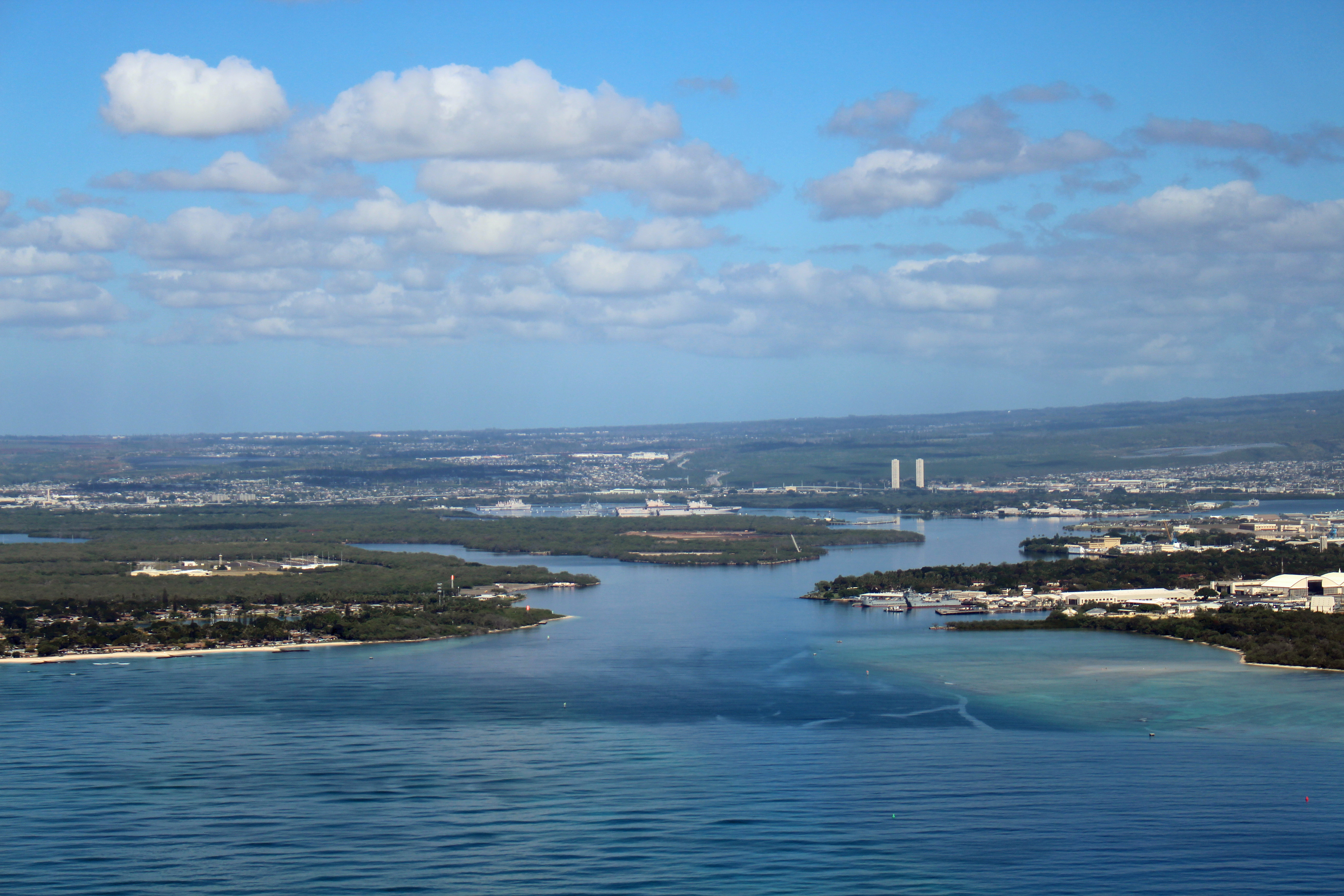
Located at 21.37°N, 157.95°W on the southern shore of Oahu, Hawaii. From altitude, Pearl Harbor's distinctive shape is clear - a lochs pattern extending inland from the channel entrance, Ford Island in the center where Battleship Row once anchored. The white Arizona Memorial is visible as a small structure over the sunken battleship near Ford Island's southern shore. The Missouri is moored nearby, gray against the blue water. Hickam Air Force Base abuts the harbor; Honolulu International's runways extend west. The harbor remains an active Navy base; carrier groups occasionally visible at berth. What appears from altitude as a working military port is America's most solemn war memorial - the place where the 20th century's defining conflict began for the nation that would end it.