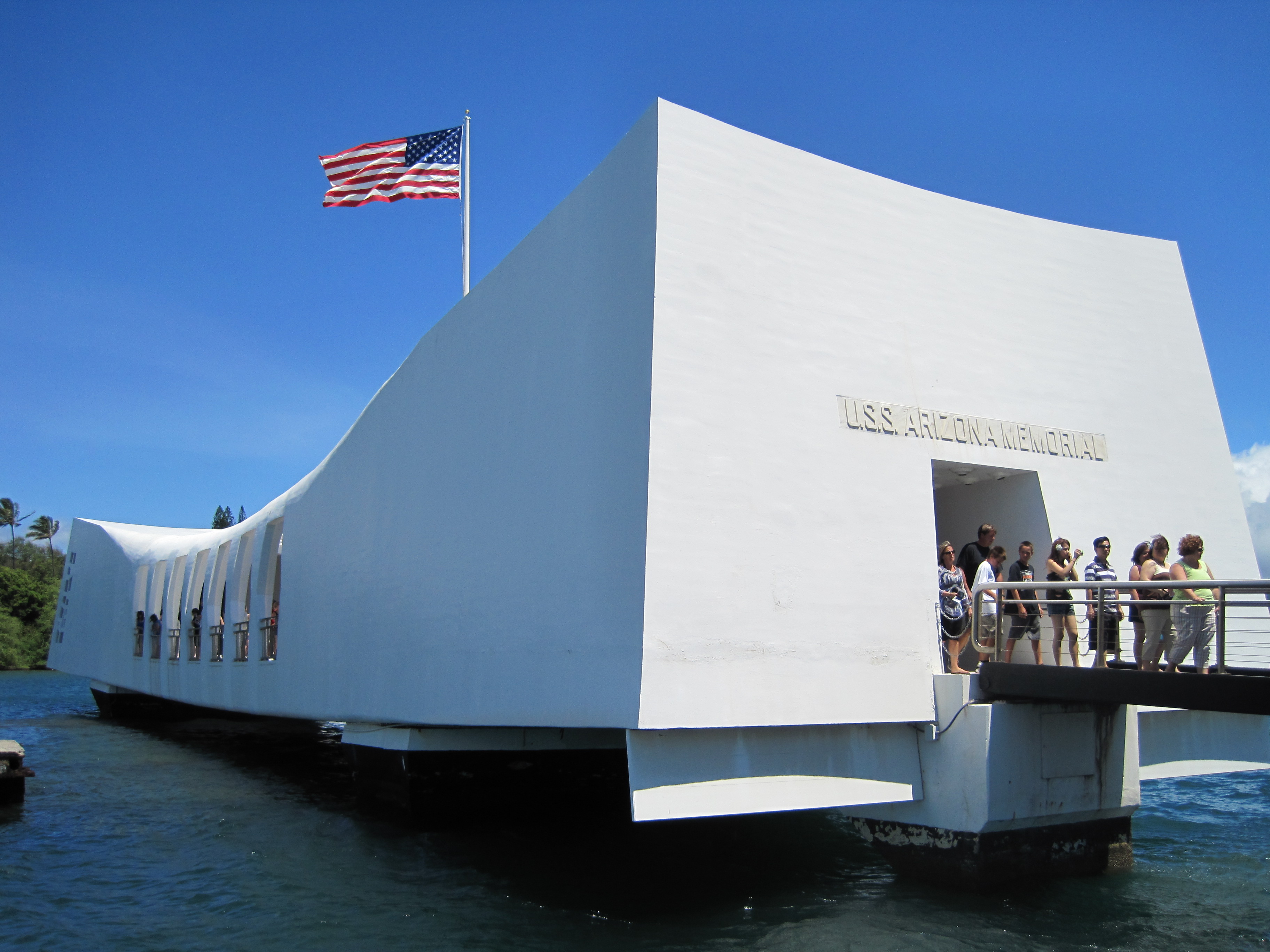
Pearl Harbor National Memorial
The visitor center at Halawa Landing sits across the water from Ford Island, quiet in a way that belies what happened here. Galleries trace the arc of the Pacific War. A 23-minute documentary plays in a darkened theater. Then a Navy-operated ferry carries visitors across the harbor to a white structure floating above a sunken battleship, and the quiet takes on a different quality entirely. Pearl Harbor National Memorial, established as a separate unit of the National Park System in 2019, is where the United States goes to remember the morning that remade the twentieth century.
What the Memorial Encompasses
The memorial's boundaries stretch well beyond the Arizona. The site includes the USS Arizona Memorial, the USS Utah memorial on the northwest side of Ford Island, the USS Oklahoma memorial near the USS Missouri, six chief petty officer bungalows on Ford Island, and mooring quays F6, F7, and F8 -- the concrete berths that formed part of Battleship Row, where eight battleships were lined up on the morning of December 7, 1941. The visitor center at Halawa Landing features galleries on the Pacific theater of World War II, memorial sculpture, and the theater screening. Until 2019, these sites were part of the larger World War II Valor in the Pacific National Monument. The John D. Dingell Jr. Conservation, Management, and Recreation Act separated the Hawaii components into their own national memorial, recognizing that Pearl Harbor's significance warranted dedicated stewardship.
Designed to Carry Meaning
Austrian-born American architect Alfred Preis designed the USS Arizona Memorial, the centerpiece of the larger memorial complex. The 184-foot structure, dedicated on Memorial Day 1962, straddles the sunken hull of Arizona without touching it -- a bridge between the world above and the 1,102 sailors and Marines entombed below. Preis explained the structure's distinctive shape, with peaks at each end and a sag in the center, as expressing "initial defeat and ultimate victory." Critics initially called it a "squashed milk carton," but the design has aged into something more solemn than any conventional monument could achieve. The shrine room at the far end holds a marble wall engraved with the names of every sailor killed aboard Arizona. A small plaque beside it lists the survivors who later chose to have their ashes interred within the wreck -- a tradition carried out by Navy divers.
The Ships That Tell the Story
Nearby but outside the National Park Service boundary, three additional historic sites form a constellation of meaning. The USS Bowfin, a World War II submarine, sits at dock near the visitor center, open for tours. The battleship USS Missouri, on whose deck Japan formally surrendered on September 2, 1945, was moved from Washington State to Ford Island in 1999. Its placement was deliberate and controversial: positioned behind and in line with the Arizona, its bow facing the memorial, Missouri symbolically watches over the ship where the war began for America. The Pearl Harbor Aviation Museum occupies Hangar 37 on Ford Island, where bullet holes from the attack are still visible in the walls. Together, these sites create something rare: a place where the beginning, the fighting, and the end of a war can all be comprehended within a single harbor.
Pilgrimage and Protocol
More than a million people visit the memorial each year, and reservations for the ferry to the Arizona often fill weeks in advance. Every sitting U.S. president since the memorial's 1962 dedication has made a pilgrimage, presenting a wreath and scattering flowers over the sunken hull. In December 2016, Japanese Prime Minister Shinzo Abe visited the USS Arizona Memorial alongside President Barack Obama -- a reciprocal gesture following Obama's historic visit to Hiroshima Peace Memorial seven months earlier. Abe was the first Japanese prime minister to visit the Arizona Memorial, 75 years after the attack. Every Navy, Coast Guard, and Merchant Marine vessel entering Pearl Harbor still participates in the tradition of manning the rails: crews stand at attention along the guardrails and salute as their ship passes the memorial.
From the Air
Pearl Harbor National Memorial is located at 21.367N, 157.939W on the southern shore of Oahu. The white USS Arizona Memorial is the most visible feature from altitude, positioned over the sunken hull along Ford Island's southeast shore. The visitor center at Halawa Landing is on the mainland side of the harbor. Nearest airport is Daniel K. Inouye International Airport (PHNL), immediately to the east. Pearl Harbor is within Joint Base Pearl Harbor-Hickam restricted airspace -- check NOTAMs and do not overfly below authorized altitudes.