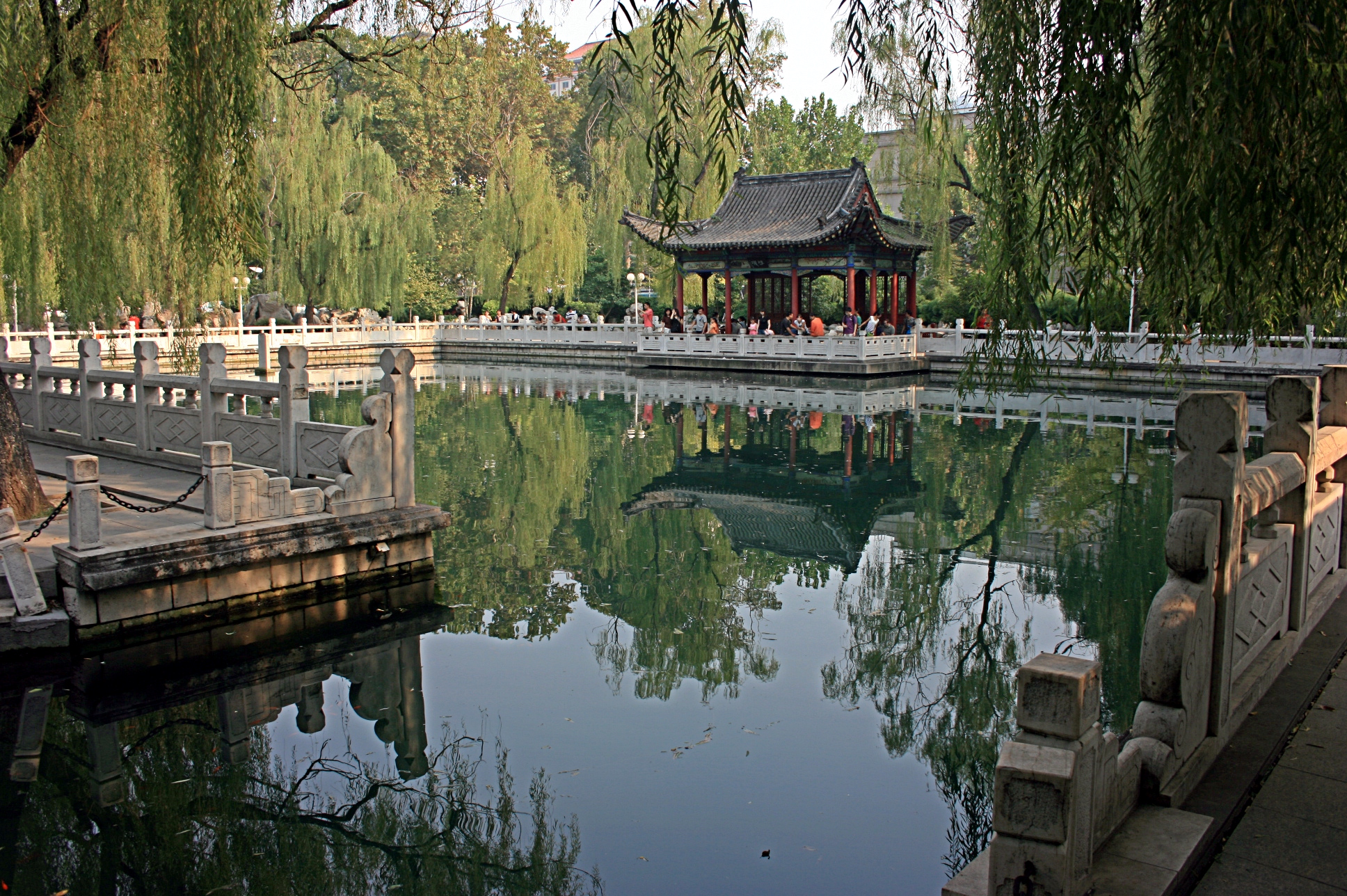
Pearl Spring
Look into the square stone pool of Pearl Spring on a still day and you will see why the name stuck. Bubbles rise continuously from the bottom, catching the light as they ascend through clear water -- strings of tiny spheres that shimmer like pearls before breaking at the surface. This artesian karst spring, one of Jinan's 72 named springs, has been drawing water from the same underground limestone formations for millennia. But what makes Pearl Spring unusual among Jinan's famous springs is not its geology. It is its proximity to power. Since 1466, the most important officials in Shandong Province have made their offices within sight of this water.
A Prince's Garden, a Governor's Seat
In 1466, the spring was incorporated into the garden of Prince De, a member of the Ming dynasty imperial family who maintained his residence in Jinan. For nearly two centuries, Pearl Spring was a private pleasure -- a nobleman's water feature, enclosed within palace walls. That ended in 1638, when war destroyed the Mansion of Prince De. Three decades later, in 1667, the Governor of Shandong, Zhou Youde, rebuilt the site as the Xunfu Yamen -- the provincial governor's office. From that point forward, the spring became inseparable from the machinery of governance. Successive governors administered the province from buildings that surrounded the spring, and the provincial government continued to reside in the vicinity until the Japanese occupation of Jinan in the twentieth century. After 1979, the site became home to the Shandong Provincial People's Congress.
Pearls and Their Neighbors
Pearl Spring does not rise alone. It anchors a group of springs that includes the Sanshui Spring, the Brook Pavilion Spring, and the Chu Spring, all fed by the same karst aquifer that underlies downtown Jinan. The spring pool itself is square, surrounded by a stone fence on all sides, and the water overflows through a canal that carries it northward into Daming Lake -- the same path followed by the water from Baotu Spring, Black Tiger Spring, and dozens of other named sources. This network of springs, channels, and the old city moat forms a continuous waterway that links Jinan's most significant landmarks. Pearl Spring sits near the center of the old city, south of Daming Lake on Yuanqian Avenue, a quiet pocket of ancient hydrology surrounded by the apparatus of modern government.
Water That Outlasts Empires
The spring has watched a Ming prince's garden rise and fall, a Qing governor's office replace it, Japanese soldiers occupy the grounds, and the People's Congress move in. Each transfer of power brought new buildings, new flags, and new purposes for the land surrounding the pool. Through all of it, the bubbles kept rising. The limestone aquifer beneath Jinan does not care about dynasties or revolutions. Water that fell as rain in the hills to the south percolated through Ordovician rock and emerged here with the same gentle persistence regardless of who sat in the office next door. Pearl Spring is named for what it does -- produce small, beautiful, ephemeral spheres of air that rise through clear water and vanish at the surface. The metaphor is hard to resist: governments come and go with similar inevitability, while the spring keeps making its pearls.
From the Air
Located at 36.67N, 117.02E in the central old city of Jinan, south of Daming Lake. Jinan Yaoqiang International Airport (ZSJN) is approximately 30 km northeast. The spring is near the Shandong Provincial People's Congress buildings, within walking distance of Daming Lake and the Fuxue Confucian Temple. From the air, Daming Lake to the north is the primary visual reference.