Pearls Airport
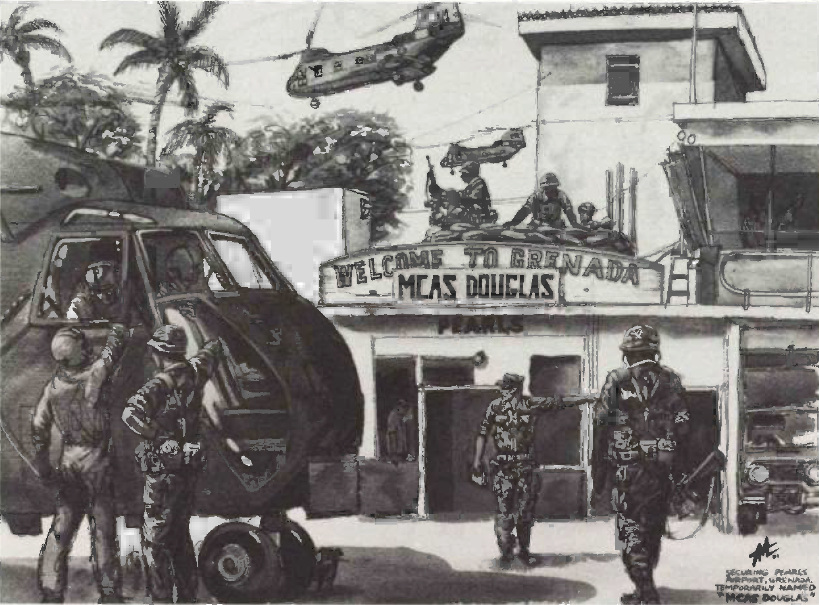
Two aircraft have not moved in over forty years. A Cubana Airlines AN-26 turboprop and a Soviet-gifted AN-2R biplane sit rusting beside a cinder block terminal on Grenada's northeast coast, exactly where U.S. Marines found them on the morning of October 25, 1983. Pearls Airport, the island nation's first airfield, opened in 1943 and closed for good in 1984. In between, it served Allied warplanes, Caribbean island-hoppers, and briefly became a staging ground for one of the Cold War's most contested military operations. Today the old runway doubles as a drag racing strip -- a peculiarly Grenadian reinvention for a place that once sat at the intersection of superpower rivalries.
A Runway Hemmed by Hills
Pearls Airport came into existence during World War II, when the Allies needed forward airfields across the Caribbean. The runway, oriented at 082/262 degrees and stretching 5,200 feet, was carved into a coastal strip 19 miles northeast of the capital, St. George's. Grenada's first airport sat in an awkward location from the start -- surrounded by hills that limited approaches and far from the population center where most travelers actually needed to go. Pan American Airways never flew into Pearls, shut out of the Windward Islands by a British government agreement designed to protect British West Indian Airways. Without Pan Am's daily schedules, the airport operated intermittently. After the war, the runway was extended and paved to its final length, and Leeward Islands Air Transport (LIAT) became the primary carrier, connecting Grenada to neighboring islands with 48-passenger turboprops.
Cold War on the Tarmac
By the early 1980s, Grenada had become a flashpoint in Caribbean geopolitics. The revolutionary government of Maurice Bishop, which had seized power in 1979, maintained close ties with Cuba and the Soviet Union. A new international airport was under construction at Point Salines on the island's southwestern tip, its 9,000-foot runway being built with the help of Cuban construction workers. Washington viewed the project with suspicion, arguing the runway was far longer than tourism required. On October 25, 1983, Marines from the 8th Marine Regiment arrived by helicopter at Pearls Airport. They met only light resistance. On the tarmac, they found the AN-26 turboprop, registration CU-T1254, which had flown in from Havana the day before carrying two senior Cuban officials. Beside it stood the AN-2R biplane, registration CCCP-71189, a Soviet gift to Grenada described as being for agricultural spraying. The Marines used Pearls as a base for operations across the eastern side of the island.
Replaced and Reclaimed
The airport that Washington had worried about -- the one at Point Salines -- opened in 1984 as Grenada's new international gateway. It was renamed Maurice Bishop International Airport, honoring the prime minister who had been executed in the internal coup that preceded the American intervention. Pearls, suddenly redundant, was decommissioned. The cinder block terminal went quiet. No one hauled away the two seized aircraft, and over the decades they became unintentional landmarks, their fuselages weathering in the salt air while vegetation crept across the apron. The runway found new life as a drag strip, its flat stretch of pavement too useful to ignore in a country where straight roads are scarce. Construction activity has also taken over parts of the site.
Relics in the Tropical Air
What makes Pearls Airport remarkable is its visibility. This is not a classified site or a fenced-off memorial -- it is an open field on Grenada's Atlantic coast where anyone can walk up to the corroding remains of Cold War aviation. The AN-26, a workhorse Soviet transport, and the AN-2R, the world's largest single-engine biplane, sit in plain view near the old terminal. Their paint has faded, their metal pitted by decades of Caribbean humidity, but their outlines remain unmistakable. For Grenadians, the site carries layered meaning: it was their country's first connection to the wider world by air, then the stage for an invasion that remains debated, and now a place where young drivers test their speed on the same concrete where military aircraft once taxied. History does not stay still here. It just finds new uses.
From the Air
Pearls Airport sits at 12.14N, 61.62W on Grenada's northeastern coast. The former runway (082/262, 5,200 ft) is clearly visible from the air as a straight coastal strip hemmed by green hills. Look for the two derelict aircraft near the terminal ruins on the north side. Maurice Bishop International Airport (TGPY) is 19 miles southwest. Approach from the Atlantic side for the clearest view. Recommended viewing altitude: 2,000-3,000 ft AGL.