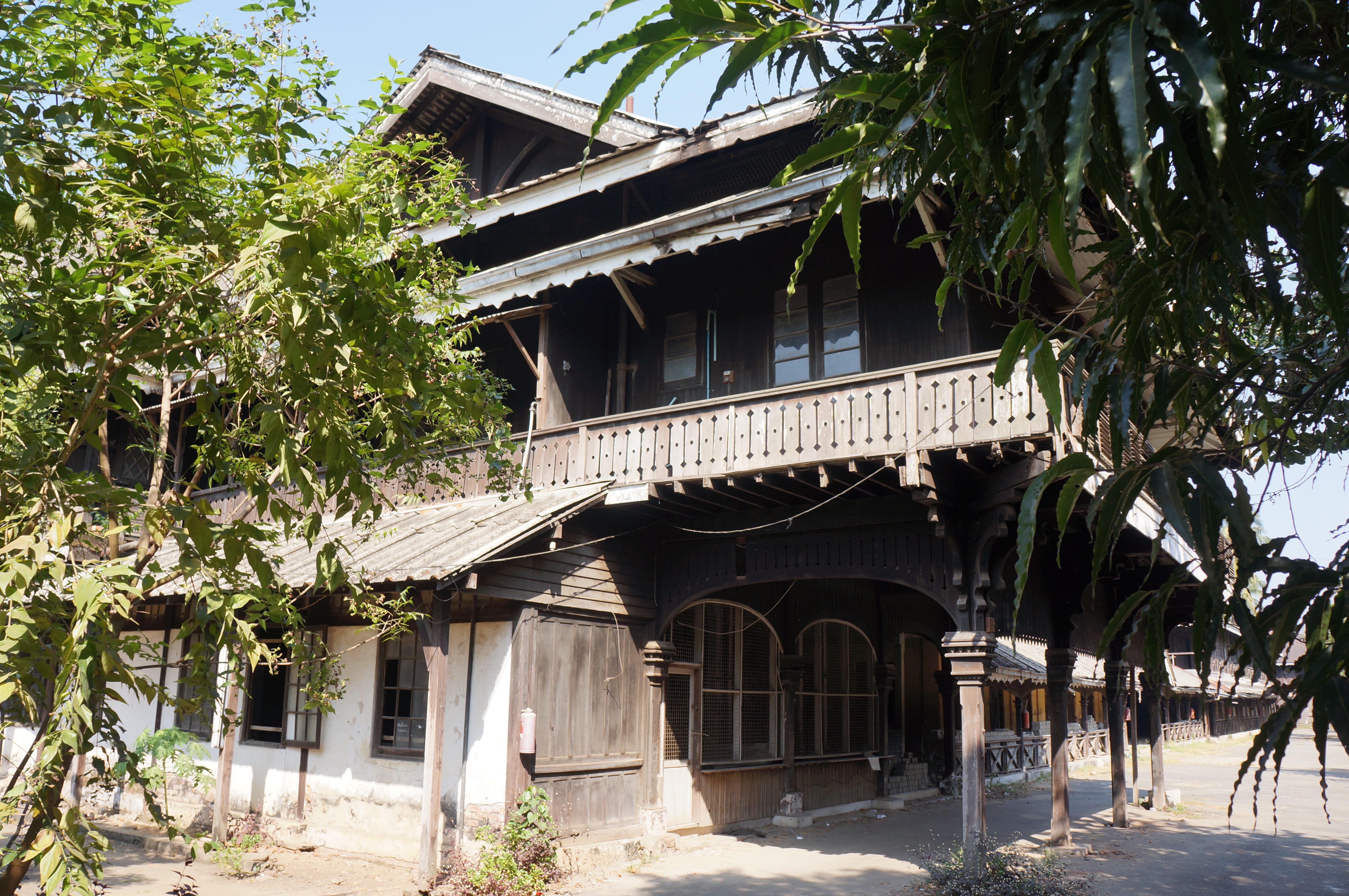
Pegu Club
The cocktail came first, at least in most people's awareness. The Pegu Club Cocktail -- gin, curacao, lime juice, Angostura bitters -- appeared in Harry Craddock's 1930 Savoy Cocktail Book and became a standard of the craft. But the building that gave the drink its name still stands in Yangon, a teak-framed Victorian clubhouse at the corner of Pyay, Zagawar, and Padonmar Roads, directly across from the Russian embassy. Founded in 1871, the Pegu Club was where British colonial officials came to drink, gossip, and maintain the social rituals of empire at the edge of the tropics.
Where the Empire Relaxed
The original clubhouse, built between 1880 and 1882, quickly proved too small. Membership outstripped capacity within a year of its opening, and the club relocated to its present site. In Southeast Asia, it occupied the same social tier as the Royal Selangor Club in Kuala Lumpur and the Tanglin Club in Singapore -- exclusive preserves of the colonial ruling class, where teak ceiling fans stirred the humid air and servants delivered gin-and-tonics on silver trays. Rudyard Kipling visited as a young journalist in 1889, absorbing the atmosphere he would later channel into his Burmese writings. Nearly a century later, Paul Theroux stopped by in the early 1970s and described the club in "The Great Railway Bazaar," by which time it had already begun its long decline.
Teak Built Against the Heat
The main clubhouse was constructed entirely of teak, Burma's great architectural timber. Louvered doors and windows in the upstairs living quarters allowed cross-ventilation, drawing whatever breeze the tropical climate offered. High ceilings amplified the cooling effect. The carriageway and carriage porch were deliberately separated -- a design choice meant to showcase the social status of arriving members. Beyond the clubhouse, the compound included the Prince of Wales Great Hall, built in 1922 in anticipation of a royal visit, three formal gardens, a residential area, and tennis courts. The compound functioned as a self-contained world where colonial officials could pretend, for an evening, that they had not left England.
Nationalized, Abandoned, Rediscovered
After Burma's independence, the military repurposed the compound as a tax office. When the country turned socialist in 1962, the government nationalized the premises outright. The main building became a pension office; surrounding structures housed government officials and their families. Then, in 2002, the government relocated to Naypyidaw, and the compound was abandoned entirely. Tropical vegetation reclaimed the gardens while moisture attacked the teak. For over a decade, the Pegu Club sat empty, joining Yangon's growing inventory of decaying colonial landmarks. Restoration began in 2018, led by KT Group in partnership with the Beaumont Partnership and the Yangon Heritage Trust, which awarded the building one of its Blue Plaques marking sites of historic significance. The first phase converted the space into a multi-purpose event venue, with further restoration planned.
The Cocktail That Outlived the Club
The Pegu Club Cocktail was first mixed sometime in the 1920s, behind the bar of the clubhouse itself. When Harry Craddock included it in The Savoy Cocktail Book in 1930, the drink entered the international repertoire. Its fame eventually inspired a New York City bar called Pegu Club, opened in 2005 on Houston Street in SoHo by bartender Audrey Saunders, which became one of the most influential cocktail bars in America and helped ignite the craft cocktail movement. That bar closed in 2020 during the COVID-19 pandemic, but its influence persisted. Meanwhile, in Yangon, the original building that started it all stands at the intersection of colonial memory and uncertain future, its teak frame slowly being stabilized, its gardens gradually returning to order, its place in cocktail history secure even as its physical survival remains a work in progress.
From the Air
Located at 16.787°N, 96.143°E in Yangon, at the corner of Pyay Road, Zagawar Road, and Padonmar Road. The compound sits north of downtown, across from the Russian embassy. The teak clubhouse is set within gardens and is not easily identified from high altitude, but the intersection of Pyay Road is a major north-south artery visible from above. Nearest airport is Yangon International (VYYY), approximately 12 km north. At 2,000-3,000 ft AGL, the compound's tree-covered grounds contrast with the denser urban fabric surrounding it.