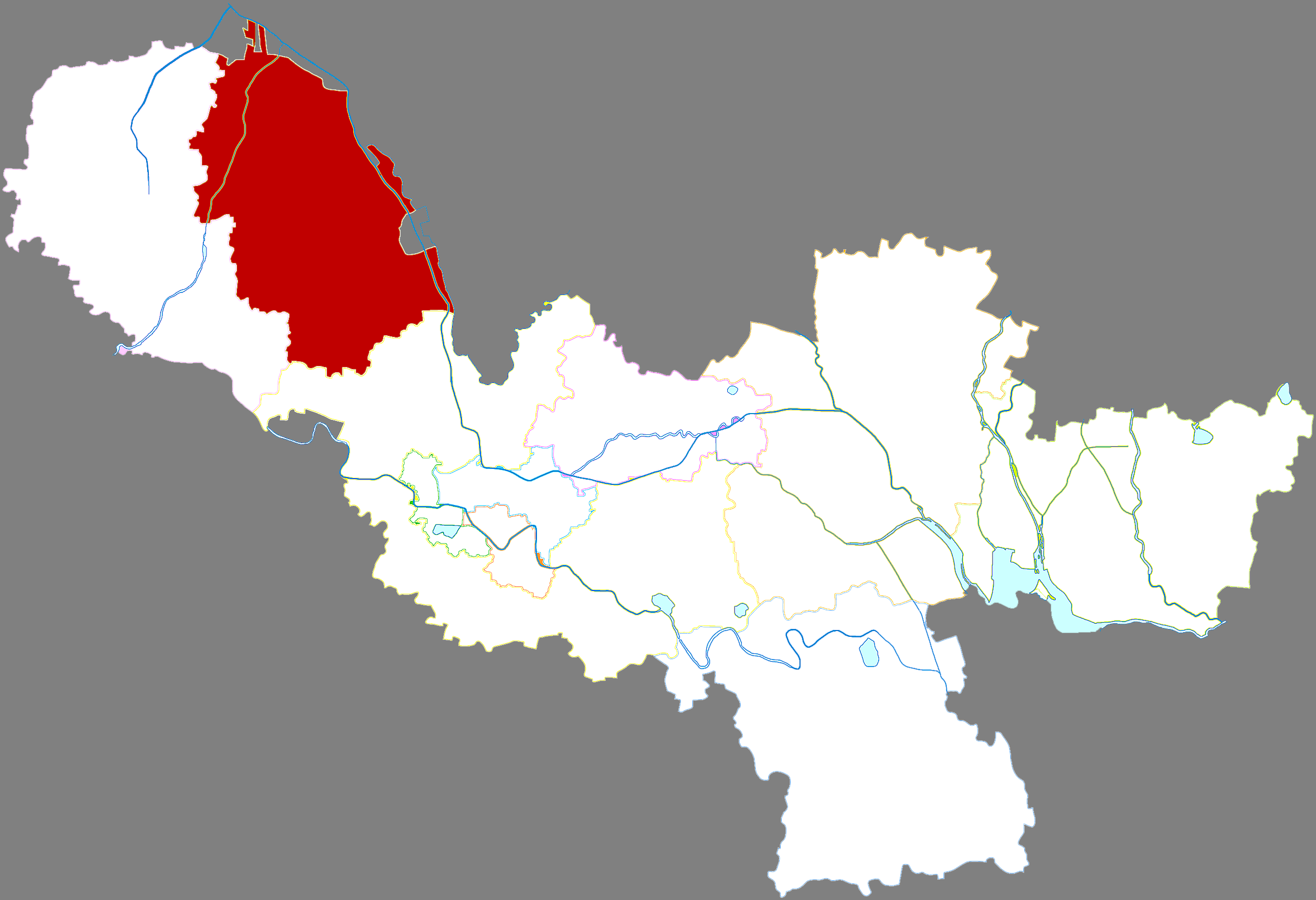
Pei County
Liu Bang was born here. That single fact has defined Pei County for more than two thousand years. The man who would become the founding emperor of the Han dynasty started as a minor local official in this unremarkable patch of land on the western shore of Nansi Lake, in what is now Jiangsu Province. He was not noble, not wealthy, and by most accounts not particularly refined. But from this county of flat farmland and quiet towns, he raised an army, overthrew the Qin dynasty, defeated the aristocratic warrior Xiang Yu, and established a dynasty that would rule China for over four hundred years and give its name to the Han Chinese ethnic majority.
A Peasant Emperor's Roots
Pei County sits under the administration of Xuzhou, bordering the Shandong cities of Jining to the northwest and Zaozhuang to the northeast. With an area of 1,576 square kilometers and a population of over 1.1 million, it is not a small place, but neither is it a famous one beyond its association with Liu Bang. His oath brother Fan Kuai, one of the most celebrated lords who helped Liu Bang overthrow the Qin and build the Han dynasty, also came from here. Fan Kuai's descendants still live in Pei County, a lineage stretching back over two millennia unbroken by the upheavals that repeatedly reshaped China. The connection between this land and the Han dynasty's founding is not abstract history; it is a living thread.
Xiaopei and the Wars of the Three Kingdoms
Within present-day Pei County lies the site of Xiaopei, an ancient town that played a pivotal role during the chaotic final decades of the Eastern Han dynasty. The region fell under the jurisdiction of Xu Province, governed by Tao Qian. Before Tao Qian died, he handed his governorship to Liu Bei, the wandering warlord who would eventually found the kingdom of Shu Han. Liu Bei took refuge in Xiaopei after Lu Bu seized Xu Province from him through deceit, making this quiet town a temporary shelter for one of the most storied figures in Chinese history. The irony is notable: the same county that produced the founder of the Han dynasty became a hiding place for the man who claimed to be restoring it, four centuries later.
The Landscape of Ambition
Pei County's geography explains much about its history. Situated on the western shore of Nansi Lake, the largest freshwater lake in northern China, and positioned at the boundary between Jiangsu and Shandong provinces, it occupies a transitional zone between the flat agricultural plains of the north and the more varied terrain to the south. This was frontier territory in ancient times, a place where competing states met and where central authority was often thin on the ground. It was exactly the kind of place that produced ambitious men with little to lose. Liu Bang understood the landscape he came from: his military campaigns exploited the networks of rivers and plains that connected Pei County to the broader Chinese heartland, turning geographic marginality into strategic advantage.
Fifteen Towns, One Legacy
Modern Pei County is organized into 15 towns, from Longgu and Yangtun in the north to Anguo in the south. The administrative structure is unremarkable, typical of a Chinese county. But the cultural memory of Liu Bang saturates the place. In a country where the founding of a dynasty is treated with a reverence that approaches the mythological, being the birthplace of the Han dynasty's creator carries weight that no amount of modernization fully displaces. Pei County is not a tourist destination on the scale of Xi'an or Beijing, but for those who understand what happened here, the flat fields and quiet towns carry a charge. From this ground, a man with no aristocratic pedigree remade China.
From the Air
Located at 34.728N, 116.933E on the western shore of Nansi Lake in Jiangsu Province, near the border with Shandong. The landscape is flat agricultural plain with the large expanse of Nansi Lake clearly visible to the east. Nearest major airports include Xuzhou Guanyin International Airport (ZSXZ) approximately 60 km southeast and Jining Da'an Airport (ZSJG) to the northwest. The Beijing-Shanghai high-speed rail corridor passes through the area.