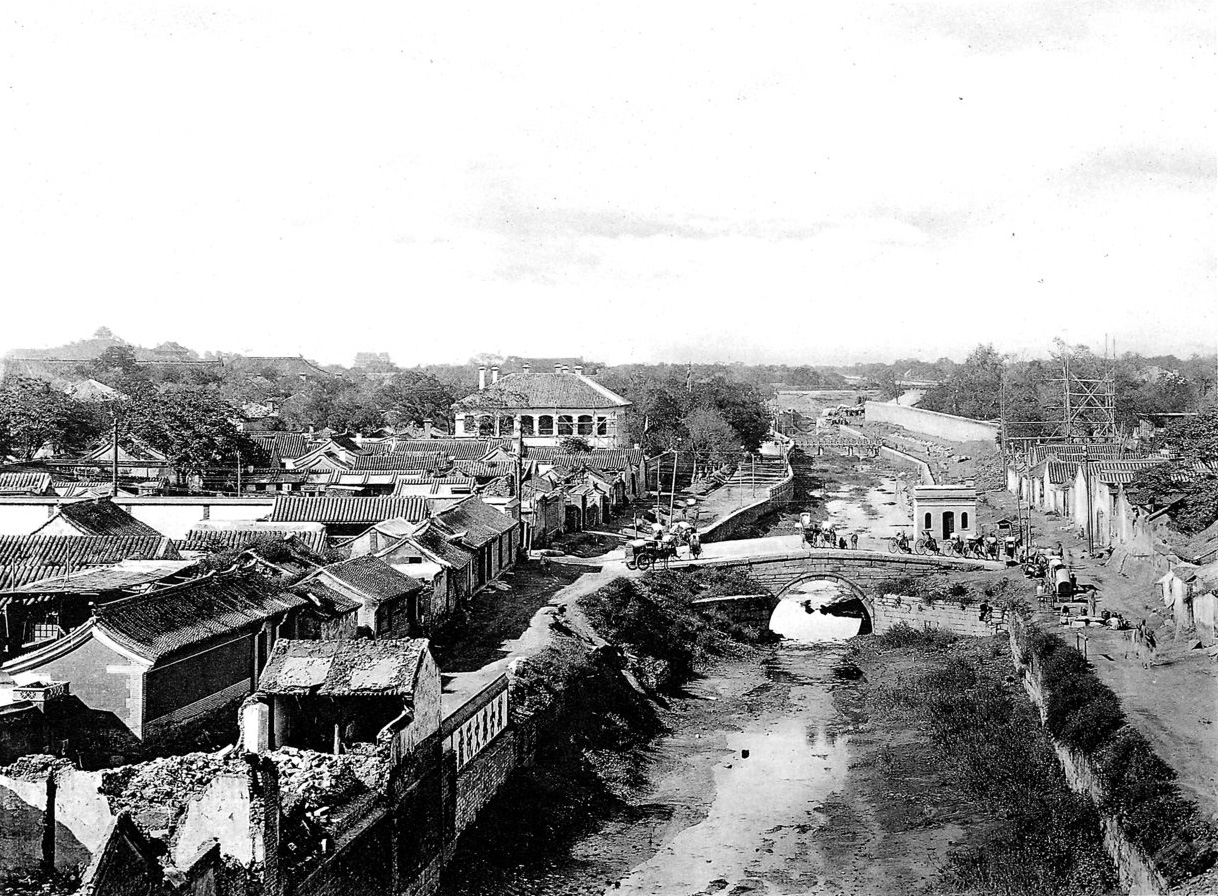
Peking Legation Quarter
In 1900, Legation Street was still "a straggling unpaved slum of a thoroughfare, along which one occasionally sees a European picking his way between the ruts and puddles with the donkeys and camels." Yet this modest lane in central Beijing -- known in Chinese as Dong Jiaomin Xiang -- was the most politically explosive address in the Chinese empire: a rectangle of foreign-controlled territory where eleven nations maintained diplomatic compounds, exempt from Chinese law, just east of Tiananmen Square.
East River-Rice Lane
The street's origins were commercial, not diplomatic. During the Yuan dynasty, it was called East River-Rice Lane, because its proximity to the Grand Canal -- 30 kilometers east -- made it the natural location for tax offices and customs authorities handling grain shipments from southern China. During the Ming dynasty, the Ministry of Rites moved in, along with hostels for tributary missions from Vietnam, Mongolia, Korea, and Burma. The transformation into a foreign enclave came after China's defeat in the Second Opium War. The Convention of Peking in 1860 forced the Qing government to permit foreign diplomatic representatives to live in the capital for the first time. In 1861, the British established their legation in the residence of a Manchu prince. France, Russia, and the United States quickly followed. By 1900, eleven nations had compounds in the quarter.
Fifty-Five Days Under Siege
The Boxer Rebellion of 1900 transformed the Legation Quarter from a diplomatic curiosity into a battlefield. For 55 days, Boxers and Qing army troops besieged the quarter, trapping roughly 900 foreign nationals -- 400 of them soldiers -- behind barricades improvised from furniture and sandbags. The siege was lifted on August 14 when the Eight-Nation Alliance marched to Beijing from the coast. Of the defenders, 55 soldiers and 13 civilians died. The Boxer Protocol of 1901 that followed reshaped the quarter utterly: China was forced to pay massive indemnities, and the Protocol decreed that the Legation Quarter was to be "specially reserved" for foreign use, with Chinese residents expelled. Walls went up, a glacis was cleared for fields of fire, and the quarter became less a neighborhood than a fortress.
A World Apart
In the decades after the Boxer Rebellion, the Legation Quarter became a pocket of Europe embedded in the Chinese capital. Paved streets, Western architecture, lawns, social clubs, and restaurants created an environment where diplomats, soldiers, scholars, and artists lived in conspicuous comfort. Chinese servants were permitted inside, but other Chinese could only enter with temporary passes. A departing Marine in the late 1920s described a life of casual luxury: afternoons off, shoes shined by servants, never making one's own bed. The foreign population in Beijing never exceeded two to three thousand civilians, but they attracted scholars and aesthetes drawn to the ancient culture preserved in the capital -- and the ability to live well on very little money. Meanwhile, White Russian refugees who had fled the Russian Civil War eked out a precarious existence on the quarter's margins, many rendered stateless after China recognized the Soviet Union in 1924.
The Last Days
World War II shattered the quarter's artificial world. When Japan attacked Pearl Harbor on December 8, 1941, the 203 American Marines still guarding the Legation Quarter surrendered and became prisoners of war. By February 1943, the remaining civilian foreigners -- missionaries, doctors, scholars, businessmen, ranging in age from six months to 85 years -- were ordered to assemble at the former American legation. They were marched past Chinese crowds to the railroad station and transported to the Weixian internment camp, 320 kilometers south. After the Communist victory in 1949, a few foreign missions lingered into the 1950s before being relocated to Sanlitun. The Cultural Revolution brought further destruction. Today, fragments survive: St. Michael's Church from 1904, the old Beijing Railway Station from 1903, and several buildings now housing restaurants and shops -- the last physical traces of a century when a small corner of Beijing answered to foreign law.
From the Air
Located at 39.903N, 116.402E, directly east of Tiananmen Square in Beijing's Dongcheng District. The former quarter is bounded roughly by Tiananmen to the west and Chongwenmen to the east. From altitude, the area is now fully integrated into central Beijing's urban fabric. Nearby airports: Beijing Capital International (ZBAA) 25 km NE, Beijing Daxing International (ZBAD) 46 km S. Best viewed at 2,000-5,000 ft.