Peking University
In 1917, when the scholar Cai Yuanpei took over as president, he inherited a school that many regarded as a diploma mill for the sons of officials. Within a few years, he had turned Peking University into the intellectual center of modern China -- a place where the ideas of democracy, science, and vernacular literature took root and exploded outward into a revolution of the mind. The May Fourth Movement of 1919, which began with student protests at the university and spread across the nation, is still considered the birth of modern Chinese political consciousness. More than a century later, Peking University remains inseparable from the story of China itself.
Imperial Origins
Peking University was established in 1898 as the Imperial University of Peking, created by royal charter from the Guangxu Emperor during the Hundred Days' Reform. It is the second-oldest university in China, after Tianjin University, which was founded in 1895. The imperial institution was renamed Peking University in May 1912 after the founding of the Republic of China. Its original purpose was to modernize Chinese education along Western lines while preserving Chinese learning, a tension that would define the university's character for decades. In 1952, during a nationwide restructuring of higher education, Peking University merged with the American-founded Yenching University and moved to Yenching's campus in Haidian, where it remains today.
The Campus That Changed a Nation
Under Cai Yuanpei's leadership, inspired by German models of academic freedom, Peking University became the staging ground for China's intellectual awakening. Faculty members like Chen Duxiu, who founded the influential journal New Youth, and Hu Shih, who championed writing in the vernacular Chinese language, used the university as a platform to challenge centuries of Confucian orthodoxy. When the Treaty of Versailles awarded Germany's concessions in Shandong province to Japan rather than returning them to China, Peking University students led the May Fourth demonstrations of 1919 that swept the country. The movement catalyzed both the rise of Chinese nationalism and the founding of the Chinese Communist Party, whose co-founder Li Dazhao served as the university's head librarian -- where a young Mao Zedong briefly worked as a library assistant.
Gardens of the Mind
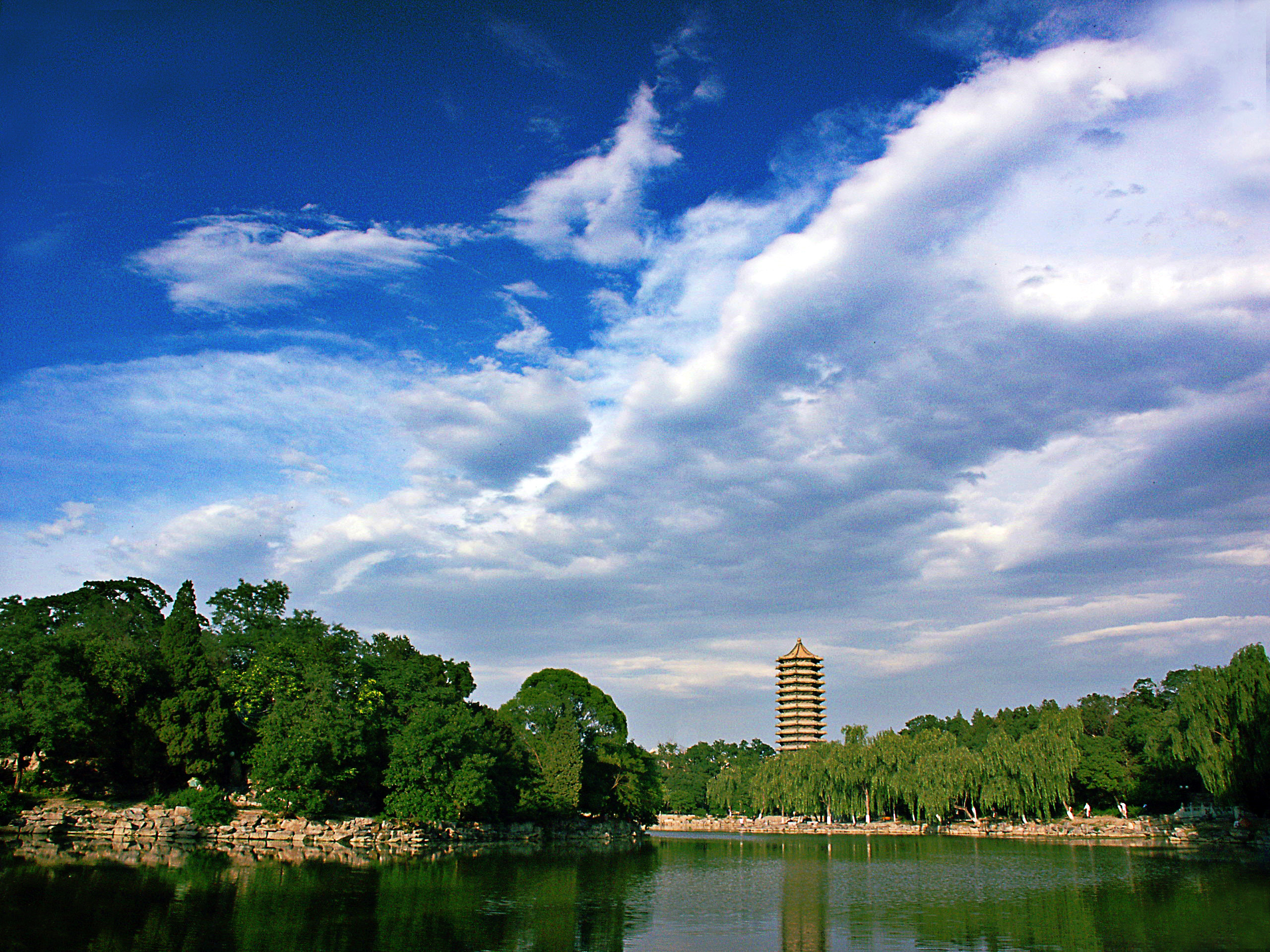
The modern campus sits on grounds that once formed part of the imperial gardens of the Qing dynasty, and the landscape retains an older beauty. Weiming Lake, surrounded by willows and traditional pavilions, is the symbolic heart of the university. The name means 'unnamed,' a deliberate gesture of scholarly humility. Nearby, the Boya Pagoda rises beside the water, a landmark visible across the northwestern corner of Beijing. The campus architecture mixes traditional Chinese garden elements with early twentieth-century Western academic buildings inherited from Yenching University, whose designers sought to blend the two traditions. Walking the grounds, students pass through courtyards and along tree-lined paths that feel more like a retreat than a modern research institution housing 55 schools and departments.
A University and Its Country
Peking University has produced an extraordinary concentration of Chinese leaders in science, politics, and letters. It consistently ranks among Asia's top universities, a member of the elite C9 League -- China's equivalent of the Ivy League. But its significance has always been more than academic. During the Cultural Revolution, the campus became a battleground for ideological purges. In 1966, the first big-character poster of the movement appeared at Peking University, launching a decade of upheaval. In 1989, Peking University students were again among those who marched to Tiananmen Square. The university's role as a barometer of Chinese intellectual life remains unchanged: where Peking University's students and faculty turn their attention, the country tends to follow.
From the Air
Coordinates: 39.987N, 116.305E. Located in Haidian District, northwest Beijing, adjacent to Tsinghua University. The campus is identifiable from the air by Weiming Lake and the surrounding green space within the dense urban fabric. Nearest major airport is Beijing Capital International (ZBAA/PEK), about 28 km northeast. Beijing Daxing International (ZBAD/PKX) lies approximately 58 km to the south.