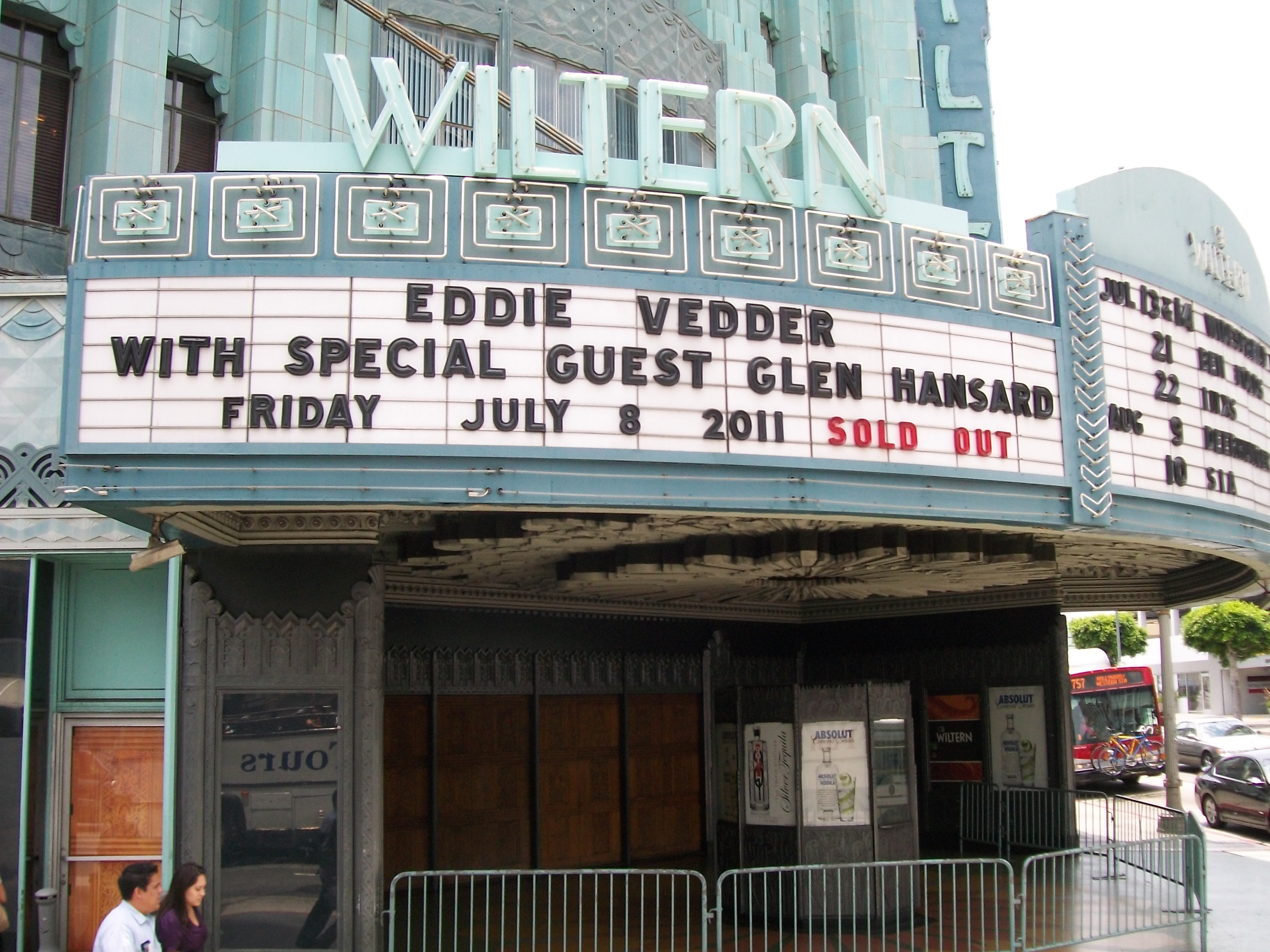
Pellissier Building and Wiltern Theatre
The color is the first thing anyone notices: a blue-green shimmer of glazed terra-cotta tile that catches afternoon light and holds it differently than any other building on Wilshire Boulevard. The Pellissier Building has stood at the corner of Wilshire and Western since 1931, twelve stories of Art Deco confidence in a city that was still deciding what it wanted to be.
A Theater for the Age of the Automobile
The building was designed by Stiles O. Clements and opened as the Warner Brothers Western Theater, positioned to serve the westward expansion of Los Angeles along the Wilshire corridor. The timing was deliberate: Wilshire Boulevard in the early 1930s was becoming the city's commercial spine, and a theater at Wilshire and Western would draw audiences from across the growing basin.
Inside, the Wiltern was a showpiece. The largest pipe organ in the western United States at the time of its opening — a 37-rank Kimball instrument — filled the hall with sound. The ceiling was an engineering fantasy: a sunburst pattern in which each radiating ray was designed as a miniature Art Deco skyscraper, an entire imaginary skyline overhead. Audiences looked up and saw a city of the future.
The theater operated through Hollywood's golden age, then declined as suburban development pulled audiences away from the old commercial corridors. By the early 1980s, it faced the fate of hundreds of similar theaters across the country: closure, conversion, or demolition.
Rescued Twice
The first rescue came in 1981, when the theater was designated a Los Angeles Historic-Cultural Monument, buying time for a more substantial intervention. Four years of renovation followed. On May 1, 1985, the Wiltern reopened with a performance by the Alvin Ailey American Dance Theater — a choice that honored both the theater's elegance and the neighborhood's demographics. Tom Petty played on August 7, 1985, and that concert was recorded as Pack Up the Plantation: Live!, preserving the sound of a restored theater in its first season.
The theater found its footing as a mid-sized concert venue — holding roughly 2,300 standing or 1,850 seated — at a scale that made it intimate enough for performers to fill without losing the connection between stage and audience. Over the following decades it became one of the city's most beloved rooms, a venue that artists requested by name.
Madonna performed ten consecutive nights here in November 2019 — an intimate residency that would have been unthinkable in the stadium-scale venues her career usually demanded. The Wiltern made that possible.
What Endures
The Pellissier Building and Wiltern Theatre are listed on the National Register of Historic Places, a recognition that the building represents something beyond local sentimental attachment. Art Deco architecture of this quality and completeness — the terra-cotta facade, the sunburst ceiling, the original proportions — is genuinely rare. Buildings like this were demolished by the hundreds in the postwar decades. That this one survived is partly luck and partly the stubbornness of Angelenos who refused to let it go.
The neighborhood around it has transformed several times over: from early 20th-century residential development to mid-century decline to the vibrant Korean American community that now anchors Koreatown. The Wiltern has watched all of it from its corner, its blue-green tiles unchanged, its interior still capable of producing the particular silence that falls over a crowd in the seconds before a concert begins.