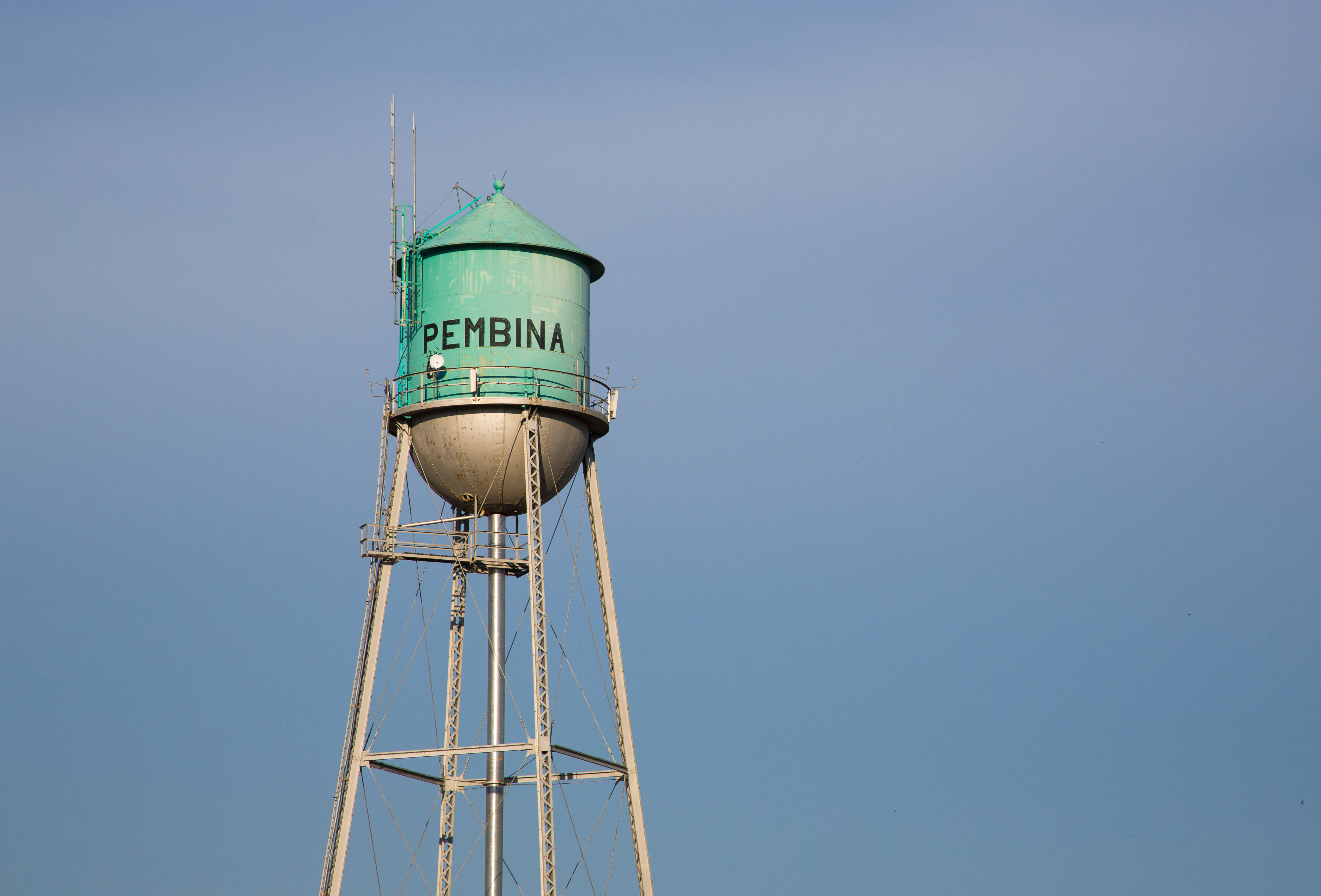
Pembina, North Dakota
By 1805, the beaver were gone. Trappers working five rival fur-trading posts clustered along the Pembina and Red rivers had stripped the streams so thoroughly that the animal that built North America's continental economy effectively vanished from the area. That detail -- the extinction of local beaver within a decade of industrial trapping -- captures the intensity of what happened at this remote confluence in the far northeastern corner of North Dakota. Today Pembina is a city of 512 people, quiet enough that the loudest regular sound may be the rumble of trucks crossing the international border a mile north. But between the 1790s and the 1870s, this was one of the most contested, multinational, and culturally complex places on the northern plains.
Five Posts, Three Companies, One River
The scramble began in the 1780s. Peter Grant of the North West Company built the first trading post on the east side of the Red River between 1784 and 1789. It had vanished by 1801. In 1797, Jean Baptiste Chaboillez, also of the North West Company, erected a post on the south bank of the Pembina River in what is now Pembina State Park. The Hudson's Bay Company had its own small post -- seemingly called Fort Skene -- on the east bank of the Red by 1793, rebuilt in 1801. The XY Company operated a post within sight of the others from 1800 to 1805 before being absorbed by the North West Company. Alexander Henry the younger ran yet another North West Company post from 1801 to 1808 on the north bank of the Pembina, directly across from Chaboillez's operation. The Hudson's Bay Company eventually absorbed the North West Company in 1821, consolidating a generation of rivalry. The HBC post established at Pembina in 1797 makes this the oldest European-American community in the Dakotas.
The Metis and the Buffalo
Pembina was the traditional rendezvous point for the Metis buffalo hunt, a massive organized expedition that defined life on the northern plains for much of the 19th century. The Metis -- people of mixed Indigenous and European ancestry -- gathered here before riding out onto the prairies in Red River ox carts, those distinctive two-wheeled vehicles whose ungreased wooden axles could be heard shrieking for miles. In 1818, Father Dumoulin established a Roman Catholic mission at Pembina, aiming to convert the buffalo hunters and other Indigenous peoples to Catholicism. He baptized 394 people before the mission closed in 1823. The Assomption Catholic Church later recorded 166 burials between 1848 and 1892, of which 147 were French or English/Scottish Metis. The Metis trade routes radiating from Pembina became known as the Red River Trails, a network that linked the northern plains to markets in St. Paul and beyond.
Fort Pembina and the Border Question
After the American Civil War, unrest among Native Americans in the Red River Valley prompted the Minnesota Legislature to petition Congress for a military fort, particularly to defend against Lakota incursions. Major General Winfield Scott Hancock recommended the post on December 8, 1869, and Fort Pembina was completed on July 8, 1870, situated just above the mouth of the Pembina River. Originally called Fort Thomas after Major General George Henry Thomas, who had died on March 28, 1870, it was redesignated Fort Pembina on September 6 that year. The fort served a dual purpose: military defense and a physical assertion of American sovereignty on a border that remained contentious. In September 1872, a joint Canadian and American boundary survey commission met in Pembina, spending the winter before setting out in spring 1873 to survey and mark the border along the 49th parallel. A fire seriously damaged the fort on May 27, 1895, and it was abandoned that August, later sold at public auction.
The Border Crossing That Outlived the Town
Pembina's modern identity is inseparable from the international boundary it straddles. The Pembina-Emerson Border Crossing is the fifth busiest along the entire Canada-United States border and the busiest between the Peace Arch crossing at Surrey-Blaine in the west and the Ambassador Bridge at Windsor-Detroit in the east. It operates 24 hours a day, one of only three such ports in North Dakota. Interstate 29 runs along Pembina's western edge, funneling traffic north to Emerson, Manitoba and south to Grand Forks and Fargo. The city was the most populous place in North Dakota according to the 1860 census and held the county seat from 1867 to 1911. Its population peaked at 642 in the 2000 census and stood at 512 in 2020. The Pembina State Museum commemorates the town's founding, and Pembina State Park preserves the ground where Chaboillez built his trading post over two centuries ago.
From the Air
Located at 48.967°N, 97.248°W in the far northeastern corner of North Dakota, at the confluence of the Red River of the North and the Pembina River. The Canada-US border lies approximately one mile north. Interstate 29 is visible running north-south on the city's western side. Emerson, Manitoba is directly across the border; St. Vincent, Minnesota lies adjacent to the east across the Red River. The terrain is extremely flat Red River Valley prairie. Grand Forks International Airport (KGFK) is approximately 75 nm south. Pembina Municipal Airport (KPMB) serves local traffic. The Pembina-Emerson border crossing complex is visible from altitude as a cluster of buildings straddling the border line. Best viewed at 3,000-5,000 feet to appreciate the river confluence and the sharp grid of the international boundary.