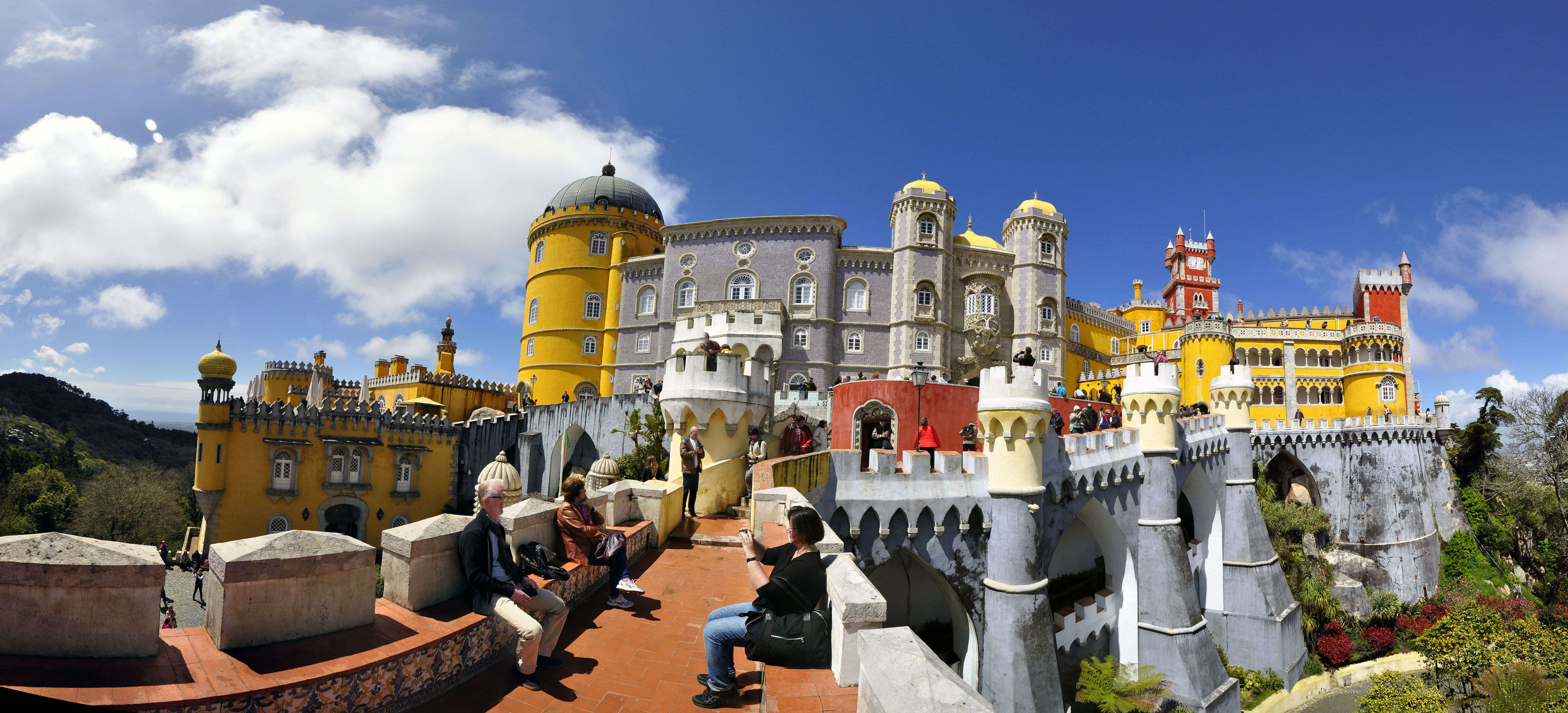
Pena Palace
On a clear day, you can see the Pena Palace from Lisbon, 30 kilometers away — a smear of red and yellow on the crest of the Sintra Mountains that looks like it wandered out of a fairy tale and got lost. That impression is not accidental. King Ferdinand II, a German prince who married into Portuguese royalty in 1836, acquired the ruins of a Hieronymite monastery in 1838 and set out to build the most exuberantly Romantic palace in Europe. He hired Wilhelm Ludwig von Eschwege, a mining engineer and amateur architect who had likely studied castles along the Rhine, and together they created a building that intentionally defies stylistic coherence — Neo-Gothic, Neo-Manueline, Neo-Islamic, and Neo-Renaissance elements colliding in a single structure that somehow holds together.
From Monastery to Fantasy
The hilltop's history predates Ferdinand by centuries. In the Middle Ages, a chapel dedicated to Our Lady of Pena stood here, reportedly built after an apparition of the Virgin Mary. King John II made a pilgrimage in 1493; Manuel I ordered a Hieronymite monastery constructed on the site. For centuries, Pena was a quiet place of meditation housing no more than eighteen monks. Lightning damaged the monastery in the 18th century, and the 1755 Lisbon earthquake reduced it to ruins — though the chapel, with its marble and alabaster works attributed to Nicolau Chanterene, survived nearly intact. These ruins captivated the young Prince Ferdinand, who bought the monastery, the surrounding lands, and the nearby Castle of the Moors, then set about transforming stone remnants into a summer residence worthy of his Romantic imagination.
Architecture as Collision
The Pena Palace is deliberate architectural chaos. Ferdinand and Queen Maria II intervened personally in matters of decoration and symbolism, suggesting vault arches, Medieval and Islamic elements, and an ornate main window inspired by the chapter house of the Convent of the Order of Christ in Tomar. The result divides into four structural sections: the fortified foundations with drawbridge, the restored convent with its clock tower, the Arches Yard with Moorish arches, and the palatial zone with its cylindrical bastion. A mythological triton guards a bay window, symbolizing the allegory of creation. The Queen's Terrace, perhaps the best vantage point for comprehending the palace's architectural logic — or magnificent lack thereof — features a sundial cannon that once fired every day at noon.
A Forest from Five Continents
Ferdinand's Romantic ambitions extended to the 200-hectare park surrounding the palace. With the help of Baron von Eschwege and Baron von Kessler, he created a botanical collection drawn from distant lands: North American sequoia and Western redcedar, Chinese ginkgo, Japanese cryptomeria, Australian tree ferns. The Queen's Fern Garden concentrates species from Australia and New Zealand in a lush ravine threaded with streams. A labyrinthine system of paths connects the palace to points of interest throughout the park, creating the sense of wandering through a curated wilderness rather than a garden. The park's global plantings mirror the palace's architectural eclecticism — everything here is borrowed, transplanted, and arranged to create something that could exist nowhere else.
Last Night of the Monarchy
After Ferdinand's death, the palace passed to his second wife, Elisa Hensler, Countess of Edla — a situation that provoked national controversy until King Luís bought it back for the royal family. The Portuguese State acquired it in 1889, and after the Republican Revolution of 1910 it became a national monument and museum. Queen Amélia, Portugal's last queen, spent her final night in the country at Pena before leaving for exile. Over the decades, the red and yellow façades faded to gray, and the palace was visually identified as a monochrome ruin. By the late 20th century, repainting restored the original colors, and in 1995 the palace and the Cultural Landscape of Sintra were classified as a UNESCO World Heritage Site. Named one of the Seven Wonders of Portugal, Pena Palace now serves for state occasions alongside its life as one of the country's most visited monuments.
From the Air
Located at 38.788°N, 9.391°W atop the Sintra Mountains at approximately 500m elevation. The palace's red and yellow façades are highly visible from the air, perched on the mountain crest above the town of Sintra. On clear days, the palace is visible from Lisbon and much of the metropolitan area. The nearby Castle of the Moors (ruined fortification) sits on an adjacent ridge. Recommended viewing altitude: 3,000-5,000 ft for the mountain setting context. Nearest airport: Lisbon/Humberto Delgado (LPPT) approximately 30 km southeast. The Sintra Mountains create orographic cloud and local turbulence; best visibility typically in morning hours.