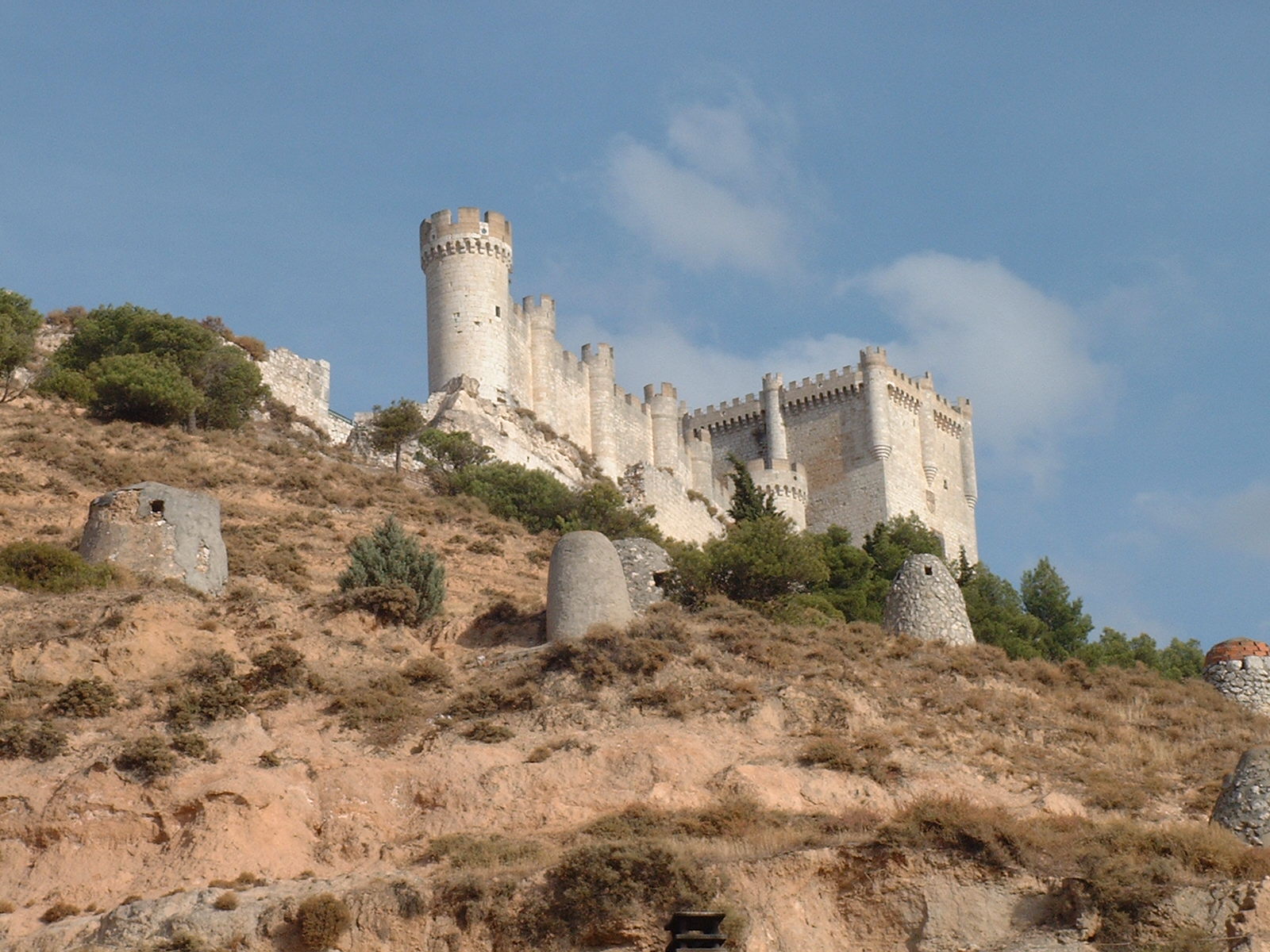
Penafiel Castle
From above, Penafiel Castle looks less like a fortress and more like a stone warship beached on a hilltop. It stretches more than 200 meters along a narrow ridge but is only about 35 meters wide -- an extraordinary ratio that gives the castle its distinctive silhouette, visible for miles across the vineyards and wheat fields of the Duero valley. At the center of this elongated hull rises a 34-meter keep, three stories of defensive architecture that have watched over the confluence of the Duero and Duraton rivers since the tenth century.
A Frontier Carved in Stone
Fernan Gonzalez, the Count of Castile who is credited with forging Castilian independence from the Kingdom of Leon, began construction on this site in 947. It was a frontier outpost, positioned to defend against Arab incursions from the south during the centuries-long Reconquista. In 1013, Sancho Garcia built a more substantial castle to hold the land, and over the following centuries the fortress accumulated layers of addition and renovation as successive members of the Spanish nobility left their mark. Juan Manuel, Prince of Villena, one of medieval Spain's most important literary figures, was among those who expanded the castle. So was Pedro Giron, whose family wielded enormous power in fifteenth-century Castile.
A Royal Birth in the Keep
In 1421, within the keep of Penafiel, Blanche I, Queen of Navarre, gave birth to Charles, Prince of Viana. The prince would grow up to become one of the most tragic figures of fifteenth-century Iberian politics -- a cultured man whose inheritance dispute with his own father, John II of Aragon, destabilized the region and contributed to the civil wars that preceded the unification of Spain. That a future prince of Navarre entered the world inside a Castilian frontier fortress speaks to the tangled web of dynastic alliances and territorial claims that defined medieval Iberia, where royal families moved across kingdoms through marriage, inheritance, and war.
The Ship on the Ridge
The castle's most striking feature is its shape. Dictated by the narrow ridge it crowns, the structure follows the topography with a precision that makes geological necessity look like deliberate design. The outer walls run in parallel lines along the ridge's length, punctuated by towers, while the central keep stands like a mast amidships. Below, the town of Penafiel clusters around the base of the hill, its Plaza del Coso -- an unusual oval-shaped square historically used for bullfights -- offering a dramatic upward view of the castle. Today the keep houses the Provincial Wine Museum, fitting for a town at the heart of the Ribera del Duero wine region, one of Spain's most celebrated appellations. The transition from medieval stronghold to cultural institution mirrors the broader transformation of Castile itself -- from a warrior frontier into a landscape of agriculture, tradition, and slow-paced beauty.
From the Air
Located at 41.60N, 4.11W atop a narrow ridge overlooking the confluence of the Duero and Duraton rivers in Valladolid Province. The castle's distinctive elongated shape -- 200+ meters long but only 35 meters wide -- makes it unmistakable from the air. Nearest airport is Valladolid (LEVD), approximately 55 km west. The town of Penafiel sits in the Ribera del Duero wine country at roughly 750 m elevation. Best viewed at 2,000-4,000 ft AGL to appreciate the ship-like profile along the ridge.