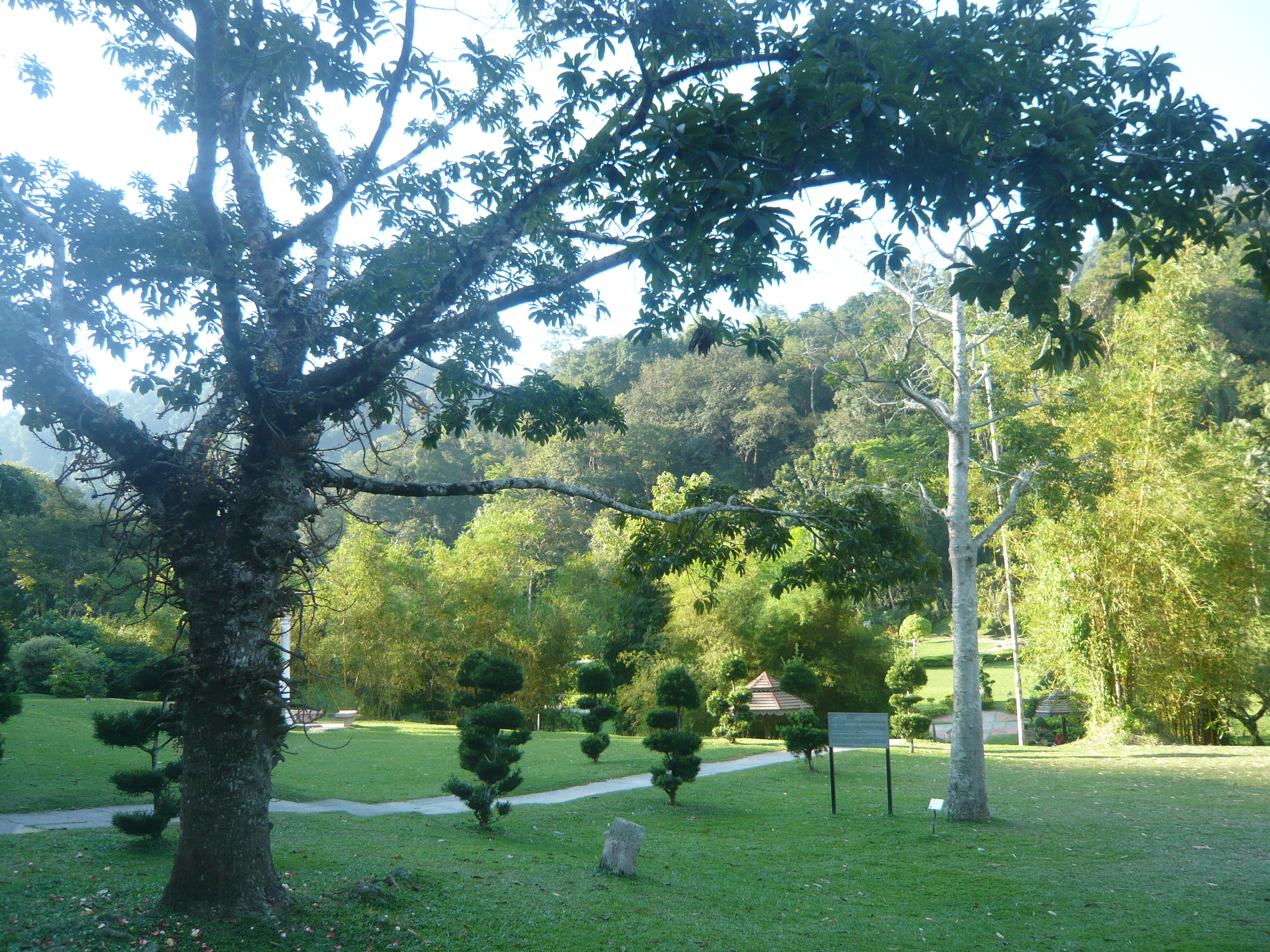
Penang Botanic Gardens
The locals call it the Waterfall Gardens, and the name tells you more than any plaque could. A cascade of water drops from over 120 meters above the valley floor, feeding the stream that runs through 29 hectares of tropical greenery tucked into what locals describe as an amphitheatre of hills. But the Penang Botanic Gardens are not merely a pleasant park with a waterfall. They are the third act of a botanical drama that began in 1794, when the British East India Company decided that controlling the spice trade required growing the spices yourself -- and that Penang Island was the place to do it.
The Spice Gambit
George Town was barely eight years old when the East India Company dispatched Christopher Smith to Penang in 1794 with a straightforward mission: break the Dutch monopoly on nutmeg and cloves by cultivating them on British soil. Smith, trained at Kew Gardens in London, planted two gardens in the Ayer Itam valley -- a small one of about 10.5 hectares and a larger plot of 158 hectares at Sungai Keluang. By 1800, the gardens held some 1,300 plants. Then ambition scaled up. A shipment of 15,000 clove trees and 1,500 nutmeg trees arrived from Ambon Island in the Moluccas, along with canary nuts and sugar palms. Smith was recalled from specimen-collecting duties to manage the sudden bounty. By 1802, he reported 19,000 nutmeg and 6,250 clove trees under cultivation, with an annual budget of nearly $12,000 and 80 laborers. The spice gardens lasted until 1806, when changing economics made the enterprise less viable and most specimens were sold off and replanted elsewhere.
A Botanist Named Porter
The second attempt came in 1822, at the urging of no less a figure than Sir Stamford Raffles, who was busy founding Singapore but still had time to nudge Penang's governor, William Edward Phillips, toward botanical ambition. The Danish naturalist Nathaniel Wallich recommended George Porter for superintendent -- a headmaster at Penang Free School who happened to be an amateur botanist and a former member of the Calcutta Gardens staff. Wallich thought enough of Porter to name a dwarf Dracaena species after him. These kitchen gardens were sited in the same Ayer Itam valley as their predecessors, possibly on the same government land. But the venture struggled. Porter answered to a local judge named Leycester who served as nominal curator, and the arrangement lacked the resources and focus that serious botanical work demanded. By 1834, this second garden had also faded.
Curtis and the Quarry
The gardens that survived were the third attempt. In 1884, Charles Curtis took charge of an abandoned quarry site in the Waterfall River valley and began transforming it into something entirely different: not a commercial spice plantation, not a kitchen garden, but a proper botanical garden for research and public pleasure. His 1885 annual report laid out the vision in detail -- new road circuits, plant houses for propagation, recreational venues, and an expanded footprint that would eventually encompass the cascading waterfall itself. Curtis battled the site as much as he shaped it. Located at 579 meters elevation with annual rainfall that averaged 381 centimeters in the 1890s, the garden suffered constant landslips on its steepest slopes. Curtis himself suffered from chronic ill health, which he blamed on inadequate housing. He took early leave in March 1903 and formally retired that December, handing the gardens to his successor Walter Fox. But the foundation he laid proved durable.
Green Lung of a Metropolis
Today the Penang Botanic Gardens serve as the primary green space for metropolitan George Town -- what Penangites call their "green lung." Joggers circle the paths at dawn. Families walk under canopies of tropical rainforest trees. The massive buttress roots of the sengkuang tree draw photographers and the curious. The gardens are part of the Penang Hill Biosphere Reserve, recognized by UNESCO as the third Biosphere Reserve in Malaysia, a designation that places them alongside the most ecologically significant landscapes in the country. The waterfall that gives the gardens their colloquial name was closed to the public during the Indonesia-Malaysia confrontation of the 1960s, a security measure that reflected how close geopolitics could press against even a botanical garden. The reservoir was reconstructed in 1950, and today it supplies approximately ten to fifteen percent of Penang's water, with most of the island's supply now drawn from Sungai Muda on the Penang-Kedah border.
From the Air
The Penang Botanic Gardens are located at 5.44N, 100.29E, on the western slope of Penang Hill on Penang Island, Malaysia. From the air, the gardens appear as a wedge of dark green canopy nestled in a valley below the ridge of Penang Hill. The waterfall may be visible as a white streak on clear days. Penang International Airport (WMKP) is approximately 14 kilometers to the south. George Town's historic waterfront district is visible to the northeast along the Penang Strait. Best viewed at 3,000-5,000 feet when approaching from the east over the strait.