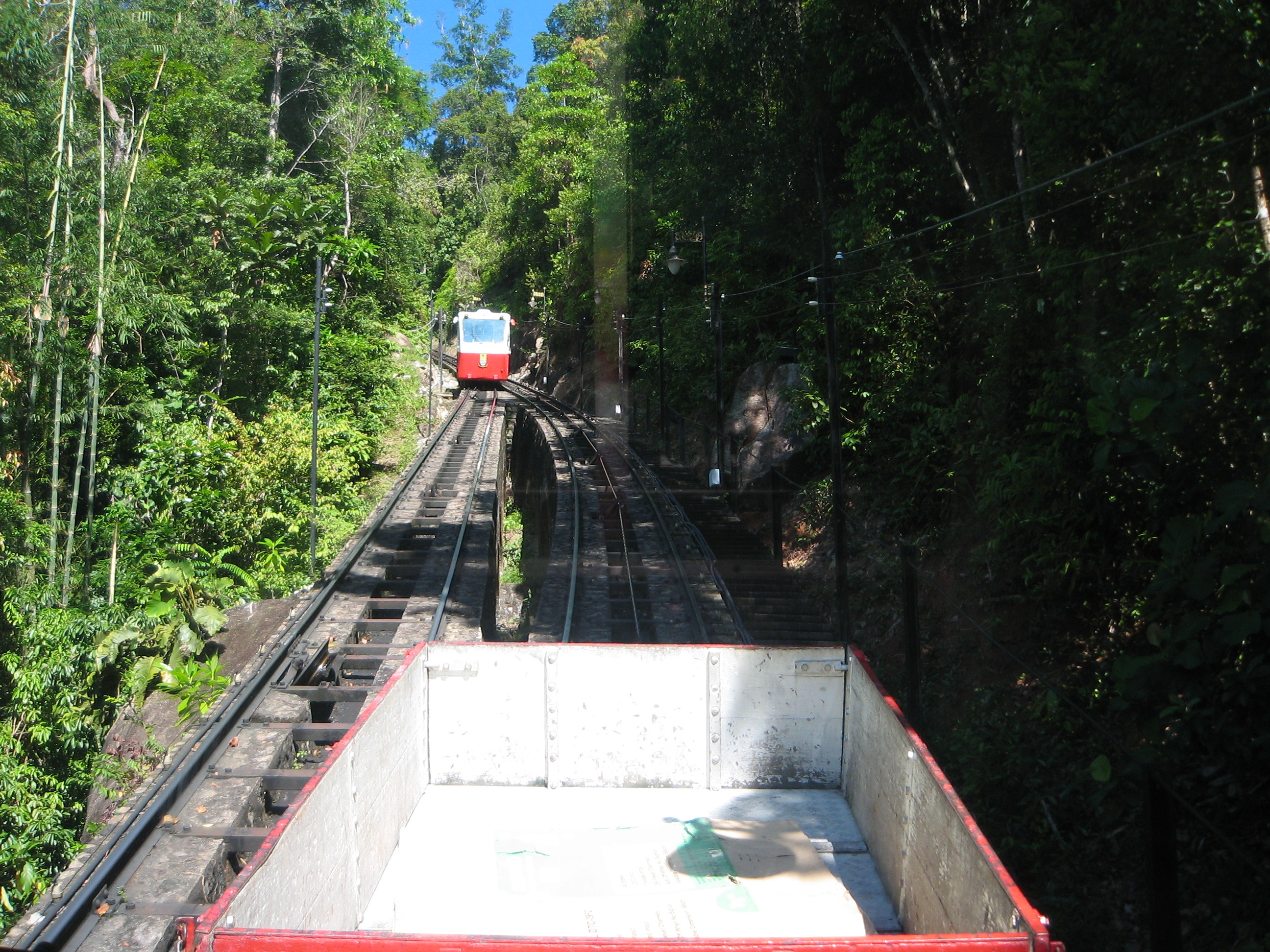
Penang Hill Railway
The first attempt was a disaster. In 1897, three British residents -- D. Logan, Joseph Heim, and Alan Wilson -- formed a company to build a mountain railway up Penang Hill, using a conventional steam engine on tracks laid between 1901 and 1905. It never worked. The gradients were too steep, the technology was wrong, and the whole enterprise was quietly abandoned. What makes this failure interesting is what it tells you about how badly the colonial community wanted to escape the lowland heat. Penang Hill sits 830 meters above sea level, and in the days before air conditioning, that altitude meant the difference between enduring the equatorial climate and briefly escaping it.
Getting the Engineering Right
The second attempt chose the correct technology: a funicular. In 1909, the Straits government organized a new project, and after a trial period, the Penang Hills Funicular Railway officially opened on 1 January 1924, inaugurated by Sir L.N. Guillemard, Governor of the Straits Settlements. The engineering challenge was considerable. The difference in gradient between the lower and upper portions of the hill meant that a single continuous track was impractical, so the railway was built as two independent sections with a transfer station in the middle. Passengers rode up the lower section -- 907 meters long, climbing 319 meters at grades up to 50.5 percent -- then stepped off and boarded a second car for the upper section, which covered 1,313 meters and rose another 367 meters at grades reaching 51.3 percent. Each section had two counterbalanced cars and a passing loop. The George Town municipality managed the railway from its opening until February 1, 1977, when the Penang state government took over.
Wooden Seats to Swiss Steel
The original 1923 carriages were wooden, with first and second class compartments -- a distinction that reflected the colonial social order as much as any engineering requirement. Those wooden cars served for over fifty years before being retired in 1977 and replaced with red Swiss-made carriages equipped with fans and automatic sliding doors. Each red car could hold up to 80 passengers, most of them standing, swaying gently as the car climbed through forest and tunnel. They became the iconic image of Penang Hill for a generation of visitors. By the late 2000s, however, the system was showing its age. Breakdowns became frequent enough that a complete overhaul was finally approved.
Five Minutes to the Top
On 22 February 2010, the 87-year-old funicular closed for a transformation that cost 63 million Malaysian ringgit. When it reopened, nearly everything had changed. New tracks were laid. New Swiss-made cars -- air-conditioned, painted blue and white, capable of carrying 100 passengers each -- replaced the old red ones. Most significantly, the two-section system was re-engineered into a single continuous run. Passengers no longer changed trains at the middle station. The new cars reach the summit in as little as five minutes, passing through a tunnel that holds the distinction of being the steepest railway tunnel in the world. Capacity jumped from 250 passengers per hour to 1,000. The timber salvaged from the old tracks was reused to build a new four-storey visitor centre at the top. The impact on ridership was dramatic: by 2014, the railway carried 1.365 million passengers, more than double the roughly half million who visited Penang Hill in 2008. By 2018, ridership had climbed to 1.74 million.
Stations Along the Ascent
The ride begins at the Lower Station in Air Itam, rebuilt with a retractable-roof building and a multi-storey car park. From there, the track passes through a series of intermediate stops -- Claremont, Viaduct, and the Lower and Upper Tunnel stations -- though since the 2010 upgrade the train normally proceeds directly to the summit without pausing. The Middle Station, roughly halfway up, is open only to residents of the hill. Stops at other stations can be arranged with the driver. At the top, the Upper Station opens onto the Skywalk, an extended viewing platform that looks out over George Town, the Penang Strait, and the Malay Peninsula mainland beyond. A food court, cafe, museum gallery, and elevator complete the summit facilities. Malaysian citizens pay 12 ringgit for a return ticket; international visitors pay 30. Disabled visitors ride free.
Congestion and the Cable Car Question
Success has created its own problem. With nearly 1.74 million riders by 2018, the railway that was designed to relieve colonial heat now generates modern congestion. Queue times can stretch past an hour during peak periods and holidays. In 2019, the Malaysian federal government announced a proposed cable car system linking the summit of Penang Hill with the Penang Botanic Gardens, intended to reduce the overdependence on the single funicular line. The proposal reflects a familiar tension in heritage tourism: how to preserve the character of a century-old experience while accommodating demand that the original builders could never have imagined. For now, the funicular remains the primary way up -- a five-minute ride through forest and tunnel that compresses a century of engineering ambition into a single, steep ascent.
From the Air
The Penang Hill Railway runs up the western face of Penang Hill at approximately 5.42N, 100.27E. From the air, Penang Hill is the dominant elevated feature on Penang Island, rising 830 meters above the surrounding lowlands. The funicular track is not easily visible through the forest canopy, but the cleared summit area with the Upper Station and Skywalk is identifiable. Penang International Airport (WMKP) lies about 16 kilometers to the south. The George Town waterfront is visible to the northeast. Best viewed when approaching from the west over the Andaman Sea, where the hill's profile stands out against the strait.