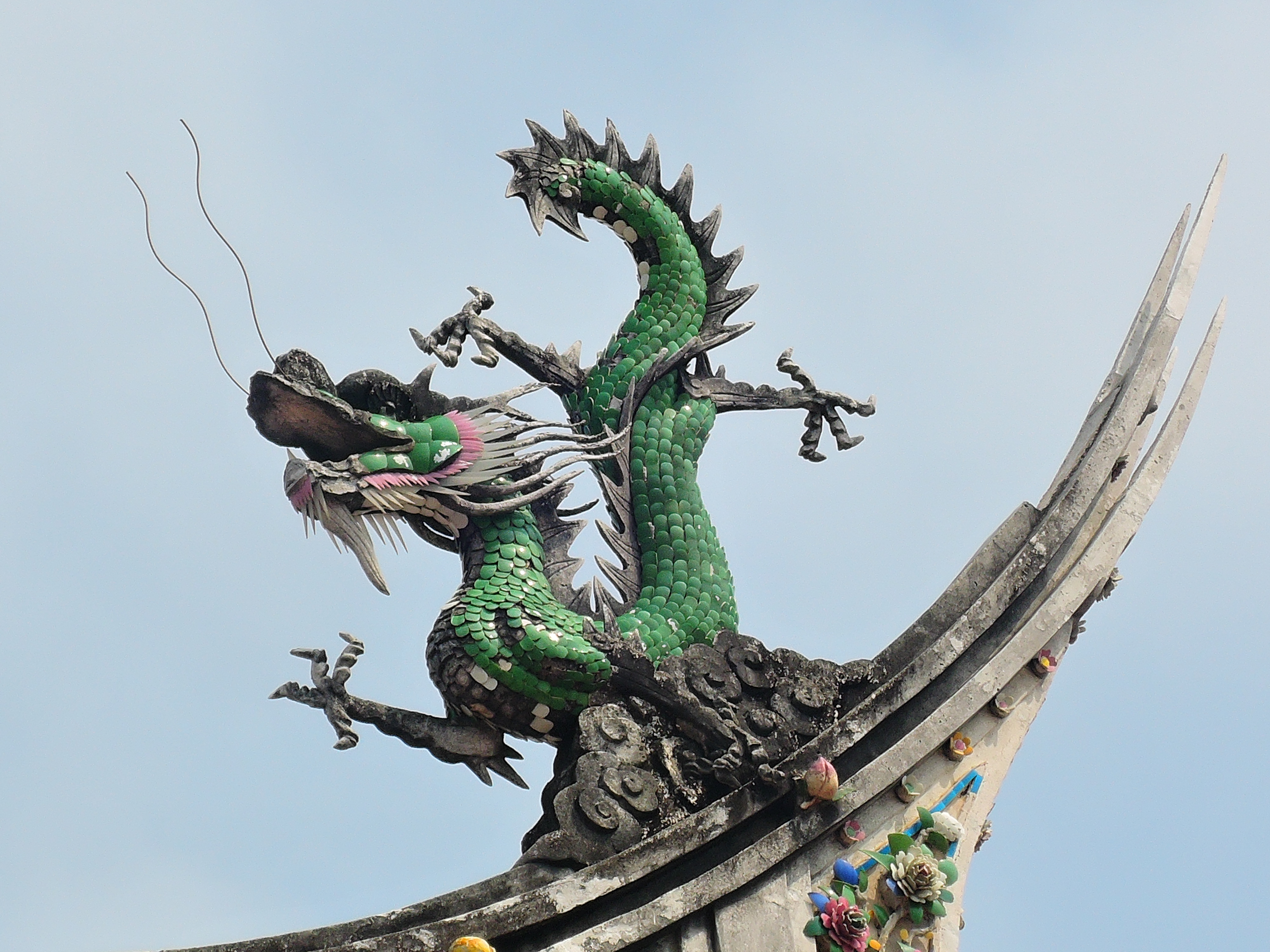
Penghu Tianhou Temple
The main idol of Mazu inside Penghu's Tianhou Temple is said to be more than 700 years old -- a single piece of solid wood weighing roughly 150 kilograms, dark with centuries of incense smoke. The figure presides over what is usually considered the oldest Mazu temple in Taiwan, a claim that places this windswept island shrine at the very origin of the sea goddess worship that would spread to hundreds of temples across the island and around the world. The city that grew up around it even took its name from the temple: Magong derives from Mazu-gong, the Palace of Mazu, though the characters have shifted over the centuries.
Before There Was Taiwan
The temple's origins are contested, with construction credited to Hoklo settlers in either 1593 or 1604. What is certain is that by the early 17th century, the shrine was already a landmark on the Penghu Islands, which served as a waystation for fishermen and traders crossing the Taiwan Strait. Its original name was the Niangma Temple -- the Temple of the Honorable Mother. After rebuilding in the 16th century, it was renamed the Tianfei Temple, the Temple of the Princess of Heaven. The current name, which translates as the Palace of the Queen of Heaven, followed Mazu's elevation in status by the Qing dynasty. Each renaming tracked the goddess's rising rank in the imperial celestial bureaucracy, a spiritual promotion system that mirrored the earthly court.
The Stone That Remembered
In 1919, workers at the temple discovered a stone stele dating to 1604. The inscription records an ultimatum delivered by Ming general Shen You-rong to the Dutch commander Wijbrant van Warwijck, demanding that the Dutch abandon the Penghu Islands. (A later general, Yu Zigao -- son of the Ming commander Yu Dayou -- separately forced the Dutch from Penghu in 1624, but that episode is distinct from this 1604 stele.) It is one of the earliest documented confrontations between Chinese and European powers over Taiwan, and the stele's survival inside a Mazu temple -- rather than a government archive or military fort -- speaks to the way sacred and political authority overlapped in the Penghu Islands. The temple was not merely a place of worship; it was a center of community power where territorial claims were literally set in stone.
Dragons in Wood and Clay
The temple complex rises on a hillside slope in three tiers -- a front temple, main temple, and back temple -- flanked by rows of auxiliary buildings called guarding dragons. The front temple, also known as the Shanchuan Temple, features a high, sweeping swallowtail roof characteristic of important Taiwanese religious architecture. Inside, the craftsmanship is dense and deliberate. Wood carvings in the Chaozhou style fill every surface. Three dragons encircle the name plaque above the entrance. The main hall's door panels carry swastika motifs -- an ancient Buddhist symbol of eternal prosperity, not the 20th-century appropriation -- alongside flowers and birds representing wealth and happiness. Column bases are carved as lions and paired rabbits. Even the roof decorations tell stories: clay carp leap through sculpted waves, and four-fingered dragons coil above scenes from Chinese folklore, including the Legend of the White Snake.
A Temple That Named a City
The relationship between the Tianhou Temple and Magong is not merely historical -- it is etymological. The city's name derives from the temple's common title, Mazu-gong, compressed and romanized through centuries of usage into Magong. This makes the Tianhou Temple one of the rare cases where a religious site literally named the city that surrounds it, rather than the other way around. Today the temple operates daily from 7:00 am to 5:30 pm, receiving pilgrims and tourists who come to see the ancient Mazu idol, trace the Chaozhou carvings, and stand before the 1604 stele. In a modern twist, the temple became one of the Taiwanese landmarks reimagined as an anime-style character by artist Chih Yu in the project We Stay, We Live -- a reminder that Mazu worship remains a living, evolving cultural force, not a museum piece.
From the Air
Coordinates: 23.56N, 119.56E. The Tianhou Temple sits on Zhengyi Street in the heart of Magong, Penghu's main city, on a hillside that rises from front to back. The temple complex and the dense old-town streets surrounding it are visible from low altitude on the southeastern shore of Magong harbor. Nearest airport: Penghu Airport (RCQC), approximately 5 km to the east. Recommended viewing altitude: 2,000-3,000 ft for old-town detail. The swallowtail roof profile is a distinctive feature when viewed from directly above.