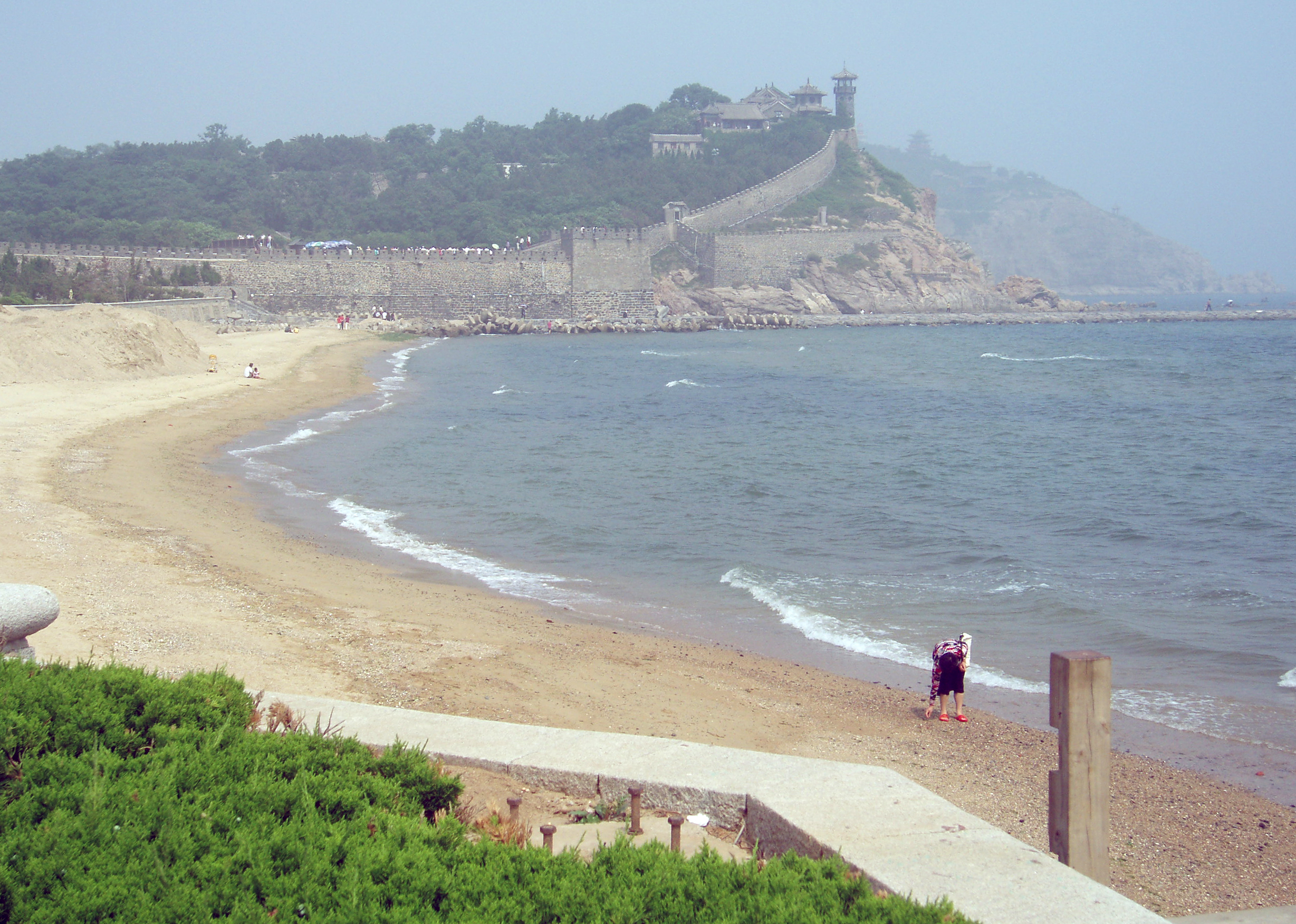
Penglai Pavilion
On certain days, when atmospheric conditions align over the strait, the sea in front of Penglai Pavilion produces mirages. Shapes hover above the water -- towers, islands, coastlines that are not there -- shimmering into existence and dissolving before anyone can be entirely sure what they saw. It is easy to understand why this spot became, in Chinese mythology, the landing place of the Eight Immortals, the point where the boundary between the earthly and the celestial seemed thinnest. The pavilion that stands here today, perched on a clifftop in Penglai, Yantai, Shandong Province, has drawn poets, generals, and warlords to write about its beauty for centuries.
Where the Yellow Sea Ends
Penglai Pavilion sits at a geographically precise spot: the dividing line between the Yellow Sea and the Bohai Sea. The boundary is marked and, on clear days, visibly different -- the waters of the two seas meet in a line of contrasting color and current. This confluence gives the pavilion a significance that goes beyond architecture. It is a place where two bodies of water, two regions, and two mythological traditions intersect. The pavilion is counted among the Four Great Towers of China, though it is occasionally dropped from the list because no single famous literary work is definitively associated with it. What it lacks in canonical poetry, however, it compensates for in sheer atmospheric drama. The mirages that appear over the strait have been documented for centuries and are caused by temperature inversions that bend light across the water, creating the illusion of floating cities.
Poets and Warlords at the Same Railing
The pavilion's visitor list spans the spectrum of Chinese history. Su Shi, the great Song dynasty poet, wrote about it. Qi Jiguang, the Ming dynasty general who defended China's coast against Japanese pirates, composed verses here. And Zhang Zongchang, a warlord of the early Republican era whose poetry was famously profane and unpolished, also left lines about the view. That such different people -- a refined literary genius, a martial hero, and a barely literate strongman -- all felt compelled to write about the same place says something about Penglai's hold on the Chinese imagination. The pavilion is part of a larger complex that includes the Dengzhou water fort, a coastal defense installation that reminds visitors this was not merely a scenic overlook but a strategic position.
Eight Immortals and a AAAAA Rating
In Chinese mythology, Penglai is one of the legendary islands of the immortals, a place of eternal youth floating somewhere in the eastern sea. The Eight Immortals -- among the most popular figures in Chinese folk religion -- are said to have gathered here before their famous crossing of the sea. An adjacent theme park, Eight Immortals Park, makes the connection explicit. The China National Tourism Administration has classified the Penglai tourism area as a AAAAA scenic spot, the highest rating in the Chinese tourism system. The designation brings both prestige and crowds, but the pavilion's real power is quieter. Stand at the railing on a hazy morning, when the mirages begin to form, and the boundary between what is real and what is imagined becomes as blurred as the line between the two seas below.
From the Air
Located at 37.83N, 120.75E on the northern coast of the Shandong Peninsula in Penglai, Yantai. The pavilion complex sits on a prominent clifftop overlooking the Bohai Strait, visible from low altitude. The dividing line between the Yellow Sea and Bohai Sea may be visible as a color difference in the water. Nearest airport: Yantai Penglai International Airport (ZSYT), approximately 15 km east. Best viewed at 2,000-4,000 ft for coastal detail.