Penglipuran
The name itself carries a warning that nobody heeded. Penglipuran may derive from pelipur, meaning "consolation," and lipur, meaning "unhappiness" -- a place where the kings of Bangli once came to find peace. Today, 3,500 visitors arrive on busy days in August, filing down the village's central stone walkway past identical traditional gates, photographing each angkul-angkul as though it were a museum exhibit. In a sense, it is. Researchers Hendrawan and Susanti delivered a blunt verdict in 2019: "When protecting the culture is the main purpose in a tourism village, this is called human museum." The question hanging over Penglipuran is whether a living village can survive being loved this much.
The Philosophy in the Walls
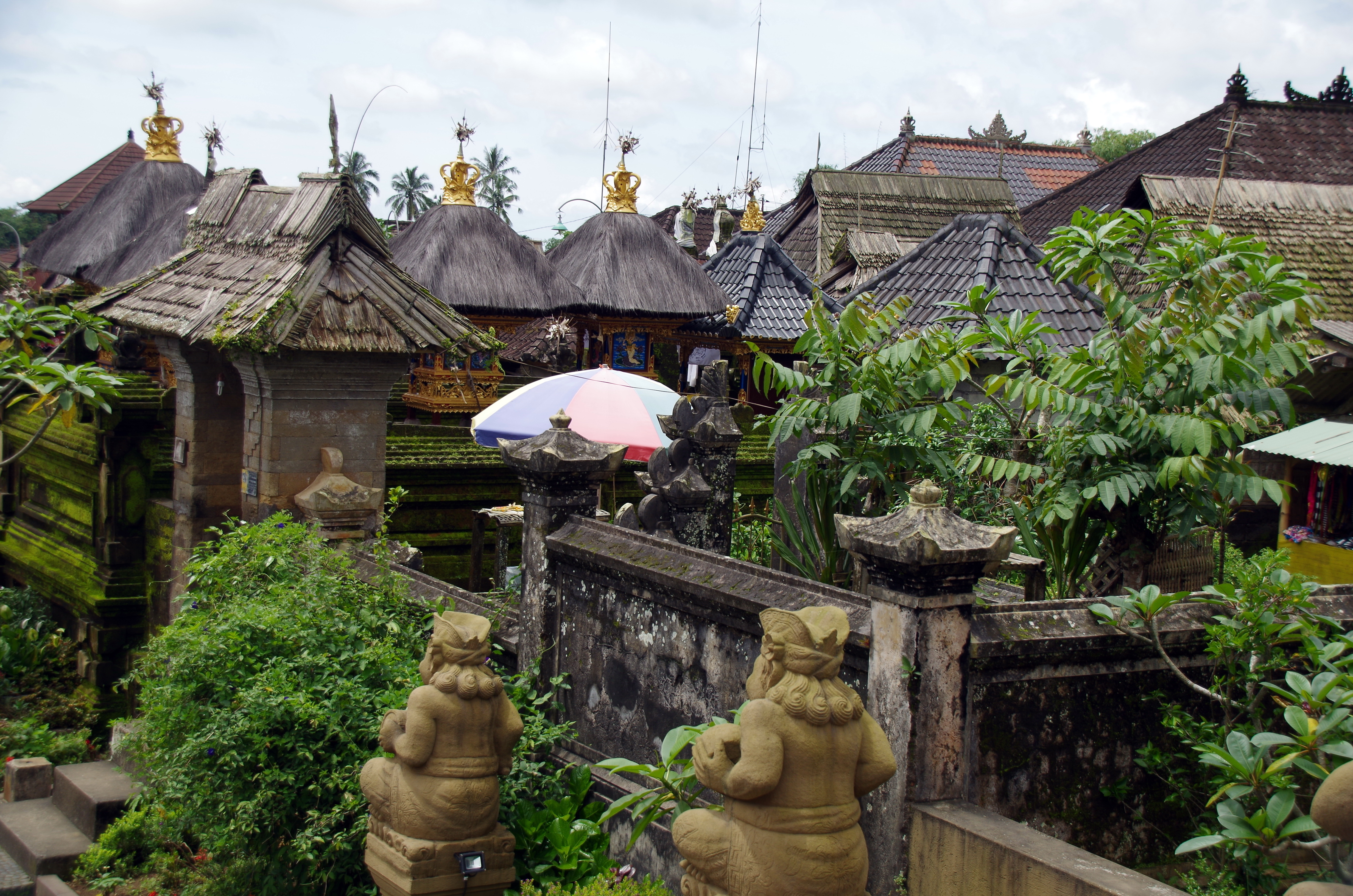
Every house in Penglipuran follows the Tri Mandala philosophy, a spatial ordering that maps cosmic principles onto domestic architecture. The sanggah, the sacral space, occupies the eastern utama mandala. The kitchen and ceremonial pavilion sit in the middle madya mandala. The bedroom lies to the west, in the nista mandala, and behind it all is the teba -- an open yard with trees and a cattle pen. This is not decoration. It is cosmology made concrete, a blueprint for living in balance with the divine, the human, and the natural world. The broader principle governing everything is Tri Hita Karana: harmony among God, people, and environment. In 1995, the Indonesian government awarded Penglipuran the Kalpataru prize for environmental stewardship, specifically for protecting the bamboo forest that surrounds the village like a green wall.
Written and Unwritten Law
What holds Penglipuran together is not charm but governance. Residents live by two codes: Awig, the written rules, and Drestha, the unwritten customs passed between generations. Together, these form a legal and moral framework that governs everything from building materials to marriage rituals. The village sits five kilometers north of Bangli town and forty-five kilometers northeast of Denpasar, at an altitude of 500 to 600 meters where temperatures range from a cool 16 degrees to 29 degrees Celsius. Its 112 hectares include the residential compound, agricultural land, and the sacred bamboo forest. The settlement is believed to date to the reign of I Dewa Gede Putu Tangkeban III, and the name Penglipuran may also derive from pengeling-pura -- "remembering the ancestral temple." Either etymology points to the same truth: this is a place defined by what it refuses to forget.
The Tourism Tide
The numbers tell a story of exponential pressure. In 2012, Penglipuran received 32,668 visitors. By 2014, that figure had nearly doubled to 64,692. By August 2023, daily visitor counts reached 3,500. During Galungan and Kuningan festivals, the demand intensifies further. These are the days when the village is at its most visually spectacular -- rows of penjor, tall decorative bamboo poles, line the main street, and young women in traditional dress carry towering banten, trays of offerings, from their homes to the temple. The spectacle draws crowds. But the crowds reshape the spectacle. What began as sacred practice now performs double duty as tourist attraction, and the line between ritual and exhibition grows harder to locate.
Concrete Where Mud Once Was
The erosion is measured in building materials. The angkul-angkul, the traditional entrance gates, were once built from packed mud. Now they are made of natural stone, brick, and concrete block with plaster finishing -- because these materials "look new," are easier to source, and faster to build with. Bamboo roof tiles give way to asbestos sheeting, chosen because it appears more modern and practical. Ceramic tiles replace earthen floors. The telajakan, the sacred garden space before each house entrance where ceremonial plants once grew, is increasingly planted with colorful ornamentals and converted into the frontage for souvenir shops. Inside the homes, the teba -- that open backyard space essential to the Tri Mandala layout -- shrinks as families add rooms for homestay guests. The architecture that draws the tourists is gradually being replaced by the architecture of tourism itself.
The Forest and the Future
The bamboo forest remains Penglipuran's most tangible link to its founding principles. It is a sacred place, integral to the ecosystem the village was built to protect. But pedestrian tracks and an asphalt road now cut through it to accommodate visitor access. The rurung gede, the village's communal open spaces of bare earth, have been paved with stones that prevent proper rainwater drainage. Each change is small. Each is practical. And each moves the village incrementally away from the Tri Hita Karana philosophy it claims to embody. The paradox is not subtle: the culture that tourists pay to see requires an environment that tourism degrades. Penglipuran has not yet resolved this tension. Whether it can -- whether any village can preserve a living culture under the weight of global curiosity -- may be the most important question facing heritage tourism in Southeast Asia.
From the Air
Penglipuran (8.42S, 115.36E) sits at 500-600 meters elevation in Bali's central highlands, roughly 45 km northeast of Denpasar. The village is not easily distinguished from altitude, but the surrounding bamboo forest creates a distinctive green canopy amid terraced agricultural land. The nearest major airport is Ngurah Rai International (WADD/DPS) approximately 55 km to the southwest. Mount Agung dominates the eastern skyline; Mount Batur lies to the northwest. Look for the orderly north-south alignment of the village layout, characteristic of traditional Balinese planning.