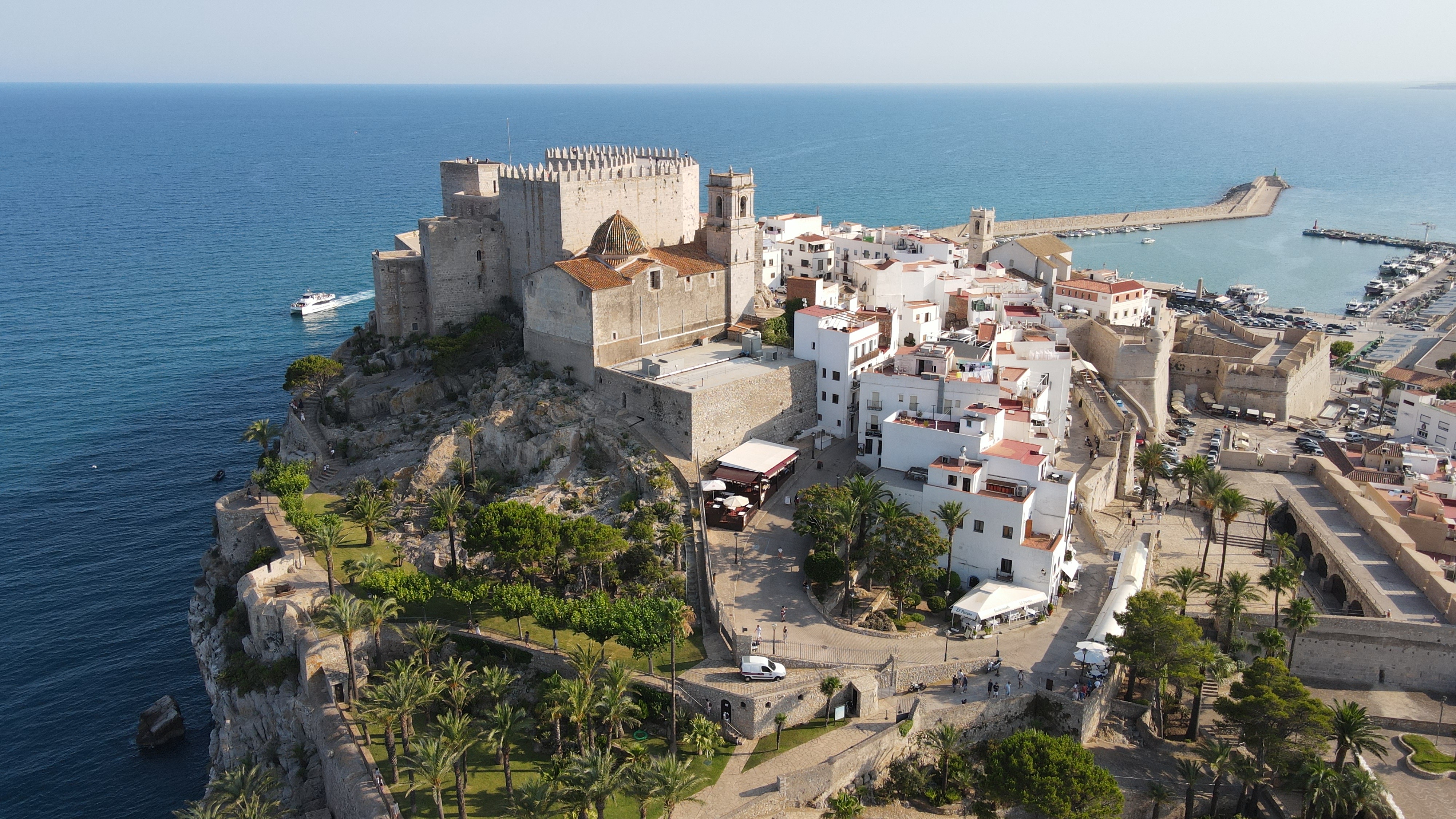
Peniscola Castle
The Knights Templar built many fortresses, but few so dramatic as the one perched on a rocky promontory 64 meters above the Mediterranean at Peniscola. Completed in 1307, the castle was designed as the centerpiece of a Templar kingdom that never came to be. Instead, it found a stranger destiny: a century later, it became the last refuge of a pope whom Rome refused to recognize, a man who clung to his claim over Christendom from this wind-battered cliff on the coast of Castellon.
The Templars' Ambition
When the Knights Templar arrived at Peniscola, they found Muslim fortifications crowning the headland. They demolished every stone and rebuilt from scratch, finishing in 1307. The result was a fortress designed around an inner ward with a chapel at its heart, as was typical of Templar strongholds. Barrel vaulting and round arches gave the interior a solemn, almost monastic weight. The Templars envisioned Peniscola as the center of their own kingdom on the Valencian coast, but the order's dissolution in 1312 ended that dream before it could take root. The basic Templar core of the castle remains intact today, its massive stone walls still speaking of ambitions that outgrew the order that conceived them.
A Pope on the Edge of the World
In the early 15th century, the castle gained its most colorful resident. Antipope Benedict XIII, the last of the Avignon line of claimants to the papal throne, retreated to Peniscola after being deposed by the Council of Constance. He modified the fortress for use as a papal residence, and from this isolated headland he continued to insist he was the rightful pope. The Mediterranean stretched before him in every direction but one, and behind him lay a narrow neck of land connecting the rocky outcrop to the mainland. It was a fitting home for a man whose stubbornness was legendary -- Benedict refused to abdicate until his death, making Peniscola a kind of alternative Vatican perched above the waves.
Centuries Under Siege
After Benedict's era, the castle's story became one of military reinvention. From the early 16th century, its defenses were overhauled to keep pace with the age of gunpowder. The Italian military engineer Giovanni Battista Antonelli redesigned the fortifications, transforming what had been a medieval stronghold into a fortress fit for cannon warfare. The castle saw action during the conflicts of the Kingdom of Aragon, then endured the War of the Spanish Succession in the early 18th century and the Peninsula War of the early 19th century. Each conflict left its mark on the walls, each generation of defenders adapting the stone to new kinds of violence. The garrison was not disbanded until 1890, making Peniscola a working military installation for nearly six centuries.
The View from the Crag
Today the castle stands restored and open to the public, its Templar bones still visible beneath the layers of later modification. Walking through the barrel-vaulted corridors, visitors trace the same paths that Templar knights, a stubborn antipope, and generations of Spanish soldiers once walked. The setting remains the castle's greatest asset. The crag juts into the sea like the prow of a ship, the town of Peniscola cascading down the hillside in a tumble of white-walled houses and terracotta roofs. From above, the narrow isthmus connecting the headland to the coast is clearly visible, a fragile thread linking fortress to mainland -- a geography that made this place defensible for seven hundred years.
From the Air
Located at 40.36N, 0.41E on Spain's Valencian coast. The castle sits on a dramatic rocky promontory jutting into the Mediterranean, clearly visible from the air. Best viewed at 2,000-3,000 feet. The nearest airport is Castellon-Costa Azahar (LECH), approximately 60 km to the south. The white-walled town and the narrow isthmus connecting the headland to the mainland are excellent visual references.