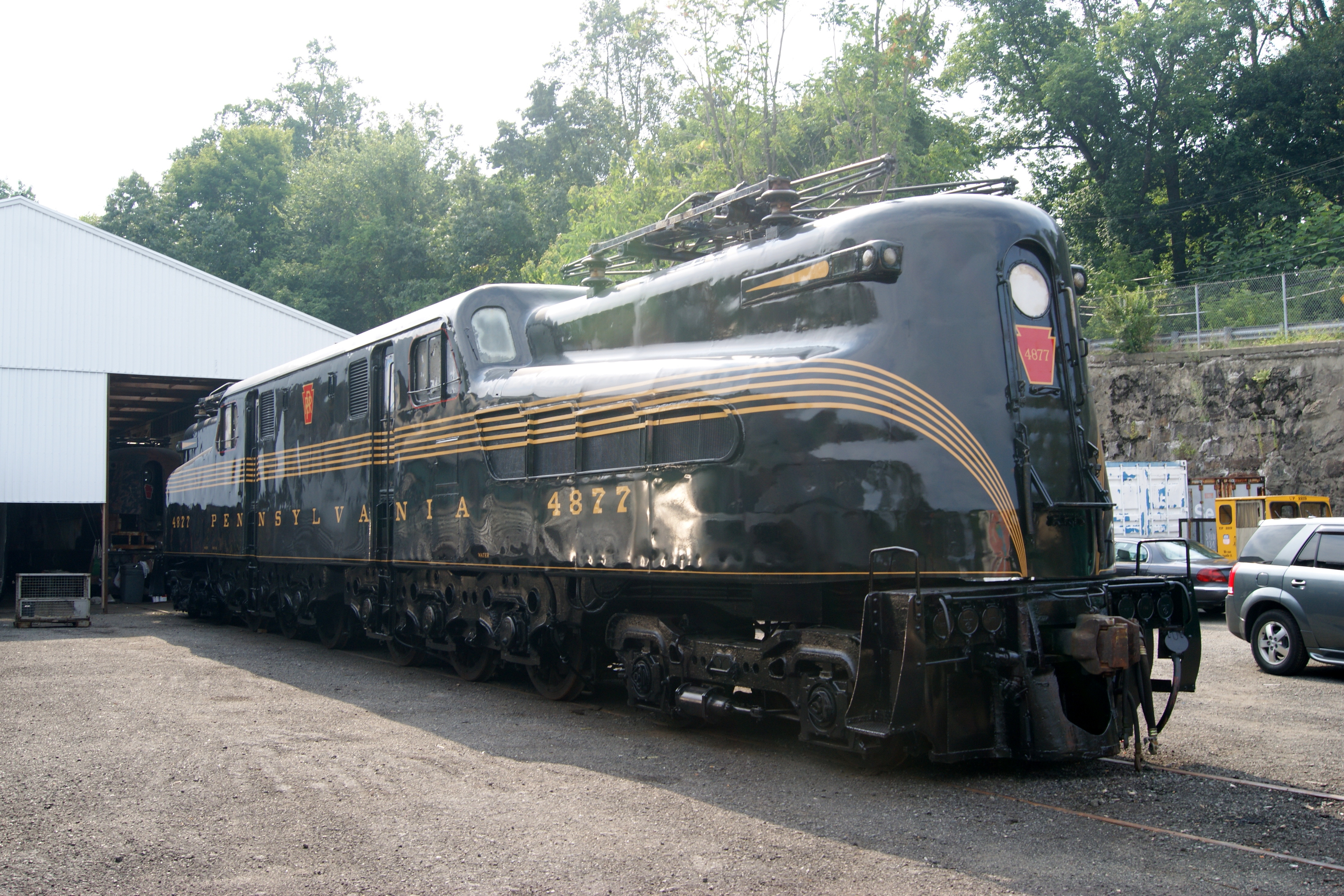
Pennsylvania Railroad 4877
Her engineer wrote a song about her. They called her "Ol' Big Red," and when the cameras rolled for a 1983 documentary about the final runs of New Jersey Transit's GG1 fleet, it was locomotive 4877 that took center stage. Built in January 1939 at the Pennsylvania Railroad's Altoona Works, she outlasted her railroad, survived two corporate mergers, wore four different paint schemes, and now sits at Boonton Yard in New Jersey -- restored to the Brunswick green livery that Raymond Loewy designed, waiting for a museum that has not yet been built.
The Machine That Loewy Made Beautiful
The GG1 was born out of necessity. By the early 1930s, the Pennsylvania Railroad needed a replacement for the P5a, its aging standard electric locomotive. General Electric developed the GG1, drawing heavily on the New Haven EP3 design. The prototype, PRR 4800, was tested against Westinghouse's competing R1 submission, and the Pennsylvania chose the GG1 -- its articulated frame and familiar traction motors won the day. An order for 57 locomotives was placed in November 1934, with first deliveries arriving in April 1935. But it was industrial designer Raymond Loewy who transformed the GG1 from a powerful machine into an icon. Loewy insisted the production bodies be welded rather than riveted, giving the locomotive its signature smooth, streamlined shell. He formulated the Brunswick green paint scheme with gold pinstripes -- the "cat's whiskers" -- that the Pennsylvania would apply to all its locomotives for the next two decades. Twelve traction motors producing a combined 4,620 horsepower pushed the GG1 to a top speed of 100 mph. It was engineering dressed in elegance.
Four Railroads, Four Lives
Number 4877 rolled out of Altoona in January 1939 and entered service on the Pennsylvania Railroad's electrified main line. For nearly three decades, she hauled passengers and freight along the Northeast Corridor. When the Pennsylvania merged with the New York Central Railroad in 1968, 4877 became Penn Central property. That marriage was famously troubled, and when Penn Central collapsed into bankruptcy, she passed to Conrail in 1976. Both Penn Central and Conrail painted her solid black -- a utilitarian scheme that erased Loewy's artistry. In the 1980s, thirteen surviving GG1s were loaned to the New Jersey Department of Transportation for commuter service on what would become New Jersey Transit's North Jersey Coast Line. In 1981, 4877 was repainted from that solid black into the Tuscan red that earned her the nickname "Big Red."
The Last Run and the Song
The GG1 fleet's final retirement date was set for October 29, 1983. Earlier that year, a documentary crew followed the last operational GG1s, and 4877 became the film's central character. Engineer Cliff Underwood, who had driven the locomotive for years, wrote a song for her -- "Ol' Big Red" -- and clips of it punctuate the documentary at intervals. The film captured the engine change at South Amboy and included extensive on-board footage, a portrait of a machine nearing the end of a half-century of service. When the documentary was released a year later as "GG1: An American Classic," it became a touchstone for railroad enthusiasts and a record of a technology that had once defined the most important rail corridor in the United States.
Brunswick Green Again
After retirement, New Jersey Transit donated 4877 to the United Railroad Historical Society of New Jersey in 1991. For years the locomotive sat in storage, her Tuscan red fading. Between 2011 and 2013, the URHS contracted Star Trak, Inc. to perform a full cosmetic restoration. The rivets were gone -- Loewy had seen to that in the 1930s -- and the welded body took the Brunswick green and gold pinstripes as smoothly as it had when new. In September 2012, the restored locomotive was displayed at a URHS open house, looking much as she had when she first left Altoona seventy-three years earlier. Today, 4877 sits at Boonton Yard, visible from the street but not regularly open to the public. She is part of a larger collection destined for the future New Jersey Transportation Heritage Center -- a museum that, when it opens, will give this locomotive and the story she carries the permanent home they deserve.
From the Air
Located at 40.637°N, 74.837°W at Boonton Yard in Boonton, New Jersey. The locomotive is stored at ground level and not visible from altitude, but the rail yard complex is identifiable from 1,500-2,000 feet AGL. Nearest airports: Morristown Municipal (MMU) approximately 8 nm east, Lincoln Park Airport (N07) approximately 5 nm northeast. The yard sits along the Montclair-Boonton Line rail corridor.