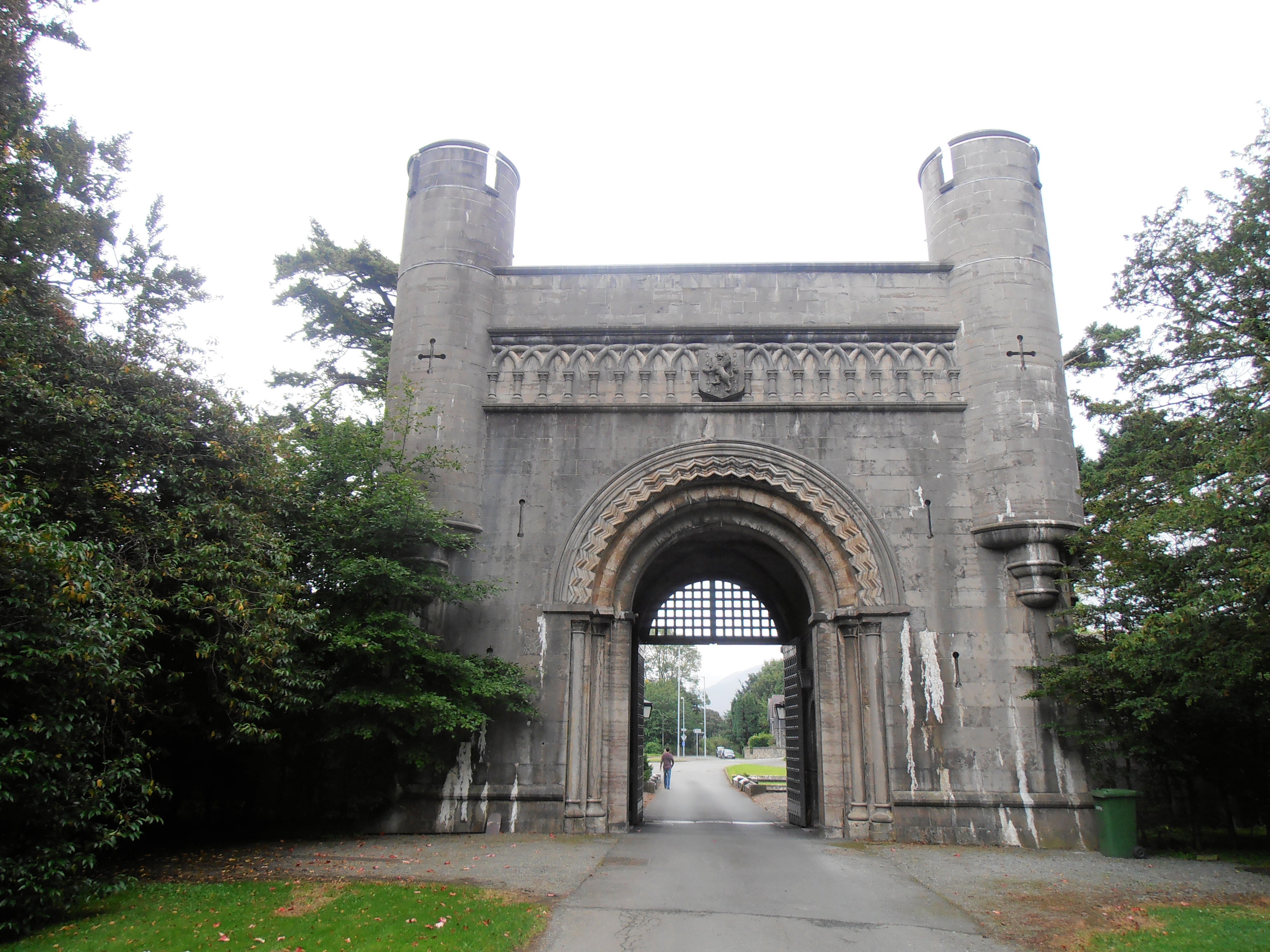
Penrhyn Castle
A visiting German prince, Hermann von Puckler-Muskau, recorded a telling detail about Penrhyn Castle in 1831. He admired the bell pulls, each fitted with a pendulum that continued vibrating for ten minutes after being rung, "to remind the sluggish of their duty." He was more struck by the sheer ambition of the place: castle building, which in William the Conqueror's time required mighty kings, was now being carried out "as a plaything" by "a simple country-gentleman, whose father very likely sold cheeses." The prince was half right. The Pennant family had not sold cheeses. They had sold sugar, grown by enslaved people on plantations in Jamaica.
Sugar, Slate, and Parliament
The fortune that built Penrhyn began in the late seventeenth century when Gifford Pennant, a former soldier, settled in Jamaica and amassed one of the island's largest estates -- four or five plantations worked by enslaved people cultivating sugar cane. His grandson, Richard Pennant, inherited the Caribbean wealth and poured it into North Wales. Recognizing the potential of industrial slate production, Richard expanded Penrhyn Quarry until it became the world's largest producer, built roads and a port at Port Penrhyn, and commissioned Samuel Wyatt to rebuild the medieval house on the estate. Elected Member of Parliament for Liverpool, Richard Pennant made over thirty speeches between 1780 and 1790 defending the slave trade against abolitionist attacks, eventually chairing the West India Committee, an alliance of some fifty MPs dedicated to opposing abolition. He was elevated to the peerage as 1st Baron Penrhyn in 1783.
Hopper's Masterpiece
The castle visitors see today is not Wyatt's work but the creation of architect Thomas Hopper, who rebuilt the house between 1822 and 1837 for Richard Pennant's cousin and heir, George Hay Dawkins-Pennant. Hopper designed one of the largest castles in Britain, a Neo-Norman structure whose cost Cadw estimates at around 150,000 pounds -- roughly fifty million in today's values. Many of the materials came from the family's own forests and quarries, and much of the labor from their industrial workforce, making the true expense difficult to quantify. The result is considered Hopper's finest work, a Grade I listed building in the Romanesque Revival style. Dawkins-Pennant, like his cousin before him, sat in Parliament and opposed emancipation, serving on the West India Committee. When the Slavery Abolition Act passed in 1833, he received significant compensation from the government.
The Great Strike
Penrhyn's story is not only about slavery abroad but about labor conflict at home. The Douglas-Pennant family, who inherited the estate in 1840, continued developing Penrhyn Quarry and were firmly opposed to trade unionism. Tensions over union recognition and workers' rights escalated into the Great Strike of 1900 to 1903, the longest industrial dispute in British history. For three years, quarrymen refused to work under conditions they considered unjust, and the community around Bethesda was torn apart. The castle was not the family's primary residence during this period -- they used it mainly as a summer home -- but its opulence stood as a visible symbol of the wealth being extracted from the labor the workers performed.
Art and Guests
Inside the castle, the Douglas-Pennants assembled an art collection of international importance, including works by Palma Vecchio and Canaletto. The paintings served a social function as well as an aesthetic one, providing an impressive setting for entertaining guests who included Queen Victoria, her son Albert Edward (the future Edward VII), and Prime Minister William Ewart Gladstone. The interiors remain largely intact, a testament to the scale on which the Victorian aristocracy lived -- and to the labor, both enslaved and waged, that made such living possible.
Reckoning
The castle passed to the National Trust in 1951 via the National Land Fund, accepted by the Treasury in lieu of death duties along with forty thousand acres of land. In the twenty-first century, the Trust has worked to explore and present the links between Penrhyn and both colonialism and slavery -- an effort that has drawn the castle into broader cultural debates about how Britain reckons with its past. The Trust's approach has been deliberate: "We are accelerating plans to reinterpret the stories of the painful and challenging histories attached to Penrhyn Castle," their website states. "This will take time as we want to ensure that changes we make are sustained and underpinned by high quality research." Penrhyn Castle does not lend itself to simple narratives. It is simultaneously one of Wales's most important buildings and a monument to the fortunes that exploitation built.
From the Air
Penrhyn Castle is located at 53.2259N, 4.0946W, in Llandygai just east of Bangor in Gwynedd. From the air, look for the large Neo-Norman castle set in extensive parkland between Bangor and the coast, with views across the Menai Strait to Anglesey. Penrhyn Quarry, one of the largest man-made holes in the world, is visible to the southeast near Bethesda. Nearest airports: Caernarfon (EGCK), RAF Valley (EGOV). Recommended altitude: 1,500-2,500 ft AGL.