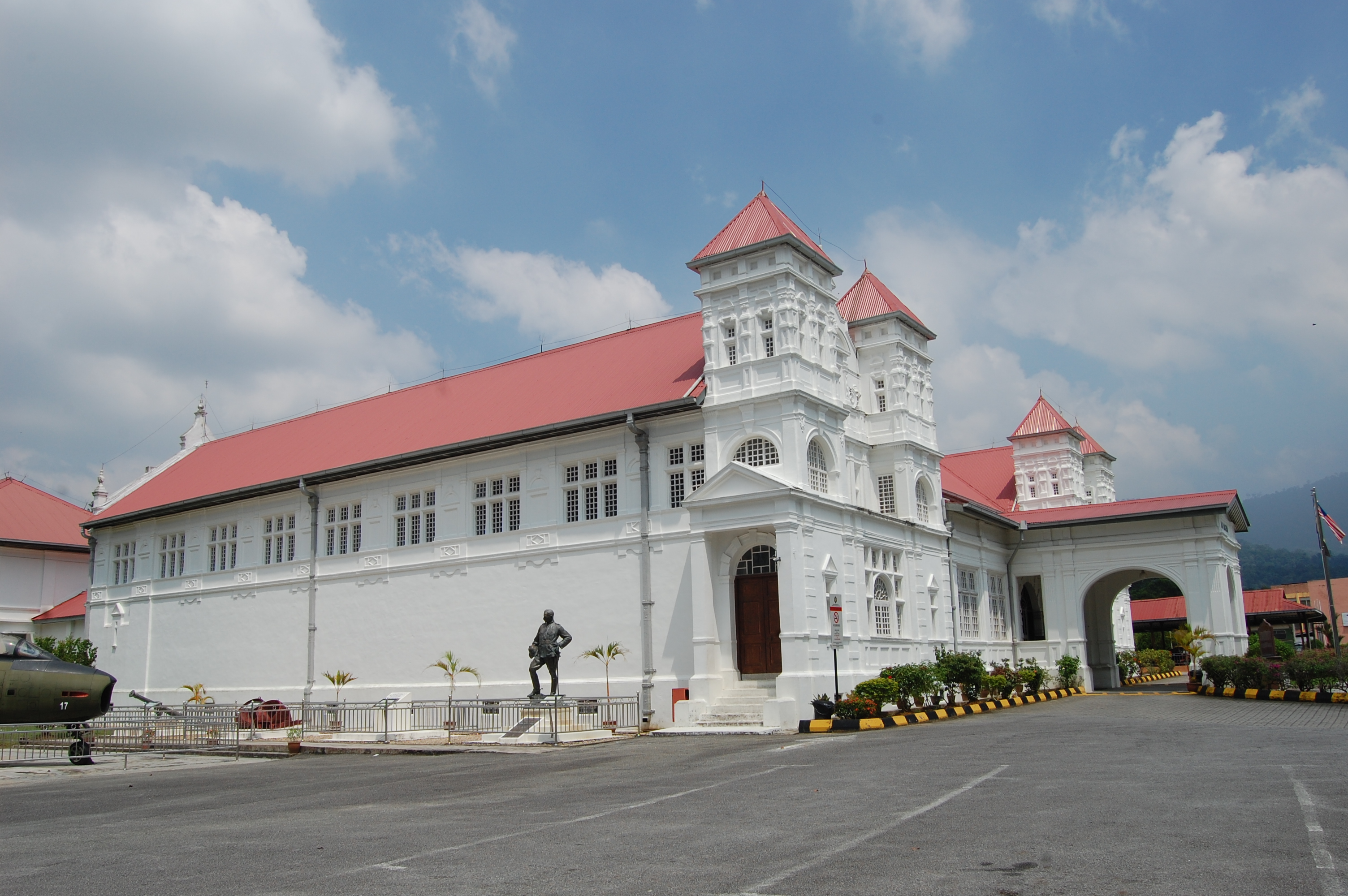
Perak Museum
Before Malaysia had a nation, it had a museum. The Perak Museum opened in 1883, making it the oldest museum in the country -- older than independence by seventy-four years, older than the federation itself. It stands at the junction of Jalan Muzium and Jalan Taming Sari in Taiping, the former capital of Perak, a town that owed its existence to tin and its refinement to the British administrators who governed it. That the colony's first museum appeared here, rather than in Penang or Singapore, says something about the particular kind of Englishman who ran Perak in the late nineteenth century: men who came to govern and stayed to collect.
The Collector on the Hill
Sir Hugh Low, the fourth British Resident of Perak from 1877 to 1889, was not a typical colonial administrator. He was a naturalist at heart, the kind of man who catalogued orchids and climbed Mount Kinabalu before most Europeans knew it existed. When he arrived in Perak, he saw a landscape teeming with specimens -- zoological, botanical, geological, ethnographic -- and no institution to house them. So he built one. The fundraising effort that created the Perak Museum was a collaboration between Low and Sir Frank Swettenham, who succeeded him as Resident and later rose to become Governor of the Straits Settlements. Together, they marshaled colonial resources and private donations to establish what Low envisioned as a center for natural history research, not merely a cabinet of curiosities.
A Building That Grew by Rooms
The museum's physical history mirrors the ambitions of its founders. Construction began in 1883, but the neoclassical main building -- comprising an office, a library, and Gallery A -- was not completed until 1886, delayed by the chronic shortage of funds that plagued even the most enthusiastic colonial projects. Extensions followed in 1889, expanding the front and back. A second exhibition hall, Gallery B, went up between 1891 and 1893. By the turn of the century, the collections had outgrown even these additions, and a two-storey wing housing Gallery C and Gallery D was constructed from 1900 to 1903. Each phase of construction tells the same story: the exhibits arrived faster than the building could accommodate them, a testament to both the richness of Perak's natural environment and the acquisitive energy of the museum's early stewards.
Leonard Wray and the Art of Looking
The museum's first curator, Leonard Wray Jr., embodied the Victorian ideal of the gentleman-scientist. A botanist and geologist by training, Wray served simultaneously as Superintendent of Government Hill at Larut -- the hill station now known as Bukit Larut -- from 1883 to 1903. His dual role meant that the man responsible for cataloguing Perak's natural specimens was also the man who walked its highland forests and knew its terrain firsthand. Under Wray's curation, the museum concentrated on the subjects closest to Sir Hugh Low's interests: ethnography, zoology, botany, and geology. The collections that Wray assembled became the foundation of a repository that documented not just the natural world of Perak but the lifeways of its indigenous peoples, the structure of its soils, and the diversity of its fauna.
Tin Money and Two Museums
The Perak Museum in Taiping should not be confused with another institution of the same name in Ipoh, the state's current capital. That second Perak Museum was erected in 1926 by Foo Choong Kit, a wealthy and successful tin miner whose fortune came from the same deposits that had built Taiping a generation earlier. The existence of two Perak Museums, one born of colonial scholarship and the other of mining wealth, captures something essential about the state: its identity was forged in the interplay between the people who dug the tin and the people who administered the digging. Taiping's museum predates Ipoh's by four decades, a reminder that before Ipoh rose to prominence, Taiping was where Perak's power and culture concentrated.
The Oldest Room in the Country
Walking through the Perak Museum today is an exercise in time travel that begins before you reach the exhibits. The neoclassical architecture, unusual for a Malaysian town of any size, announces the building's colonial origins. Inside, the galleries that Wray and his successors filled still house collections spanning natural history and cultural heritage. The museum sits in a town that has largely surrendered its former prominence to Ipoh, and that quietness works in its favor. Taiping's Lake Gardens, developed from abandoned tin mines, lie nearby, and the pace of the town allows the kind of unhurried attention that a museum founded on Victorian curiosity was designed to reward. For a building that opened in 1883, the Perak Museum has outlasted the empire that created it, the tin industry that funded it, and the political order that shaped its collections.
From the Air
Located at approximately 4.86°N, 100.75°E in Taiping, Perak, Malaysia. The museum sits at the junction of Jalan Muzium and Jalan Taming Sari in central Taiping. From the air, Taiping is identifiable by the Lake Gardens -- distinctive green spaces with ornamental lakes that were converted from old tin mines -- just south of the town center. The Bukit Larut hill range rises dramatically to the east. Nearest major airports: Sultan Azlan Shah Airport (WMBA) in Ipoh, approximately 75 km southeast; Penang International Airport (WMKP) roughly 90 km northwest. Recommended viewing altitude: 2,000-4,000 feet for detail of Taiping's colonial-era town center.