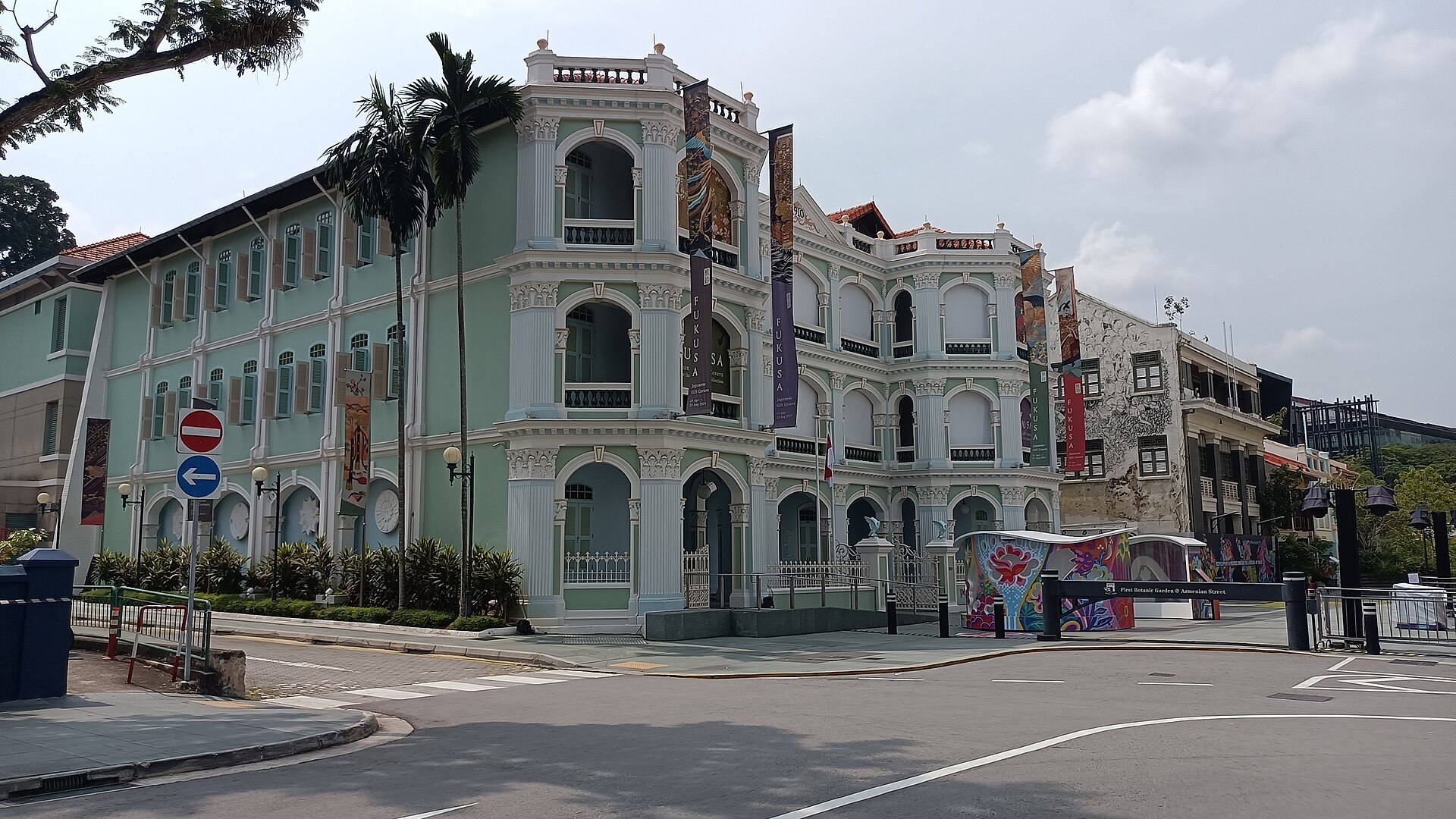
Peranakan Museum
A wedding bed sits at the heart of the Peranakan Museum, and it carries more history than most entire collections. Mrs. Quah Hong Chiam of Penang gave birth to the first seven of her eleven children on this ornately carved bed, its lacquered surfaces witnessing the continuation of a culture that had been blending Chinese and Malay traditions for centuries. That the bed ended up here, in a converted schoolhouse on Armenian Street in Singapore, says something about how the Peranakan story keeps finding new rooms to inhabit.
Children of Two Worlds
The Peranakans are descendants of Chinese immigrants who settled in the Malay Archipelago centuries ago and married into local communities. The result was neither wholly Chinese nor Malay but something distinct - a culture that wove Hokkien ancestral rites with Malay culinary traditions, that dressed in kebayas and batik while observing Confucian family hierarchies. In Singapore, Malacca, and Penang, Peranakan communities developed their own dialect, their own cuisine, their own aesthetic sensibility. The men were called Baba; the women, Nonya. Their homes glittered with hand-beaded slippers, intricately patterned porcelain, and carved furniture that took months to complete. Conceived in 2006 and opened on 25 April 2008, the Peranakan Museum became the only institution in the world dedicated entirely to preserving and interpreting this hybrid heritage.
A Schoolhouse Transformed
The museum occupies the Old Tao Nan School building, a structure with its own layered past. Before it held display cases and climate-controlled galleries, these rooms echoed with the voices of students at one of Singapore's earliest Chinese-medium schools. The building later served as an extension of the Asian Civilisations Museum, housing overflow artifacts. When curators recognized that the Peranakan collection deserved its own dedicated space, the schoolhouse underwent a reinvention - ten permanent galleries spread across three floors, each exploring a different dimension of Peranakan life. The museum closed for renovations in April 2019 and reopened in February 2023 after nearly four years of work, its galleries refreshed to reflect evolving scholarship on Peranakan communities across Southeast Asia.
Twelve Days of Ceremony
Walk through the second-floor galleries and you enter the elaborate choreography of a traditional Peranakan wedding - a twelve-day affair governed by rituals that no modern ceremony could replicate. The lap chai, or exchange of gifts between families, required careful negotiation over symbolic offerings. The chiu thau ceremony marked a young person's coming of age, a threshold crossed with specific prayers and dress. Visitors can see the wedding chamber recreated in full, from the embroidered hangings to the porcelain vessels, and follow an indoor wedding procession that captures the scale and precision these celebrations demanded. Every detail was codified: the colors, the foods, the sequence of blessings. To the Peranakans, a wedding was not merely a joining of two people but a performance of cultural identity, each ritual affirming who they were and where they came from.
The Nonya's Art
Gallery six belongs to the Nonyas, the women whose hands produced some of the most exquisite domestic craft in Southeast Asian history. Their beadwork - painstaking, jewel-bright, often stitched onto slippers and purses - required eyesight and patience that bordered on devotion. The Nonya kebaya, a fitted blouse worn with a sarong, became a signature garment, its lace and embroidery varying by region and generation. But the Nonyas were more than artisans. They were the primary transmitters of Peranakan culture to the next generation, teaching children the language, the recipes, the customs. Gallery nine extends this domestic world to the dining table, displaying what curators call the world's finest collection of Nonya porcelain - pieces commissioned from Chinese kilns but decorated with motifs specific to Peranakan taste, a vivid pink-and-green palette unlike anything produced for the Chinese domestic market.
Living Heritage
The final gallery, titled Conversations, does something unusual for a museum: it asks whether its own subject is still alive. Modern Peranakans speak here about what their heritage means in contemporary Singapore, where cultural identity is simultaneously celebrated and complicated by a nation that categorizes its citizens into neat racial categories. Some Peranakans cook the old recipes; others have never tasted them. Some speak Baba Malay; most do not. The museum does not resolve this tension - it presents it honestly, letting visitors hear directly from the people whose ancestors fill the display cases downstairs. It is a fitting conclusion to a museum born from the recognition that cultures this rich deserve more than a wing in someone else's building.
From the Air
Located at 1.294°N, 103.849°E on Armenian Street in Singapore's Museum Planning Area, near Fort Canning Hill. The colonial-era building sits in the civic district, identifiable from the air by the cluster of heritage structures along the Singapore River. Nearest airports: Singapore Changi Airport (WSSS) approximately 17 km east, Seletar Airport (WSSL) approximately 12 km north. Best viewed at 2,000-3,000 feet for district context.