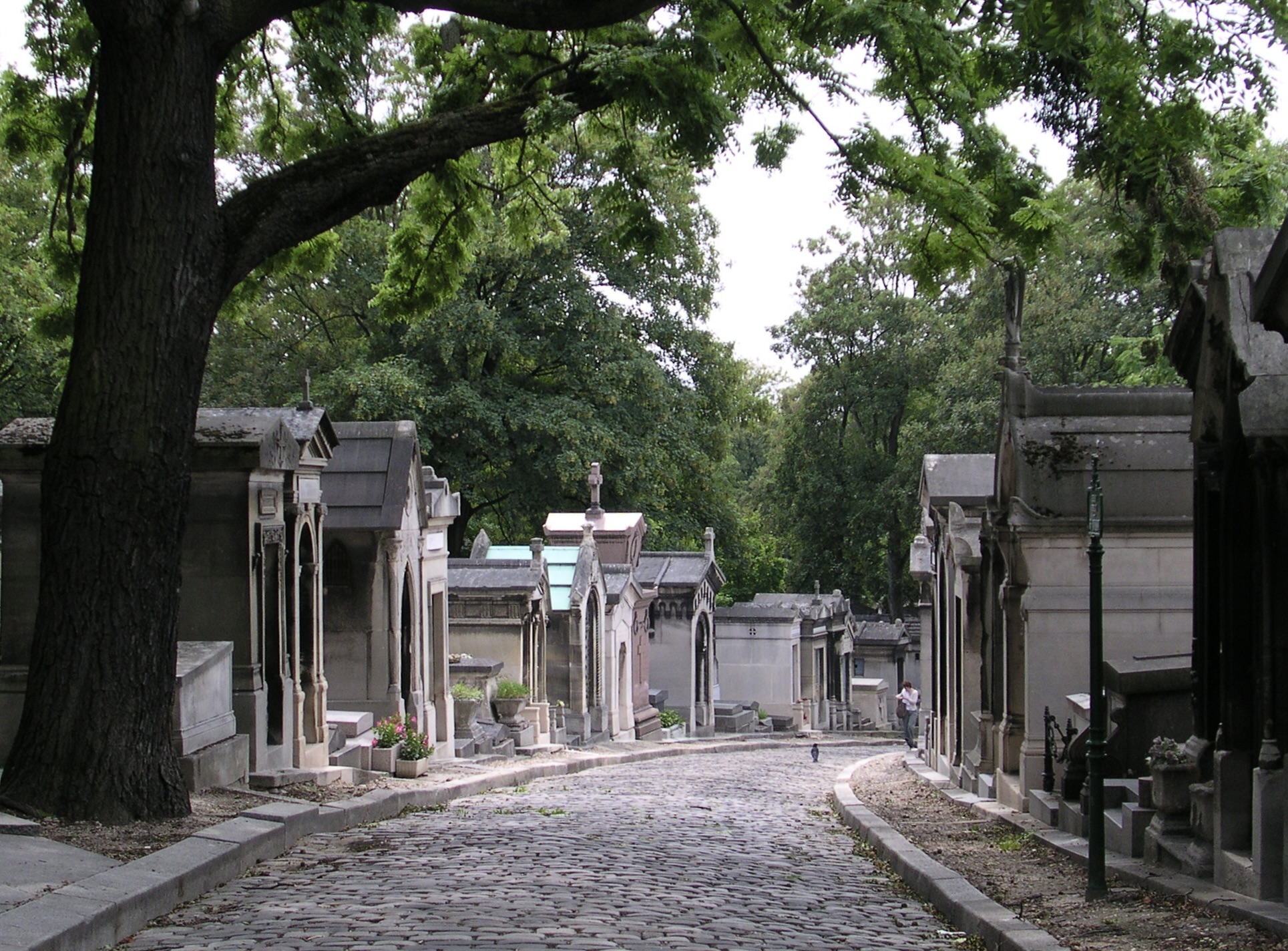
Père Lachaise Cemetery
Nobody wanted to be buried here at first. When Père Lachaise opened in 1804 on a windswept hill in what was then far-eastern Paris, Parisians considered it too remote and too unfashionable. In desperation, the city's prefect arranged for the remains of Molière and La Fontaine to be transferred here, followed by the supposed remains of the medieval lovers Héloïse and Abélard. The marketing worked. Within a few years, Père Lachaise had become the most desirable resting place in the city, and within decades, the most famous cemetery in the world. Today, more than 3.5 million visitors walk its cobbled lanes each year -- more than many of Paris's living neighborhoods attract.
The King's Confessor and Napoleon's Decree
The cemetery takes its name from Père François de la Chaise, confessor to Louis XIV, who lived in the Jesuit house on this hillside from the 1680s. The property had a longer history: Louis XIV himself watched skirmishing between rival armies during the civil wars of the Fronde from this very hilltop in the 1650s. The city of Paris purchased the land in 1804, and Napoleon -- who had been proclaimed Emperor just three days earlier -- decreed that "every citizen has the right to be buried regardless of race or religion." Landscape architect Alexandre-Théodore Brongniart designed the grounds as a garden cemetery, the first of its kind in Paris, replacing the crowded, unsanitary churchyard burials that had plagued the city for centuries. The Holy Innocents' Cemetery, whose overflowing mass graves had been a public health crisis, had been closed since 1780.
A City in Miniature
Walking Père Lachaise feels less like visiting a graveyard than like wandering a hillside village whose residents happen to be dead. The 44 hectares contain over 70,000 burial plots, many of them elaborate stone houses, Gothic chapels, and classical temples in miniature. Cobblestone paths wind uphill past ancient chestnut trees whose roots have lifted and cracked the paving. In autumn, the cemetery fills with amber light filtering through the canopy. Cats patrol the alleys. Some tombs are meticulously maintained; others have been claimed by ivy and moss, their inscriptions worn to illegibility. The cemetery was expanded five times in the 19th century to meet demand, and its winding, hilly layout gives it an organic quality that later cemeteries, designed on grids, lack entirely.
The Roll Call
The list of those buried here reads like an encyclopedia of Western culture. Frédéric Chopin lies beneath a weeping muse, his grave perpetually covered with fresh flowers. Oscar Wilde's tomb, a massive winged sphinx by sculptor Jacob Epstein, was for years smothered in lipstick kisses -- a glass barrier now protects it. Jim Morrison's modest grave draws the largest crowds, fenced off after decades of vandalism and impromptu parties. Édith Piaf, Marcel Proust, Gertrude Stein, Isadora Duncan, Honoré de Balzac, Eugène Delacroix, Sarah Bernhardt, Colette, Richard Wright, Georges Méliès -- the concentration of talent is staggering. Each grave becomes a small shrine, maintained by admirers who leave letters, photographs, and metro tickets alongside more conventional flowers.
Blood on the Hill
Père Lachaise holds darker history as well. On May 28, 1871, the last defenders of the Paris Commune made their final stand among the tombstones. Government troops cornered 147 surviving Communards against the cemetery's eastern wall and executed them on the spot. Their bodies were thrown into a common ditch at the base of the wall, which became known as the Mur des Fédérés -- the Federalists' Wall. Every year, French labor unions and leftist organizations march to this wall on the anniversary. The cemetery also contains three World War I memorials and monuments to victims of Nazi concentration camps, the French Résistance, and the genocide of Armenians, Roma, and other groups. These memorials coexist with the literary and musical shrines, layering remembrance upon remembrance.
The Living Garden
For all its famous residents, Père Lachaise is also a functioning urban ecosystem. The cemetery supports one of the richest concentrations of biodiversity in Paris -- over 250 plant species, along with populations of foxes, hedgehogs, and dozens of bird species that thrive in the old-growth trees sheltering the graves. The cemetery operates as a green lung for the densely built 20th arrondissement. Parisians jog along its paths, read on benches between tombs, and bring children to play among monuments that elsewhere would be roped off. This easy coexistence between the living and the dead is the cemetery's most Parisian quality -- a refusal to treat mortality as something to be hidden behind walls, and an insistence that a cemetery can also be a park, a forest, and a pilgrimage site all at once.
From the Air
Located at 48.8611°N, 2.3942°E in the 20th arrondissement of eastern Paris. The 44-hectare green expanse is visible from the air as a large wooded area on the eastern hillside of the city. Best viewed from 2,000-3,000 feet AGL. The main entrance is near the Philippe Auguste Métro station on Line 2. Nearest airports: Paris-Orly (LFPO) 16 km south, Paris-Le Bourget (LFPB) 10 km northeast, Paris-Charles de Gaulle (LFPG) 22 km northeast.