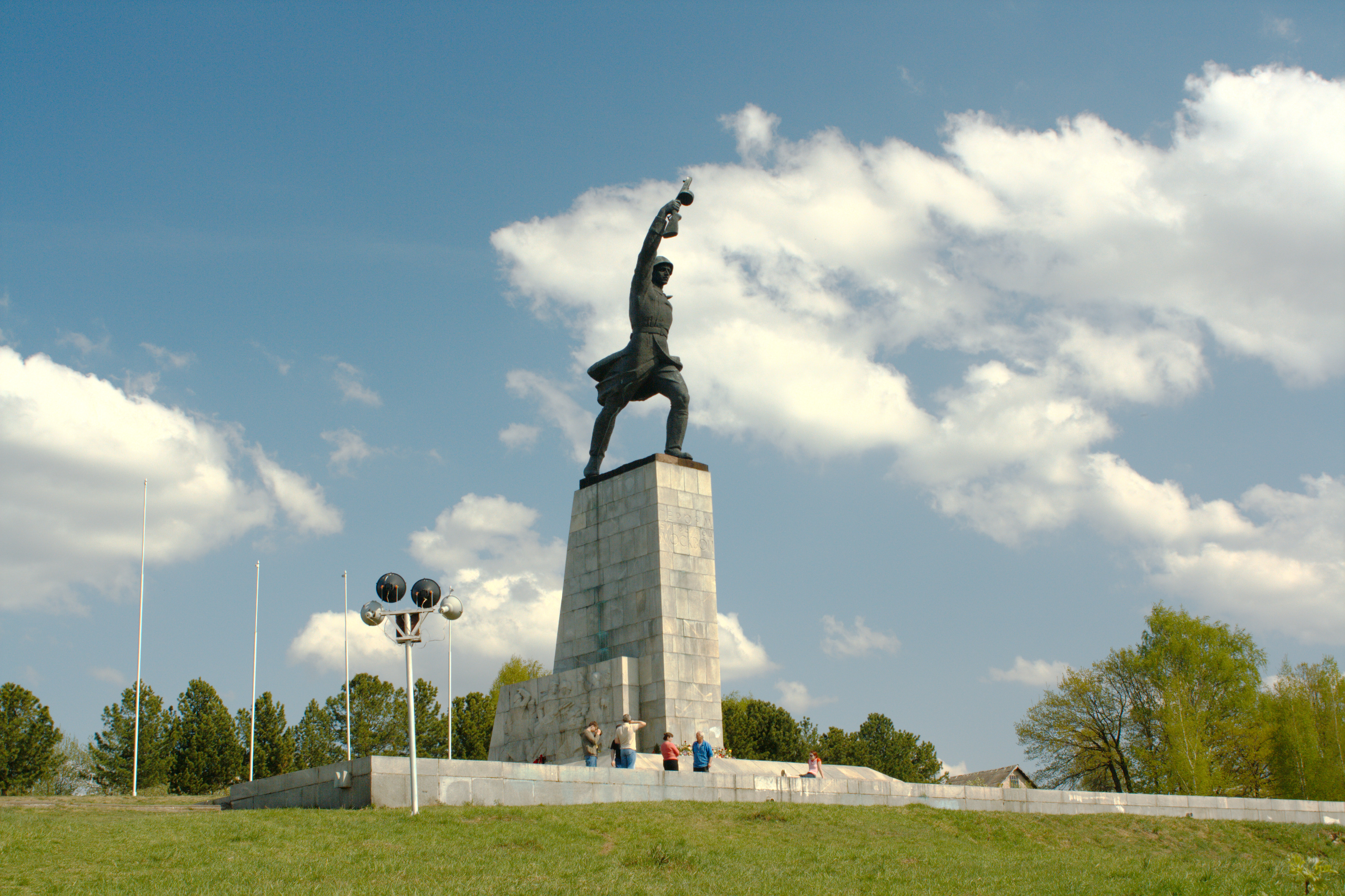
Perimilovsky Heights
The bronze soldier stands 28 meters above the ridgeline, his PPSh submachine gun raised overhead, frozen in the act of charging forward. Below him, the ground drops more than 50 meters in steep, nearly unclimbable slopes to the Moscow Canal and the town of Yakhroma. In late November 1941, this ridge was the easternmost point the Wehrmacht reached on the fronts north of Moscow. The soldiers who held it were not seasoned troops but newly drafted civilians from the towns of Sergiev Posad and Dmitrov, rushed to the front line in dark coats that stood out against the snow. Many of them died on these slopes. The counterattack that followed, launched on December 6, became the first major Soviet offensive of the war.
The Canal as a Last Line
The Moscow-Volga Canal, opened just a few years before the war, was far more than a waterway. It was a vital artery for water supply, energy, and transportation, with highways and railways running along its banks. By late November 1941, the front line had reached the canal. German aircraft flew over Dmitrov and Yakhroma as the civilian population evacuated, and those who remained dug trenches, anti-tank ditches, and barriers. On November 26-27, Wehrmacht forces approached Yakhroma and Krasnaya Polyana. To prevent the Germans from using the canal infrastructure, Soviet engineers blew up the control towers at the third and fourth canal locks, the railroad bridge between Yakhroma and Turist stations, and the Rogachevsky road bridge in Dmitrov. The bridge trusses fell into the canal bed, blocking it entirely.
An Armored Train and a Phone Call from Stalin
There were no regular military units in Dmitrov when the Germans broke through to the canal. What arrived first was NKVD armored train No. 73, dispatched from the town of Verbilki under Captain Malyshev's command. During a three-hour engagement, the armored train repulsed five German attacks, buying time that the defenders desperately needed. Lieutenant-General Vasily Kuznetsov, commander of the 1st Shock Army, was in Dmitrov when Supreme Commander Stalin called him by telephone with a blunt order: "Drive back the invaders behind the canal." The 1st Shock Army had been formally established only on November 25, assembled in frantic haste from the local population near Sergiev Posad, then called Zagorsk. By November 29, it consisted of seven rifle brigades, eleven ski battalions, an artillery regiment, and two light bomber regiments.
Black Silhouettes on White Snow
The men of the 1st Shock Army went into battle with minimal training, many still wearing civilian clothes. Their dark coats and overcoats were starkly visible against the December snow. They attacked at full height, upright and exposed, against the German 7th Panzer Division positioned at the Yakhroma bridge and the 14th Motorized Division in front of Dmitrov. The terrain of Perimilovsky Heights gave the defenders one critical advantage: the ridge rises more than 50 meters above the canal in steep slopes stretching two kilometers along its bank, providing a commanding view of the western approach. From the heights, the advancing enemy was visible in the open, exposed on the gentle western slope. From December 1 to 5, fighting continued as the 1st Shock Army and the 20th Army attacked at the junction of two German divisions. After the battles, the fields below the heights were strewn with fallen soldiers, dark shapes scattered across the white ground.
The Road That Began in Forty-One
On December 6, 1941, Soviet forces launched the Moscow counteroffensive along the entire front. Within ten days, Yakhroma was liberated, and by December 10, the entire Dmitrov district was free of German forces. It was the first significant reversal of Wehrmacht momentum in the war, a turning point whose psychological impact extended far beyond the modest territory recovered. On December 6, 1966, the 25th anniversary of the counteroffensive, the monument was unveiled atop Perimilovsky Heights: a 13-meter bronze soldier on a 15-meter granite pedestal adorned with bas-reliefs. The bronze figure was cast in Leningrad, the relief panels made in Mytishchi, the granite quarried in Ukraine and shipped to a hillside so steep that the construction machinery could barely make the ascent. One of the monument's sculptors, Alexei Postol, had himself been wounded at the front. He had wanted to build a monument to the heroes of Panfilov, but his first completed work became this soldier above the canal.
A Poet's Five Words
Visitors climbing from the Yakhroma side follow zigzag paths cut into the slope, with observation platforms offering views of the town below and the canal stretching to the north and south. Roughly a third of the way up, a granite pedestal bears a five-line poem by Robert Rozhdestvensky, commissioned at the request of Yakhroma's residents: "Remember: From this threshold, in an avalanche of blood, misery and smoke, it's where the road began in the forty-first to the victorious the forty-fifth." In May 2020, Yakhroma received the honorary title of Moscow Region "City of Military Glory." That same month, a more quietly significant change occurred: the name of General Andrey Vlasov, who had commanded forces in the area before later defecting to the Germans, was removed from the memorial's commemorative plaque. Even eighty years on, the history inscribed on these heights is still being revised.
From the Air
Located at 56.30°N, 37.50°E near the town of Yakhroma in Dmitrovsky District, Moscow Oblast, approximately 65 km north of central Moscow. The Moscow Canal is the primary visual landmark, running north-south through the terrain. The 28-meter monument atop the ridge may be visible from lower altitudes. Nearest major airport is Sheremetyevo (UUEE), approximately 50 km to the south. The terrain features the distinctive steep eastern bank of the canal contrasting with the gentle western slope. Flat to rolling terrain with mixed forest and agricultural land.