Permian Basin Petroleum Museum
Every other month or so, the staff at the Permian Basin Petroleum Museum fires up one of the race cars in the parking lot. Not to move it to storage, but to keep it alive. The museum houses seven vehicles from Chaparral Cars, the legendary Texas racing team that revolutionized motorsport aerodynamics in the 1960s, and mechanical things need to run. The fact that a petroleum museum in Midland, Texas, doubles as a shrine to ground-effect race cars makes perfect sense when you understand the Permian Basin. Oil built this region, and oil money built everything else, from universities to racing teams that won at Sebring and the Nurburgring and got banned for being too fast. The museum opened in 1975 to tell that story, and over the decades it has grown into one of the largest petroleum-focused collections in the world.
A Billion Years in the Making
The Permian Basin takes its name from the Permian geological period, roughly 299 to 252 million years ago, when this part of Texas and New Mexico lay beneath a shallow inland sea. As marine organisms died and sank into the sediment, their remains slowly transformed under heat and pressure into the hydrocarbons that would later make West Texas one of the most productive oil regions on Earth. The museum's geology exhibits walk visitors through this ancient history, explaining how prehistoric life became the black gold that fueled American industry. Display cases hold core samples, fossil specimens, and the minerals that signal the presence of petroleum deposits. It is a reminder that the oilfield roughnecks drilling outside Midland today are tapping into a resource created before dinosaurs roamed the planet.
From Boomtowns to Modern Industry
The petroleum history wing recreates the human story of oil. A full-scale replica of a 1920s town center features a company storefront, land and title office, and vintage fuel pump, evoking the era when wildcatters turned empty prairie into boomtowns overnight. Artifacts trace the industry through the decades: a Gulf Oil sign from the glory days, a Texaco pump, a nitroglycerin truck used to shoot wells. The exhibits do not shy away from the global forces that shaped the basin, including the creation of OPEC in the 1960s and its impact on American producers. Outside, the museum maintains an outdoor exhibit space with eight full-size cable-tool drilling rigs, including the Santa Rita Number 2, which helped prove the viability of West Texas production. A 1930s steel production derrick towers over the machinery, a monument to the industrial ambition that transformed the landscape.
Chaparral Cars and the Pursuit of Speed
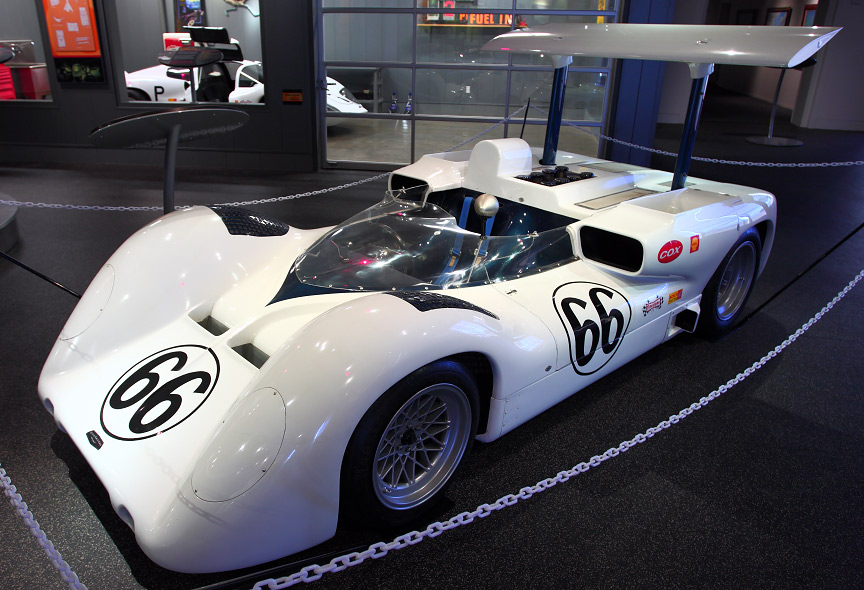
The museum's Chaparral Gallery is an unexpected treasure. In 1962, race car drivers Jim Hall and Hap Sharp founded Chaparral Cars in Midland, using oil money and engineering brilliance to build some of the most innovative vehicles in motorsport history. Their small Texas shop pioneered the use of aerodynamic wings, ground-effect designs, and even a controversial fan car that generated so much downforce it was banned after a single season. Seven Chaparral race cars sit in the museum, alongside a prototype Corvette that Hall tested for Chevrolet. The collection includes the Chaparral 2J, the legendary sucker car that terrified the 1970 Can-Am field with its qualifying speed until SCCA officials outlawed it under pressure from rival teams. The museum keeps these machines in running condition, firing them up periodically to ensure that pistons stay unseized and history stays alive.
The Basin From Above
Midland sprawls across the Permian Basin at roughly 2,800 feet elevation, a city defined by the industry beneath it. From the air, the region is a patchwork of pump jacks, tank batteries, and drilling pads stretching to the horizon in every direction. The museum sits on the western side of the city, its building and outdoor exhibit space visible as a cluster of industrial equipment distinct from the surrounding commercial development. The landscape is flat and dry, punctuated by the infrastructure of extraction. Midland International Air and Space Port lies between Midland and its twin city Odessa, handling both commercial flights and private aircraft serving the oil industry. The museum's position in this landscape is fitting: a repository of petroleum history surrounded by petroleum production, where the past and present of West Texas energy share the same view.
From the Air
The Permian Basin Petroleum Museum sits at 31.97N, 102.09W on the west side of Midland at approximately 2,800 feet MSL. The outdoor exhibit area with large drilling equipment may be visible from lower altitudes. Midland International Air and Space Port (KMAF) is roughly 8 nm southwest. The surrounding Permian Basin landscape is dominated by oil field infrastructure. Best viewed from 3,000-4,000 feet to see the museum in context with the industrial surroundings. Clear conditions typical; expect oil field helicopter traffic throughout the region.