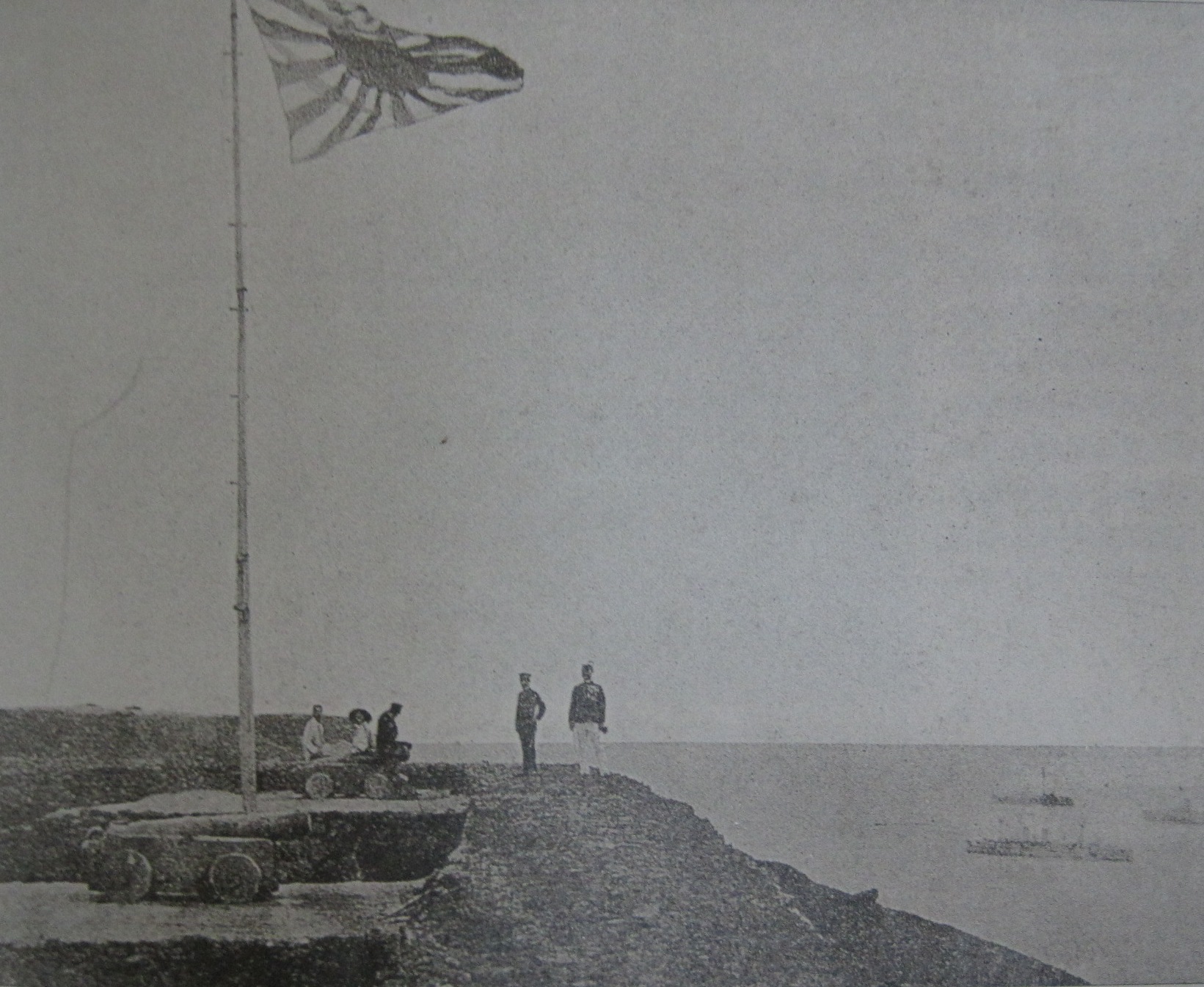
Pescadores Campaign (1895)
The peace negotiations were already underway in Shimonoseki when the troop ships sailed. On March 15, 1895, a Japanese expeditionary force of 5,500 men departed for the Pescadores Islands, exploiting a deliberate loophole: while an armistice halted fighting in northern China, Taiwan and the Pescadores had been specifically excluded from its terms. The Japanese could attack without jeopardizing the peace talks. It was a legal nicety wrapped around a military necessity -- whoever held the Pescadores controlled the Taiwan Strait, and whoever controlled the strait controlled the fate of Taiwan itself.
The Strategic Keystone
As the First Sino-Japanese War ground toward its conclusion, Japanese planners understood that the coming Treaty of Shimonoseki would cede both Taiwan and the Pescadores to Japan. But a treaty is only paper until boots hit the ground. The Pescadores archipelago sat midway between mainland China and Taiwan, making it the geographic key to the island. If Japan occupied the Pescadores first, China could send no further reinforcements across the strait, and Taiwan's defense would collapse from isolation. The Chinese understood this too. They had garrisoned the islands with 15 regular battalions -- approximately 5,000 men -- and built the Hsi-tai coastal defense battery in the late 1880s, a fortification prompted by the French capture of the Pescadores during the Sino-French War a decade earlier. On paper, the defense was formidable.
Three Days, Three Islands
The reality on the ground bore no resemblance to the defensive plans. Japanese forces landed on Pa-chau Island -- modern-day Wangan -- on the morning of March 23, meeting almost no resistance. The Chinese garrison was demoralized, and the defense crumbled with startling speed. On March 24, after a naval bombardment of the Chinese forts, Japanese troops went ashore on Fisher Island (modern-day Siyu) and Penghu Island itself. They fought several brief engagements with defending Chinese soldiers, captured the Hsi-tai battery and the port town of Makung, and in the next two days occupied the remaining major islands of the archipelago. The entire campaign lasted three days. James W. Davidson, an American war correspondent who traveled with the Japanese army and later wrote The Island of Formosa, Past and Present in 1903, documented the operation in detail, drawing on privileged access to official Japanese sources and senior officers.
The Enemy They Could Not Fight
Japanese battle casualties were minimal -- a testament to the speed of the operation and the demoralization of the Chinese defenders. But the real killing started after the fighting stopped. Within days of securing the islands, a cholera epidemic swept through the Japanese garrison. More than 1,500 soldiers died in the outbreak, a toll that dwarfed the combat losses many times over. The disease struck with the cruel irony common to 19th-century military campaigns: the men who survived the bullets succumbed to contaminated water. The cholera dead would become a grim footnote to a campaign that Japanese planners had otherwise executed with clinical efficiency.
The Treaty's Down Payment
The Pescadores campaign achieved exactly what its architects intended. With the islands secured and the strait under Japanese control, the Treaty of Shimonoseki was signed in April 1895, formally ceding Taiwan and the Pescadores to Japan. The subsequent invasion of Taiwan's main island that summer met stiffer resistance from both Qing forces and local militia, but the outcome had been decided in the strait. For the Penghu Islands, the campaign marked the beginning of fifty years of Japanese colonial rule -- a period that would transform the archipelago from a Qing military outpost into a Japanese naval base, eventually becoming the Mako Guard District that served the Imperial Japanese Navy through two more wars. The three-day battle was over quickly, but its consequences reshaped the western Pacific for half a century.
From the Air
Coordinates: 23.56N, 119.60E. The 1895 campaign played out across the Penghu archipelago in the Taiwan Strait. Key landing sites include Wangan (Pa-chau Island) to the south and Siyu (Fisher Island) to the west, with the main prize being Makung (modern Magong) on the main island. The Hsi-tai battery site is near the western coast. Nearest airport: Penghu Airport (RCQC). From cruising altitude, the full archipelago is visible as a scattered chain of low islands midway between Taiwan and mainland China. Recommended viewing altitude: 8,000-15,000 ft to see the strategic position in the strait.