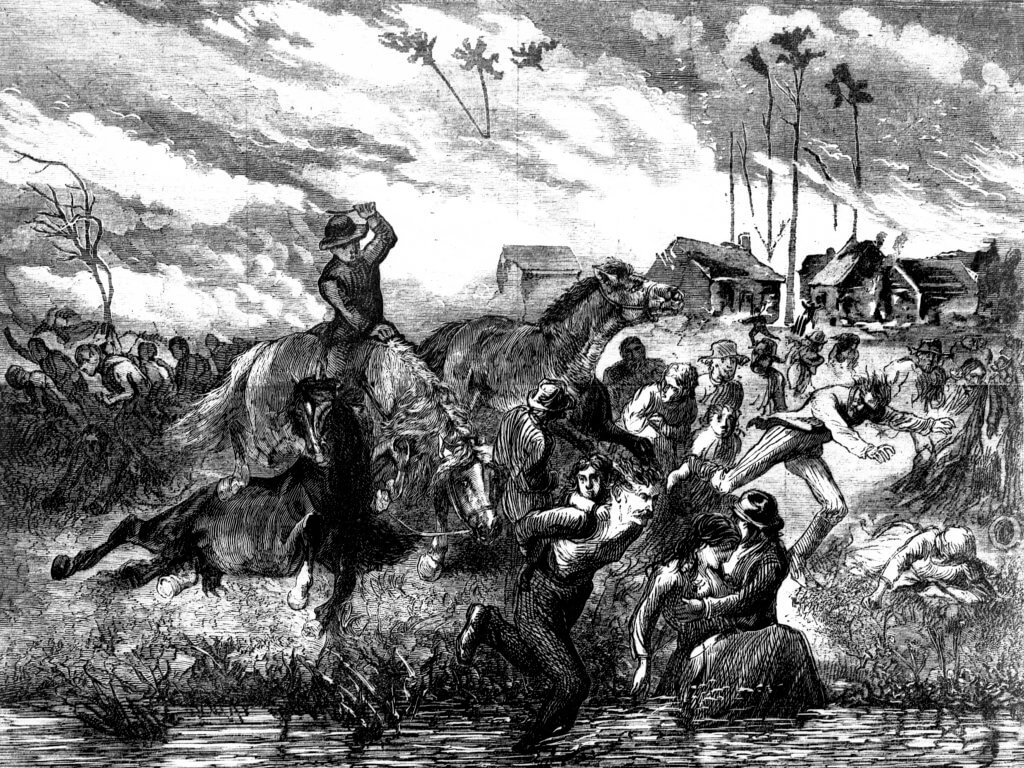
The Peshtigo Fire: The Deadliest Fire in American History That Nobody Remembers
On the night of October 8, 1871, the deadliest fire in American history swept through the forests and towns of northeastern Wisconsin. The Peshtigo Fire killed between 1,500 and 2,500 people - the exact toll will never be known because entire families, entire communities, were erased. The fire moved so fast that people who ran were overtaken by flames. Those who jumped into rivers boiled. Those who hid in wells suffocated. The town of Peshtigo was reduced to ash in an hour. But America barely noticed. That same night, 250 miles to the south, the Great Chicago Fire broke out - killing 300 people, destroying a major city, and consuming all the nation's attention. Peshtigo's dead were forgotten in the glow of Chicago's flames.
The Tinderbox
The summer and fall of 1871 had been catastrophically dry across the upper Midwest. Logging operations had left vast expanses of slash - the branches, treetops, and sawdust that remained after the valuable lumber was hauled away. Railroads had laid tracks through the forests, throwing sparks. Small fires burned constantly in the woods. Smoke had hung over the region for weeks.
Peshtigo was a lumber town of 1,700 people on the Peshtigo River. A large woodenware factory dominated the town, surrounded by wooden buildings, wooden sidewalks, sawdust streets. The forest pressed in from all sides. When residents looked at the haze in the sky, some wondered if they were living in a tinderbox waiting for a match.
The Firestorm
On the evening of October 8, conditions aligned for catastrophe. A cold front moved through, bringing high winds from the southwest. The scattered fires in the woods merged and intensified. The wind drove them together into a single massive conflagration.
What happened next was not an ordinary fire - it was a firestorm. The flames generated their own weather, creating tornado-like winds that drove the fire forward at incredible speed. Survivors described a wall of flame hundreds of feet high, moving faster than a horse could gallop. The sound was like a continuous explosion. The sky turned red, then orange, then white-hot. The air itself seemed to ignite.
The River
Many residents fled to the Peshtigo River, hoping the water would save them. Some survived by submerging themselves in the cold water, coming up only to breathe, pushing burning debris away. They would stay in the river for hours, watching their town burn.
But the river could not save everyone. Some drowned in the panic. Others died from the heat even in the water - the air was so hot it burned their lungs when they surfaced to breathe. Logs floating downstream crushed swimmers. Parents tried to hold children above water and failed. When dawn came, bodies lined the riverbanks. The water was warm from the heat.
The Toll
The town of Peshtigo was completely destroyed. Of its 1,700 residents, at least 800 died. Entire families vanished - parents, children, grandparents, with no one left to report them missing. The fire had moved so fast that many victims were never identified; the heat had been so intense that bodies were reduced to ash.
The surrounding region suffered equally. The fires burned across 1.2 million acres, destroying a dozen communities. Sugar Bush lost 260 of its 300 residents. Entire lumber camps disappeared. The total death toll was estimated between 1,500 and 2,500 - six to eight times higher than the Chicago Fire. But precise numbers were impossible. Some victims had been transient workers whose names were never recorded. Some families left no survivors to count them.
The Forgotten Fire
The Peshtigo Fire should have been one of the defining disasters of American history. It killed more people than any other fire before or since. It demonstrated the devastating potential of firestorms decades before the term was coined. It revealed the dangers of industrial logging practices.
But the Great Chicago Fire happened the same night. Chicago was a major city; Peshtigo was a lumber town. Chicago had newspapers that could tell its story; Peshtigo's newspaper had burned. Chicago's fire became legendary, immortalized in the story of Mrs. O'Leary's cow. Peshtigo was reduced to a footnote. Today, a small museum in Peshtigo commemorates the fire. Most Americans have never heard of it.
From the Air
Peshtigo (45.05N, 87.75W) lies in northeastern Wisconsin near Green Bay. Green Bay-Austin Straubel International Airport (KGRB) is 35km south. The town has been rebuilt; the Peshtigo Fire Museum preserves artifacts and stories. The terrain is flat with extensive forests. Weather is continental - cold winters, warm summers. The fire site is not visible from the air, but the forested landscape shows the environment that made the fire possible.