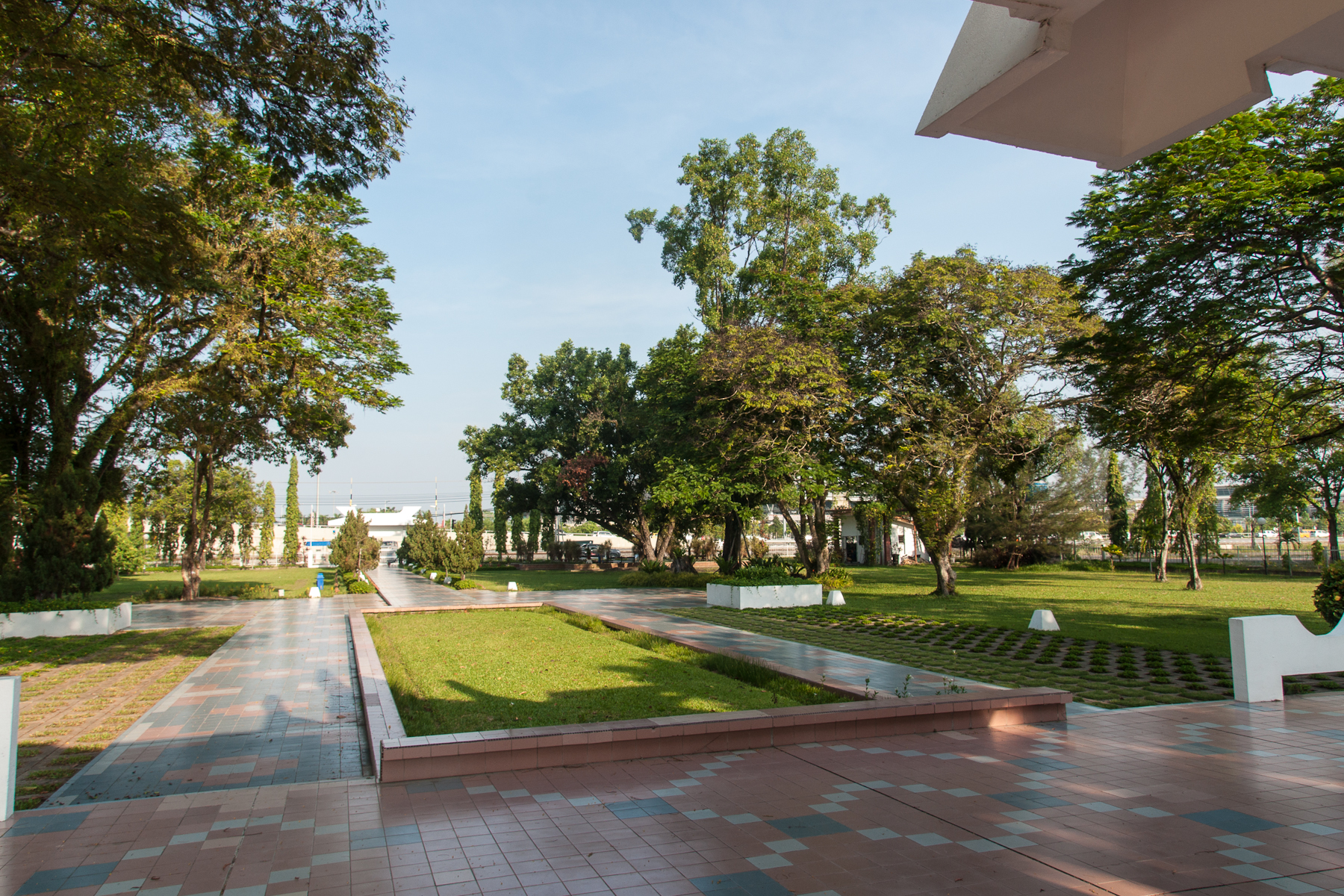
Petagas War Memorial
The train arrived at 5:30 in the morning. It had carried 176 men from Batu Tiga Prison along the North Borneo Railway, stopping at an open stretch of track near Petagas where two large pits had been dug the day before. Rainwater had already filled them. What happened next, on 21 January 1944, would become the defining act of resistance and reprisal in Sabah's wartime history. Today the Petagas War Memorial stands on this exact ground, a 7,800-square-meter park where the executed are buried and where their names are inscribed in three languages on metal plates that stand two meters high.
The Revolt That Shook Jesselton
The uprising began with a doctor. Albert Kwok, a Kuching-born Chinese physician, had moved to Jesselton on 15 May 1941 and organized more than 300 members into a resistance movement against the Imperial Japanese Army's increasingly brutal occupation of northern Borneo. Outgunned from the start, the fighters had little more than parangs, bujaks, and kris blades. When Japanese authorities began cracking down on any hint of opposition, the revolt was launched ahead of schedule on 9 October 1943, timed to coincide with the eve of the Republic of China's National Day. The attack on Jesselton killed more than 50 Japanese soldiers and administrators. But the reprisal was swift and savage. Reinforcement troops arrived from Kuching, and systematic retaliation against the civilian population began immediately.
The Morning at Petagas
After threatening to execute more civilians unless the revolt's leaders surrendered, the Japanese compelled Kwok and several commanders to turn themselves in on 19 December 1943. They were imprisoned at Batu Tiga Prison. On the morning of 21 January, they and 170 others were transported by train to Petagas. The five principal leaders, including Kwok, Charles Peter, and Kong Tze Phui, were forced to stand in a row and lean forward. Four Japanese officers and the son of a Japanese businessman killed during the uprising beheaded them with katana. The remaining prisoners knelt before the pits and were killed by machine gun fire, small arms, and bayonets. Eyewitnesses reported that screams from the site could be heard throughout the day and into the following night. Most of those executed had nothing to do with the uprising. Before Petagas, 96 men had already been tortured and killed at Batu Tiga. Another 131 were transferred to Labuan Military Prison, where all but seven died from starvation, torture, or execution.
A Place That Refuses to Forget
Two years after the massacre, the Chinese War Victims Relief Association held a memorial service at the site. In 1948, a marble memorial was erected, and the grounds were designated a permanent place of remembrance for all of North Borneo's wartime victims. The remains of men murdered at Labuan were reburied at Petagas in 1949. The memorial's significance deepened after Malaysia's formation in 1963: Sabah's first Chief Minister, Fuad Stephens, was the son of Jules Stephens, a revolt member, while the Head of State Mustapha Harun had been a member of the resistance movement himself. In 1979, renovations replaced the original wooden monument with marble stone. Workers discovered clay jars containing human remains during the construction, the reburied prisoners from Labuan.
Names Written in Stone and Metal
Today an archway inscribed in Malay, Chinese, and English marks the entrance. An 80-meter pathway leads to the central monument, a structure faced on all four sides with metal plates. Three plates describe the massacre's history; the fourth is an epitaph listing every name. The north-side plate bears an altered quotation from the Gospel of John. Directly before the monument, a 10-by-5-meter enclosed grass area holds the remains of the dead. In 2018, eight additional civilians, separately identified through British war crime documents discovered in the National Archives of the United Kingdom, were added to a new plaque. An annual memorial service has been held on 21 January every year since the park opened. In 1998, a representative of the Japanese government attended for the first time.
From the Air
Located at 5.92°N, 116.05°E in Putatan District, very close to Kota Kinabalu International Airport Terminal 2 (WBKK). The 7,800-square-meter park is tree-lined and enclosed by a white metal fence. Look for the rectangular park near the Putatan railway station on approach to the airport. Best viewed at low altitude on the southern approach to KK. The memorial is just inland from the coastal road connecting the airport to the city center.