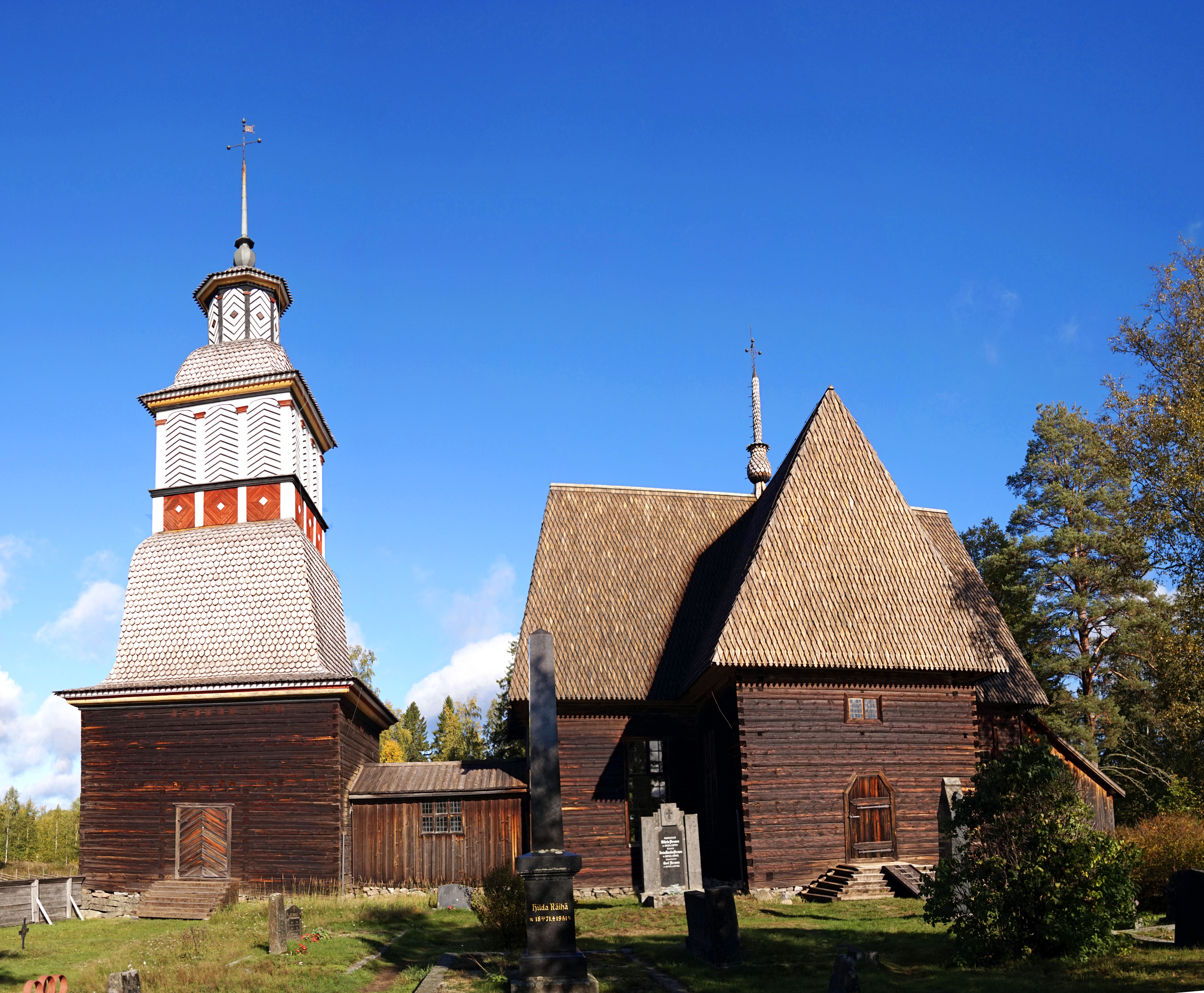
Petajavesi Old Church
It took thirty-five years just to start building. The people of Petajavesi, a small community in the Finnish lake district, received permission from the Swedish crown in 1728 to construct their own church -- the nearest one in Jamsa was simply too far to reach. But permission is not the same as resources, and it was not until 1763 that a church builder named Jaakko Klemetinpoika Leppanen from Vesanka finally laid the first timbers. What he created in the next two years would outlast the Swedish empire, survive a century of neglect, and eventually be recognized as one of the finest wooden churches on Earth.
Where Gothic Meets Renaissance in Pine
Leppanen designed the church with a cross-shaped floor plan -- four arms of equal length meeting at a central crossing, a layout that had arrived in Nordic countries at the end of the seventeenth century and become standard for countryside churches by the eighteenth. But the church is no mere copy of prevailing fashion. Its roof soars upward with a steep pitch that evokes the earlier Gothic tradition, while the octagonal cupola crowning the crossing borrows its circular oculus from Renaissance architecture. The effect is a building that feels both ancient and sophisticated, rooted in the forest yet reaching for something beyond it. Inside, the pulpit, pews, galleries, and chandeliers were all hand-carved by local craftsmen from pine wood -- every surface shaped by hand tools, every joint fitted without industrial precision. The bell tower, added in 1821, completes the composition with a simple vertical accent against the surrounding birch and spruce.
A Kingdom's End, a Church's Beginning
When Leppanen built the church between 1763 and 1765, Finland was still part of the Kingdom of Sweden. The province of Tavastia, where Petajavesi lies, had been Swedish territory for centuries. That world was about to end. The Finnish War of 1808-1809 transferred Finland to the Russian Empire as an autonomous grand duchy, and the political landscape shifted irrevocably. But the church, standing on its small rise about a kilometer west of the village center, remained. It served the congregation of Jamsa -- the same distant parish whose inaccessibility had prompted its construction in the first place -- and accumulated the quiet patina of use: the worn edges of pews, the soot on ceiling beams, the thin grooves where generations of feet crossed the same pine threshold.
The Century of Forgetting
When a new church was eventually built for the growing community, the old one was abandoned. The congregation moved on, and the wooden building was left to the elements. Only the cemetery around it and the bell tower continued to serve a purpose. Decades passed. The roof held, the walls stood, but the interior gathered dust and silence. It was precisely this neglect that preserved the church. Without renovations, without modernization, the original craftsmanship survived intact -- the hand-carved details, the eighteenth-century layout, the physical evidence of a building tradition that was vanishing across Scandinavia.
Rediscovery and World Recognition
In the 1920s, the Polish-Austrian art historian Josef Strzygowski encountered the church and recognized what the locals had long taken for granted: this was an architectural treasure, a nearly unaltered example of the wooden church-building tradition that had once defined the Nordic countryside. Since 1929, the building has been carefully restored multiple times, each effort guided by the principle of preserving rather than transforming. In 1994, UNESCO inscribed Petajavesi Old Church on the World Heritage List, citing it as an outstanding example of the eastern Scandinavian wooden church tradition. Today the church hosts weddings in the summer months and services on most Sundays -- a living building again after its long sleep, its pine walls still holding the scent of centuries.
From the Air
Located at 62.25N, 25.18E in central Finland's lake district, approximately 1 km west of the Petajavesi village center. The wooden church and its bell tower are small structures but identifiable at low altitude near the intersection of local roads. Nearest major airport: Jyvaskyla (EFJY), approximately 30 km to the east. Terrain is rolling lakeland with dense forest. Best viewed below 3,000 ft AGL for the church to be visible among the trees.