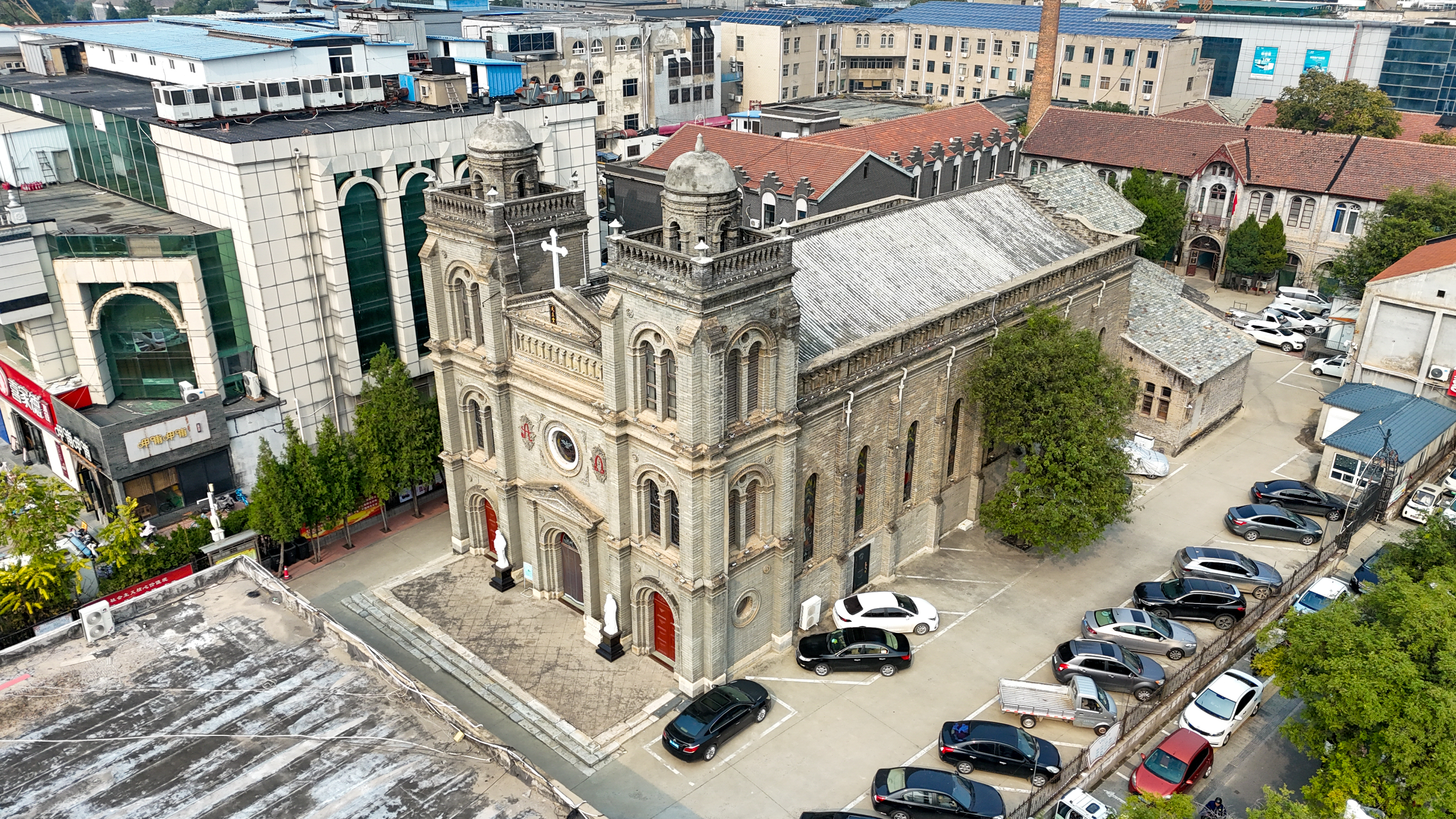
Peter and Paul Cathedral (Baoding)
The Catholics of Baoding have built their cathedral twice and defended their faith against forces that most congregations never face. Saints Peter and Paul Cathedral stands in the heart of Baoding, Hebei Province, the seat of a diocese whose history is wound tightly around the Boxer Rebellion, Japanese bombardment, and the ongoing tensions between China's Catholic communities and the state. The church that exists today is a reconstruction, completed in 1992 after the original was reduced to rubble during the Second World War. Its survival -- in any form -- is itself a statement.
After the Boxers
In 1900, the Boxer Rebellion tore through northern China. The Boxers -- a populist movement fueled by anti-foreign and anti-Christian sentiment -- massacred large numbers of Catholics and burned churches across the region. In Baoding, the Catholic community scattered. Some fled to the nearby village of Donglu, where a reported Marian apparition during the crisis would later become a defining event in Chinese Catholic devotion. When the violence subsided and the Eight-Nation Alliance imposed the Boxer Protocol, French missionaries returned to Baoding. In 1905, they constructed a new church and dedicated it to Saints Peter and Paul, planting a European Gothic presence in the heart of a Chinese provincial capital.
Cathedral of a New Diocese
In 1910, when the Catholic Church formally established the Diocese of Baoding, the church was expanded and elevated to cathedral status. It became the spiritual center for Catholic communities spread across the flat agricultural landscape of central Hebei -- communities that had endured persecution during the Boxer Rebellion and would face new trials in the decades ahead. The cathedral's role was both practical and symbolic: a place of worship, certainly, but also a visible assertion that Christianity had permanent roots in this corner of China, roots that the Boxer violence had failed to destroy.
Destruction and Rebuilding
The cathedral survived the fall of the Qing dynasty, the warlord era, and the early years of the Republic. It did not survive the Second World War. In 1941, Japanese artillery bombardment set the building ablaze, and the cathedral was reduced to ruins. For over fifty years, the site remained devastated. It was not until 1992 that the cathedral was rebuilt, restored to a form that echoes the original French Gothic design. Today it is listed among Hebei Province's cultural protection sites -- a recognition that the building's significance extends beyond its religious function to its place in the region's layered history.
Faith Under Pressure
The Diocese of Baoding, which this cathedral serves, has experienced some of the most sustained pressure on Catholic practice anywhere in China. Various diocesan leaders have been arrested or detained. The nearby pilgrimage village of Donglu has been the target of military-scale suppression operations. Yet the diocese persists. The cathedral itself -- with its main entrance, interior nave, and the adjacent Fengtian Building -- serves an active congregation in a city where Catholicism has been present for over a century. From the air, the cathedral's architecture marks it as something distinct from its surroundings: a Gothic form planted on the North China Plain, bearing witness to a community that has been tested by rebellion, war, and state power, and has continued.
From the Air
Located at 38.86°N, 115.49°E in the city center of Baoding, Hebei Province. Nearest major airport is Beijing Daxing International Airport (ZBAD), approximately 140 km to the northeast. The cathedral's Gothic architecture makes it a distinctive structure within Baoding's urban landscape. The flat North China Plain extends in all directions. Best viewed at 2,000-4,000 feet to distinguish the church's form from surrounding buildings.