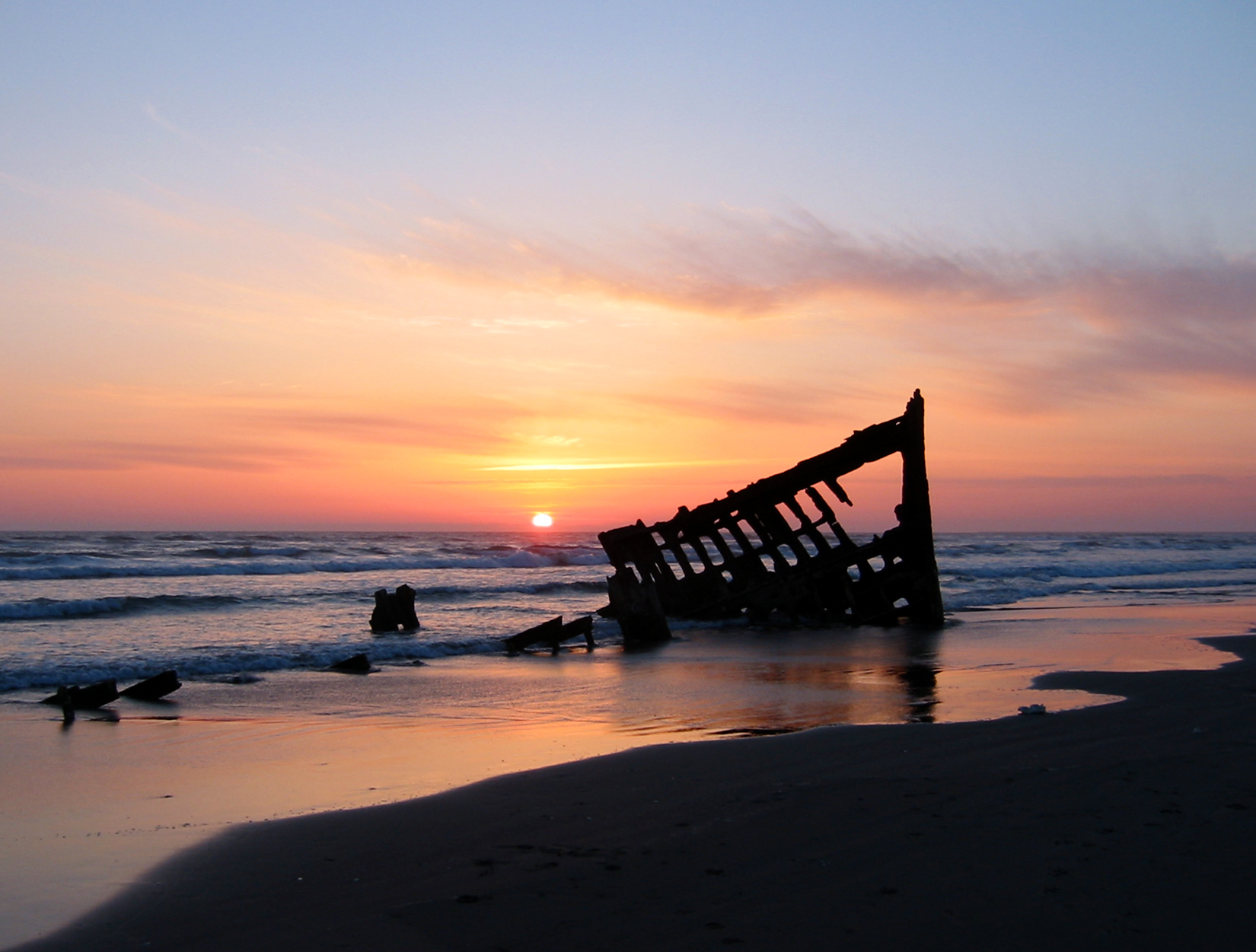
Peter Iredale: The Shipwreck That Stayed
"May God bless you, and may your bones bleach in the sands." Captain H. Lawrence raised his glass to his dying ship, and the Peter Iredale obliged. More than a century later, her ribs and bow still jut from the beach at Fort Stevens State Park, rusted the color of dried blood, tilting into the wind as if still trying to make headway. Of the roughly two thousand vessels that have wrecked in the Graveyard of the Pacific - that notorious stretch of water where the Columbia River collides with the open ocean - the Peter Iredale is the one you can walk up and touch.
Steel and Sail from Maryport
The Peter Iredale was built in the English port of Maryport in June 1890 by R. Ritson & Co, the largest vessel their yard had produced. She was a four-masted steel barque - 285 feet long, 2,075 net register tons, fashioned from steel plates riveted onto an iron frame. Her rigging carried royal sails above double topsails and topgallant sails, enough canvas to drive her across oceans at the mercy of wind alone. Named for her owner, a well-known Liverpool shipping figure, she spent sixteen years carrying cargo across the world's trade routes. By 1906, the age of sail was yielding to steam, but ships like Peter Iredale still worked the long hauls where fuel costs made engines impractical. Under Captain Lawrence's command, she sailed from Salina Cruz, Mexico, in late September, bound for Portland, Oregon, carrying a thousand tons of ballast and a crew of twenty-seven - including two stowaways.
Three Twenty in the Morning
The voyage north along the Pacific coast was uneventful until October 25, 1906. At 3:20 a.m., Captain Lawrence spotted the Tillamook Rock Lighthouse through the darkness and altered course toward the Columbia River's mouth. What followed was a sequence that the Graveyard of the Pacific had rehearsed hundreds of times before: thick mist rolled in, tides pulled where the charts said they shouldn't, and wind shifted at the worst possible moment. Lawrence turned east-northeast, then northeast, trying to thread the river entrance. A heavy northwest squall struck instead, and despite the crew's attempt to wear the ship away from shore, Peter Iredale grounded hard on Clatsop Sands. The surf drove her higher onto the beach. A lifeboat dispatched from nearby Hammond evacuated all twenty-seven crew members to Fort Stevens. Not a single life was lost - a mercy the Columbia River Bar did not always grant.
Swallowed by the Sand
At first, the situation looked salvageable. The hull had sustained little damage, and plans were drawn to tow Peter Iredale back to sea during favorable tides. But the Oregon coast does not operate on human schedules. Week after week, the weather refused to cooperate. As the crew and salvagers waited, the ship listed to port and settled deeper into the wet sand. Each tide packed more sediment around the keel. What had been a temporary grounding became permanent. A British Naval Court inquiry in Astoria that November found no fault with Lawrence or his crew, commending their efforts to save the vessel. The salvage rights were sold in 1917, but the wreck was never broken up. The Pacific had claimed her, and the Pacific would decide what remained.
Caught in the Crossfire
Thirty-six years after she grounded, Peter Iredale found herself in a war zone. On the night of June 21, 1942, the Japanese submarine I-25 surfaced off the Oregon coast and lobbed seventeen shells at Fort Stevens - one of only a handful of attacks on a mainland U.S. military installation during World War II. The wreck sat directly in the line of fire, but the shells missed both the fort's battery and the old barque's remains. The following day, the military strung rolls of barbed wire from Point Adams southward along the beach, preparing for a potential Japanese invasion that felt terrifyingly plausible after the fall of Kiska and Attu in Alaska's Aleutian Islands. Peter Iredale's skeleton was wrapped in the wire, tangled in a conflict that would have been unimaginable to the men who built her in Victorian England. The barbed wire stayed until the war ended.
Bones on the Beach
Walk the beach at Fort Stevens State Park today, and you will find what Captain Lawrence's toast foretold: bones bleaching in the sand. The bow section still stands, its iron ribs curving upward like the ribcage of some enormous beast. A few masts lie nearby. Rust has eaten the steel plates thin enough for the ocean wind to whistle through. More than a century of tides, salt spray, and Pacific storms have reduced a 285-foot sailing ship to a sculpture, but they have not erased her. The wreck sits within Fort Stevens State Park, an Oregon state park adjacent to the Lewis and Clark National Historical Park, making Peter Iredale one of the most visited and photographed shipwrecks anywhere. Sunset is the preferred time - the low light turns the rust to gold against the dark sand, and the skeletal bow frames the horizon where the Columbia's brown water meets the gray Pacific.
From the Air
Located at 46.18°N, 123.98°W on Clatsop Spit, approximately 4 miles south of the Columbia River channel. From altitude, the wreck is visible as a dark shape on the beach near the south jetty of the Columbia River. Fort Stevens State Park surrounds the site. The Columbia River Bar - the 'Graveyard of the Pacific' - is visible to the north where the river mouth meets the ocean, often marked by turbulent water and breaking waves. Astoria Regional Airport (KAST) is approximately 8 miles to the northeast. The Tillamook Rock Lighthouse, whose light Captain Lawrence spotted before the wreck, is visible on its isolated rock to the south-southwest.