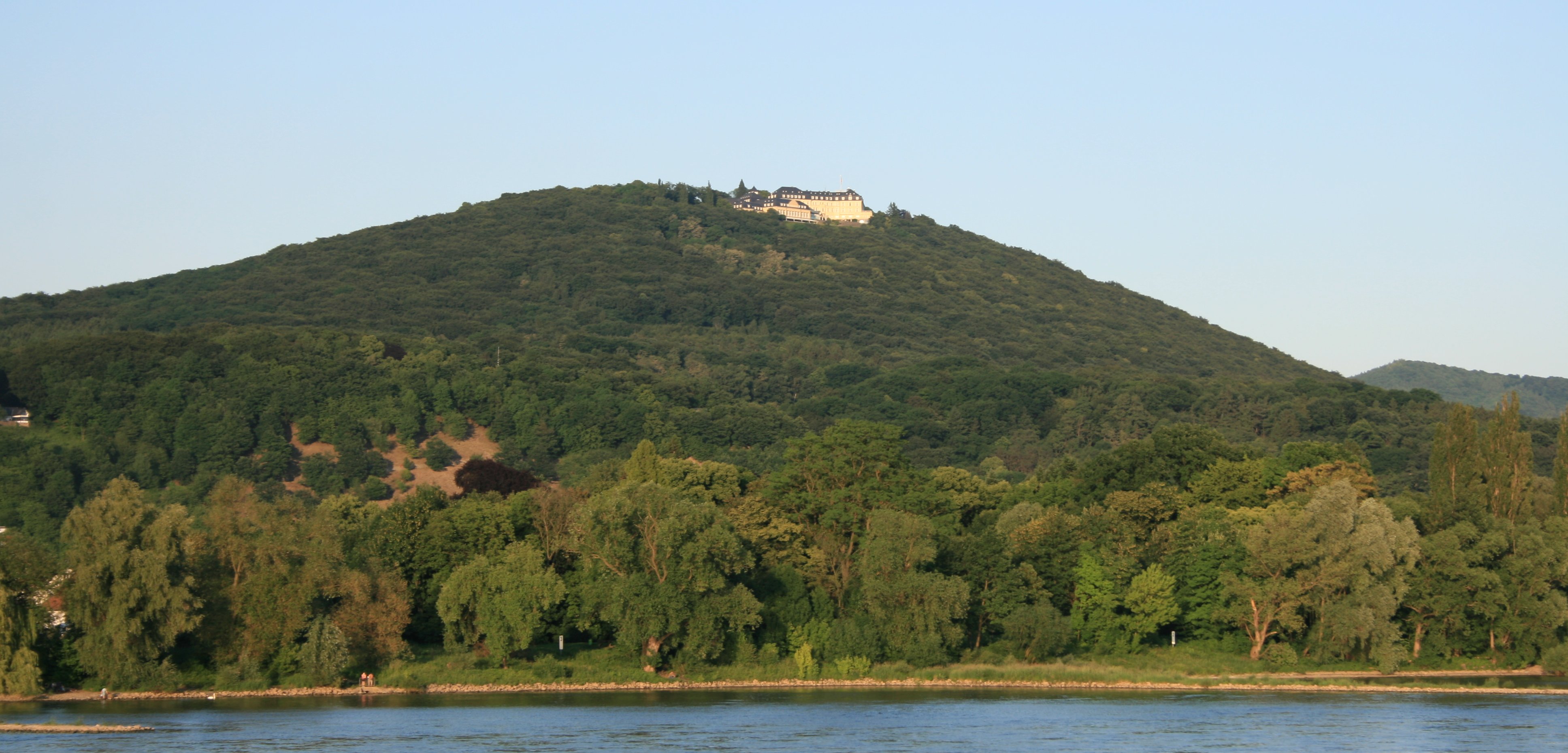
Petersberg (Siebengebirge)
On 22 November 1949 in a hotel dining room on top of a 331-meter volcanic hill above the Rhine, Konrad Adenauer signed the Petersberg Agreement and West Germany got its first ladder back into international politics. The Allied High Commission had its headquarters in the same building. The Hotel Petersberg was at that moment one of the most diplomatically significant addresses on earth, and it had reached that status almost by accident, having opened in 1892 as a private resort hotel for Cologne industrialists who wanted a view. Before the hotel, the peak had been a Cistercian sanctuary. Before the Cistercians, an Augustinian hermitage. Before the hermitage, an Iron Age ring wall. Before the ring wall, a Bronze Age settlement that goes back to 3500 BC. People have been climbing this hill for five and a half thousand years, mostly for the view. The diplomats were just the most recent.
Five Thousand Years on the Peak
Archaeological excavation has confirmed human occupation on the Petersberg as early as 3500 BC. A defensive ring wall constructed around 1000 BC, in the late Bronze Age, still leaves traces visible to walkers who know where to look. The hill was first documented under the name Stromberg in 1142. By that point Augustinian hermits had built a small religious community on the summit, drawn by the same isolation that had attracted the earlier ring-wall builders, and probably for the same view down the Rhine toward Cologne. In 1189 Archbishop Philipp von Heinsberg of Cologne assigned the abandoned hermitage to Cistercian monks brought in from the abbey of Himmerod. The Cistercians, less interested in cliff-top isolation than in productive valley land, built their proper abbey down in the Peterstal valley in 1202. Heisterbach Abbey became one of the wealthier Cistercian houses on the Rhine. The Petersberg itself stayed mostly empty until 1764, when a chapel dedicated to Saint Peter was erected on the peak. The chapel gave the hill its modern name. Before that it had been Stromberg, mountain of the current.
The Countess of the Rhine
In 1834 the area was sold to a Cologne merchant named Joseph Ludwig Mertens. His wife Sibylle Mertens-Schaafhausen built a summer residence on the Petersberg, used it as a base for a remarkable cultural salon, and became known across the Rhineland as the Rheingrafin, the countess of the Rhine. Mertens-Schaafhausen was a serious collector of antiquities, an amateur archaeologist who funded excavations at Pompeii, and a patron of musicians and writers. Her summer house on the Petersberg attracted poets, painters, and minor princes during the high years of Rhine Romanticism. The salon ended with her death in 1857. The mountain dropped quietly back into private ownership and stayed quiet until the end of the 19th century, when the Nelles brothers from Cologne bought the area, opened the Hotel Petersberg in 1892, and built the Petersbergbahn, a rack railway up the slope to bring tourists from Konigswinter on the Rhine bank below. The railway ran for 66 years before closing in 1958.
Mulhens and Modernity
In 1912 the property changed hands again, this time to Ferdinand Mulhens, head of the family that owned the 4711 eau de cologne business in Cologne. Mulhens converted the hotel into a spa, expanding the terraces facing the Rhine and adding the kind of formal landscaping a Belle Epoque clientele expected. The new access road built in the 1930s replaced the rack railway as the main route up. Mulhens was a serious player in early 20th-century Rhineland industry, and the Hotel Petersberg under his ownership became a place where Cologne and Bonn society went to be seen by each other. The location was visually exceptional. Standing on the Petersberg terrace at dawn, you look directly across the Rhine at Bad Godesberg and Bonn; turn slightly south and you see the Drachenfels with its ruined castle and the spires of Schloss Drachenburg. The view was sellable in 1912, sellable in 1949, and sellable today.
Where West Germany Started
After the Second World War, the Allied occupation needed a working headquarters near the new West German government at Bonn. The Hotel Petersberg, intact and isolated and easy to secure, was requisitioned as the seat of the Allied High Commission, the body that administered British, French, and American supervision of the new Federal Republic. On 22 November 1949 Chancellor Konrad Adenauer signed the Petersberg Agreement at the hotel, the first major treaty signed by an independent West German government. The agreement gave West Germany consular representation abroad, ended the dismantling of certain factories, and admitted the new state to several international economic bodies. It was the document that ended the country's pariah status. After the Allied High Commission dissolved in 1955, the hotel passed to the Federal Republic itself as a guest house for visiting heads of state. The list of guests over the following decades reads like a postwar diplomatic register. Queen Elizabeth II stayed at the Petersberg. So did Mikhail Gorbachev. So did Nelson Mandela. The hotel kept its register and the register kept its weight.
A Working Address
The German federal government moved most of its operations from Bonn to Berlin between 1990 and 1999, and the Petersberg's role as state guest house quieted. The hotel is still owned by the Federal Republic, still maintained by Steigenberger, and still occasionally used for state visits and diplomatic conferences. The Petersberg International Climate Dialogue, an annual meeting that helps shape global climate-change negotiations, has been hosted here since 2010. The 1764 Saint Peter chapel still stands a short walk from the hotel. The Cistercian ruin at Heisterbach Abbey in the valley below, partially demolished in the Napoleonic secularizations and never rebuilt, is one of the most photographed Gothic fragments in Germany. Walk the path down from the hotel terrace to the abbey and you cross five thousand years of continuous occupation in about forty minutes. The view from the top, looking west across the river at Bonn and the Godesburg cone beyond, has been used to negotiate the terms of West German sovereignty, the end of European arms races, and the next decade of climate policy. It is also, in spring and autumn, one of the most ordinary good views in Germany. People just walk up to look at it.
From the Air
Coordinates: 50.6861, 7.2075. The Petersberg is one of the most prominent peaks in the Siebengebirge, rising to 331 meters above the Rhine's east bank, directly opposite Bonn. From the air the summit is unmistakable: the large white Hotel Petersberg sits on a flat terrace at the very top of the hill, with formal gardens visible. Recommended viewing altitude 3,000-4,500 feet. Nearest major airport: Cologne Bonn (EDDK), 14 nm north-northwest. Watch for the EDDK Class C/D shelf. Best photographic angle is from over the Rhine looking east, especially at sunrise when the hotel terrace catches direct light.