Petroglyph Provincial Park: Where Stone Speaks
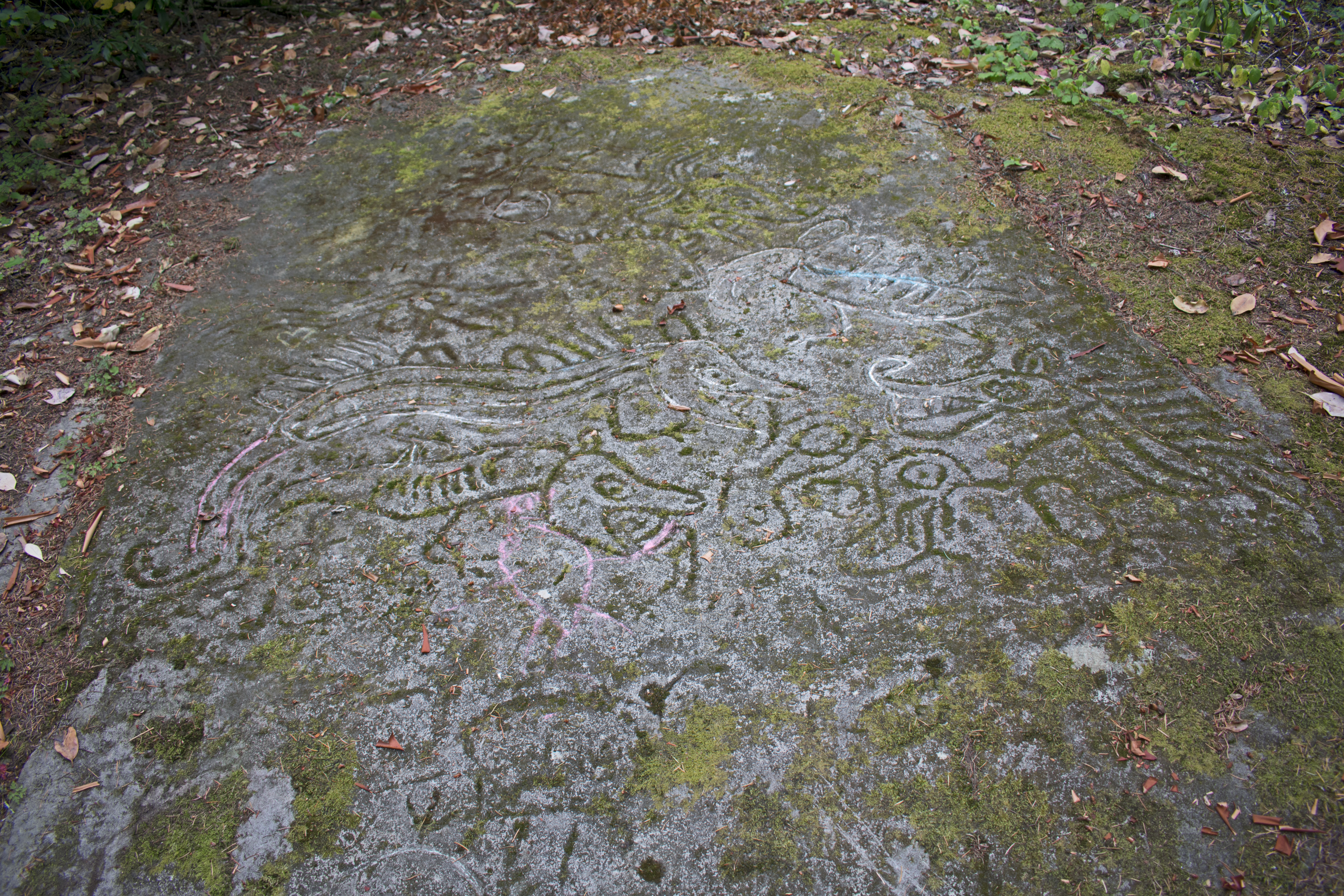
The carvings were not placed randomly. Wherever the Coast Salish and Snuneymuxw people made petroglyphs, they chose sites where forces of nature were believed to be especially powerful - near waterfalls, unusual rock formations, places where the physical world seemed to thin and something deeper showed through. At Petroglyph Provincial Park, near the estuary of the Nanaimo River on the southern edge of Nanaimo, that principle produced a remarkably dense concentration of rock carvings, some dating to at least the 10th century CE. Mythological sea creatures undulate across sandstone surfaces. Human figures stand in postures that suggest ritual or transformation. Animals appear that bridge the natural and spiritual worlds. The park was established on August 24, 1948, to protect these carvings, and over seven decades later, they remain its sole purpose.
Carved at the Threshold
The petroglyphs at this site reflect a worldview in which landscape was not passive scenery but an active spiritual presence. The Coast Salish chose their carving sites with intention - places where a waterfall's roar suggested power, where a cliff face or unusual formation marked a boundary between the ordinary and the sacred. The Nanaimo River estuary, where fresh water meets salt, where tidal rhythms shift the boundary between land and sea twice daily, was precisely such a threshold. The carvings made here were not decoration. They were communication with forces the carvers understood to inhabit these liminal spaces, and the density of petroglyphs at this site suggests it held particular spiritual significance within the broader landscape of Coast Salish sacred geography.
Sea Creatures and Spirit Figures
The carvings depict a world both recognizable and strange. Sea creatures appear in forms that suggest species known to the Pacific coast - but rendered with the stylistic conventions of Coast Salish spiritual art, their bodies elongated, their features abstracted into patterns that convey meaning beyond mere representation. Human figures appear alongside them, some in postures that suggest transformation or ceremony. Animals that exist in the boundary between natural and supernatural occupy the stone surfaces. These are not illustrations of daily life. They emerge from a tradition in which art, spirituality, and relationship to place were inseparable - where carving an image into rock was an act of engaging with the powers that inhabited that specific location.
The Snuneymuxw Connection
The petroglyphs are part of the cultural heritage of the Snuneymuxw First Nation, whose traditional territory encompasses the Nanaimo area and whose relationship with this landscape stretches back thousands of years. The carvings represent a fraction of the spiritual and cultural knowledge the Snuneymuxw maintained about their territory - knowledge embedded in place, in the specific geography of rivers, shorelines, and rock faces that carried meaning far beyond their physical form. The park protects the carvings but cannot fully convey the cultural context that gave them their original significance. That context belongs to the Snuneymuxw people, for whom these are not archaeological artifacts but living connections to ancestral practice and belief.
A Park Without Facilities
Petroglyph Provincial Park is deliberately minimal. There are no campgrounds, no visitor centers, no interpretive buildings. The park exists for one reason: to protect the carvings. Visitors walk among the sandstone surfaces and encounter the petroglyphs directly, without the mediation of museum glass or explanatory dioramas. The experience is closer to discovery than exhibition - figures emerging from rock that has held them for a millennium or more, their meaning partially legible through the imagery but ultimately belonging to a cultural tradition that visitors can respect without fully accessing. The park's restraint is itself a statement: some things are better encountered than explained, and the power of a thousand-year-old carving lies partly in the silence that surrounds it.
From the Air
Petroglyph Provincial Park is at 49.141°N, 123.927°W at the south end of Nanaimo, near the Nanaimo River estuary. From altitude, the park is a small green area along the southern approach to Nanaimo, near where the Nanaimo River meets the harbour. The park is close to BC Highway 19. Nanaimo Airport (CYCD) is approximately 5 km to the south-southwest. The Nanaimo River estuary and delta are visible nearby.