Petropavlovsk-Kamchatsky
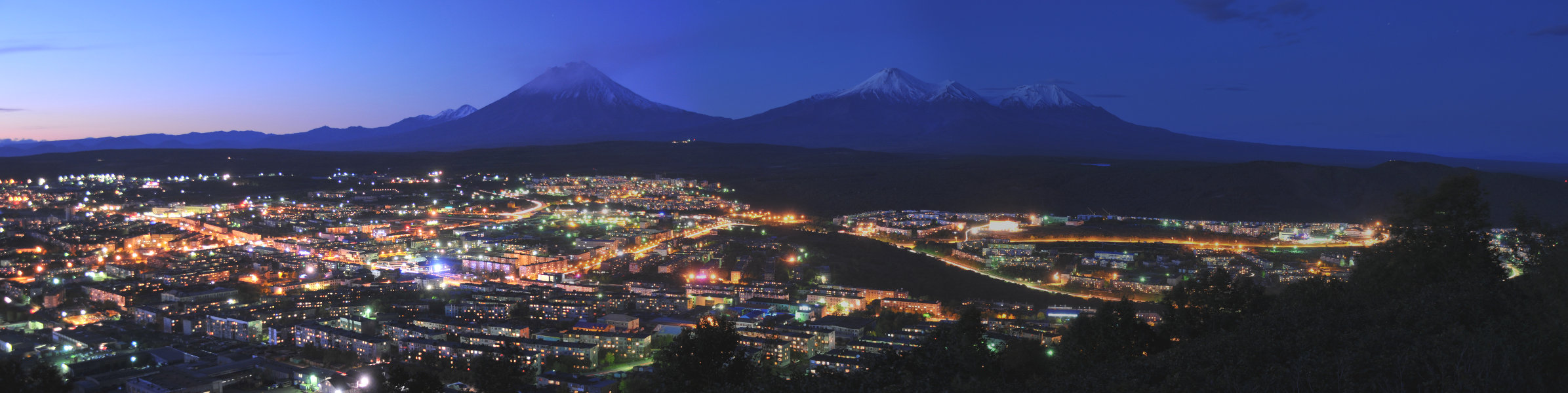
Here is a city that is closer to San Francisco than to its own capital. Petropavlovsk-Kamchatsky sits on the shores of Avacha Bay, ringed by volcanoes whose snow-capped cones loom over the rooftops like sentinels. With roughly 180,000 residents, it is the largest city on Russia's Kamchatka Peninsula and the principal gateway for anyone hoping to reach one of the most volcanically active landscapes on Earth. Getting here requires commitment: there are no roads connecting the city to the rest of Russia. You fly in, or you do not come at all.
A City Without Roads
Petropavlovsk-Kamchatsky holds a distinction shared by only one other city of comparable size: it cannot be reached by road from any other significant population center. Only Iquitos, in Peru, claims the same isolation among large mainland cities. A handful of local roads connect the city to its airport at Yelizovo and to the closed military city of Vilyuchinsk, but beyond that, the peninsula's terrain -- volcanic ranges, river valleys, and trackless wilderness -- defeats any attempt at overland connection. Most visitors arrive on flights from Moscow, an eight-hour journey on an Aeroflot A330 that spans nine time zones. S7 Airlines offers a three-hour connection from Vladivostok. Seasonal service to Anchorage, Alaska, existed for a time but was permanently cancelled in 2022.
Volcanoes at the Doorstep
The city's setting is extraordinary even by Russian standards. Koryaksky Volcano rises to the north, its symmetrical cone visible from virtually every street. Avacha Bay, one of the largest natural harbors in the world, provides the city's economic lifeline -- a deep-water port sheltered from Pacific storms. The climate shares parallels with Anchorage and Juneau in Alaska: summers bring temperatures that occasionally reach 25 to 30 degrees Celsius along with frequent rain and evening mists, while winters are milder and far snowier than the Siberian interior, though January and February can see the thermometer plunge to minus 20. Mountain skiing at Krasnaya Sopka is within 25 minutes of the city center, and whale-watching trips depart from Avacha Bay.
Teatralnaya Square and Three Streets
The compact city center is walkable. Teatralnaya Square serves as the hub for major events, with three main streets -- Leninskaya, Sovetskaya, and Partizanskaya -- radiating outward. Cheap buses and minibuses run fixed routes along the main road, operating on a flat fare paid to the driver as passengers alight. The city has reasonable tourist infrastructure for such a remote location, with hotels, restaurants, and outfitters catering to the growing number of visitors drawn by Kamchatka's wilderness. Each September, the Festival of Bard Songs fills the city with music -- an annual tradition that reflects the adventurous, slightly countercultural spirit of the people who choose to live at the edge of a continent.
Gateway to Fire and Ice
For most travelers, Petropavlovsk-Kamchatsky is not the destination but the starting point. From here, helicopter flights carry tourists to the Valley of Geysers, the calderas of active volcanoes, hot springs steaming in snow-covered valleys, and rivers thick with spawning salmon where brown bears gather by the dozen. The peninsula has more than 160 volcanoes, roughly 30 of them active, and a biodiversity that includes some of the densest populations of brown bears on Earth. The city's role as sole gateway gives it an outsized importance: every expedition, every scientific survey, every adventure tourism operation on the peninsula begins and ends here, in a city whose infrastructure must bridge the gap between modern travel expectations and one of the most geologically dynamic, logistically challenging environments on the planet.
From the Air
Petropavlovsk-Kamchatsky is located at approximately 53.02N, 158.65E on the southeastern coast of the Kamchatka Peninsula. Yelizovo Airport (UHPP) is the primary airport, located about 30 km from the city center, handling both civilian and military traffic. Koryaksky and Avachinsky volcanoes provide dramatic visual landmarks on approach. Avacha Bay is one of the largest natural harbors in the Pacific and is readily identifiable from altitude. Expect variable weather with frequent fog, low cloud, and precipitation. Winds can be strong and gusty, particularly during winter months. The volcanic terrain surrounding the city creates turbulence risks.