Petsamo–Kirkenes Offensive
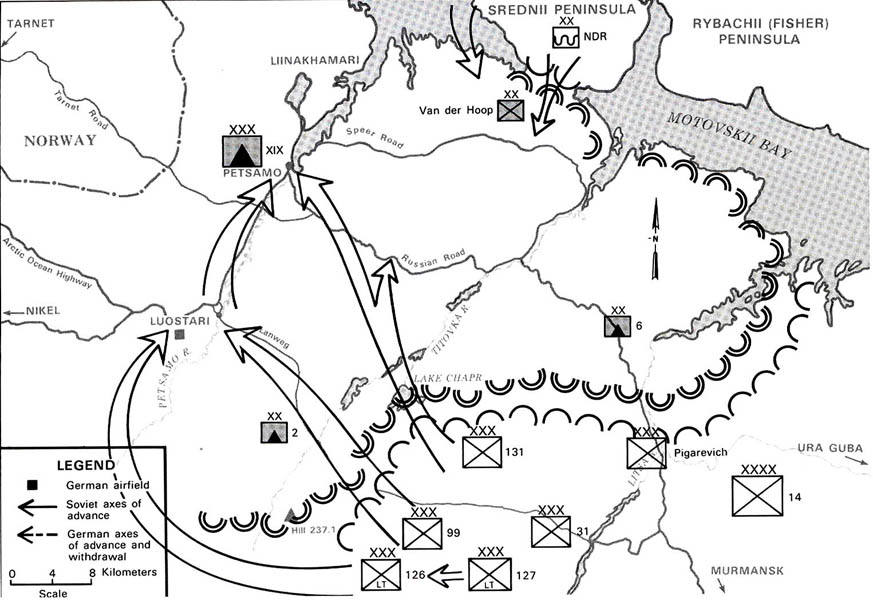
Stalin called it the Tenth Shock, the last of his ten devastating blows against the Wehrmacht in 1944. In the Arctic, where the front lines had barely moved for three years and both sides had settled into a frozen stalemate above the tree line, the Red Army launched the Petsamo-Kirkenes offensive in October 1944. It was a campaign fought with ski troops and reindeer-drawn supply trains, with naval infantry storming shorelines and US-supplied amphibious vehicles crossing rivers that no bridge could span. By its end, the Wehrmacht had been driven out of the Arctic entirely, northern Norway had been liberated, and the Soviet Union had seized the nickel mines that had kept German armour factories running.
Three Years of Frozen Stalemate
The Arctic front had been a backwater since 1941, when the German-Finnish Operation Silver Fox failed to capture Murmansk. The terrain made major operations nearly impossible: roadless tundra, months of polar darkness, temperatures that seized engines and froze exposed skin in minutes. Yet the Germans maintained substantial forces in the sector for two reasons. First, the Finnish nickel mines at Petsamo supplied metal essential for German armour plate. Second, the coast of northern Norway had to be defended against a potential Allied amphibious landing. When Finland signed the Moscow Armistice on September 4, 1944, the strategic picture changed overnight. The Petsamo region was ceded to the Soviet Union, Finland agreed to expel German forces from its territory by September 15, and the Wehrmacht's 20th Mountain Army began retreating westward under Operation Birke. The German high command decided to withdraw completely from northern Norway and Finland under Operation Nordlicht. Before that withdrawal could be completed, the Soviets struck.
An Army Built for the Arctic
General Kirill Meretskov's Karelian Front and Admiral Arseniy Golovko's Northern Fleet would execute the operation jointly. The main striking force was the 14th Army, which had been stationed in the Arctic since the war's beginning and understood the environment intimately. The Stavka, the Soviet high command, reinforced Meretskov with units specifically configured for Arctic warfare. The 126th and 127th Rifle Corps were composed of light infantry with ski troops and naval infantry. Thirty engineer battalions would handle the terrain's challenges. Transportation companies equipped with horses and reindeer hauled supplies where trucks could not go, while two battalions used American-supplied amphibious vehicles for river crossings. The Soviets assembled thousands of mortars and artillery pieces, 750 aircraft, and 110 tanks. The German XIX Mountain Corps, defending with the 2nd and 6th Mountain Divisions along with fortress and ad hoc units, had roughly 45,000 men and no armour at all.
Breakthrough and Pursuit
The offensive unfolded in three phases. First came the breakthrough of the German defensive positions, where Soviet artillery and air superiority overwhelmed the mountain troops. Then began the pursuit toward Kirkenes, with light rifle corps racing across the tundra to cut off retreating German units while naval infantry conducted amphibious landings along the coast to outflank defensive positions. The Northern Fleet contributed 20,300 men to these seaborne operations, striking at harbors and coastal strongpoints that the Wehrmacht was using as waypoints in its retreat. The final phase was the battle for Kirkenes itself and the southward pursuit that followed. The Germans fought rear-guard actions with the discipline their mountain divisions were known for, but they were outmatched in numbers, firepower, and mobility across terrain they had held for three years without ever truly mastering.
Liberation and Legacy
The offensive drove the Wehrmacht entirely out of the Arctic and liberated the northern tip of Norway, making the Red Army the only Allied force to fight on Norwegian soil. For the people of Finnmark, the Soviet soldiers who entered Kirkenes were liberators, a fact that Norwegian veterans of the period remembered long after the Cold War made that history uncomfortable. The nickel mines of Petsamo, which had drawn German troops to the Arctic in the first place, passed permanently to Soviet control. The Petsamo region itself, Finnish since 1920, was absorbed into the Russian SFSR. The offensive was the last major operation on the northern flank of the Eastern Front. The soldiers who fought it, on both sides, endured conditions as extreme as any battlefield of the Second World War: polar darkness, subzero temperatures, terrain that swallowed entire columns. That it is one of the war's least remembered campaigns says more about how history is written than about what the soldiers experienced.
From the Air
Located at 69.43°N, 31.23°E, centered on the Petsamo region (now Pechengsky District, Russia) and extending northwest to Kirkenes, Norway. The terrain is Arctic tundra with scattered lakes and no significant tree cover. Kirkenes Airport Hoybuktmoen (ENKR) is at the offensive's western terminus. The Barents Sea coastline is visible to the north. Murmansk Airport (ULMM) is approximately 160 km to the southeast. Best viewed at 5,000-10,000 ft AGL. The Norway-Russia border is visible as a cleared corridor through the landscape.