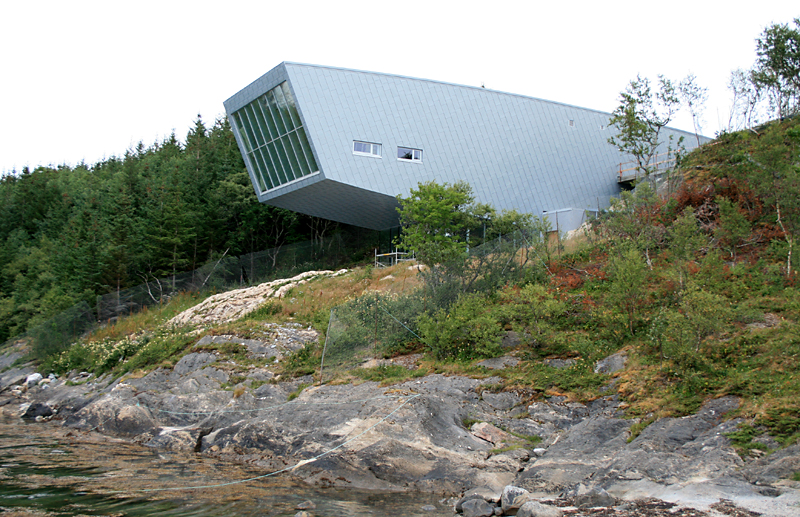
Petter Dass Museum
Fishermen along the Helgeland coast flew strips of black cloth in their sails for a hundred years after Petter Dass died in 1707. That is the kind of devotion this museum commemorates -- not the polite respect owed to a historical figure, but the raw grief of communities who felt a voice had been taken from them. Dass was their priest, their poet, and the man who gave Northern Norway its first great work of literature. His museum at Alstahaug, where he served as parish priest for eighteen years, sits at the intersection of ancient churchyard and modern architecture, a place where the 17th century and the 21st century regard each other across a cable-sawn cleft in solid rock.
The Trumpet of Nordland
Born around 1647 on the island of Donna in Nordland, Petter Dass was the son of a Scottish merchant from Dundee named Peter Dundas who had settled along the northern Norwegian coast. After schooling in Bergen and theology studies at the University of Copenhagen, Dass returned north and in 1689 became parish priest at Alstahaug, where his parish stretched across what today encompasses five municipalities. His masterwork, Nordlands Trompet -- The Trumpet of Nordland -- was a poetic celebration of the region's landscape, people, wildlife, and seasons, written in baroque verse that managed to be both learned and deeply local. His hymns endure in Norwegian worship to this day, including Herre Gud, ditt dyre navn og aere. Dass wrote about the cod and the storms, the midnight sun and the dark winters, giving voice to a landscape that the literary establishment in Copenhagen had largely ignored.
Stone, Glass, and a Cut in the Earth
The museum complex at Alstahaug includes an 18th-century parsonage with furnishings from the 16th and 17th centuries, but the centerpiece is the building that opened on 20 October 2007, designed by the celebrated Norwegian architecture firm Snohetta. Their approach was radical: they cable-sawed a cleft into the rocky ridge immediately west of medieval Alstahaug Church and inserted a freestanding structure between the 70-meter-long, wire-cut rock walls. The 1,350-square-meter building seems to emerge from the landscape rather than sit upon it, its roof following the terrain's natural profile. Large glass walls at entry level create visual connections -- toward the historic churchyard representing the past, and toward the open sky suggesting the future. The design earned international recognition for the way it honored both the harshness and the beauty of the northern environment.
Sacred Ground
The courtyard at Alstahaug and the nearby area have been gathering places for centuries. Alstahaug Church, the cemetery, and the surrounding buildings are all protected by the Norwegian Directorate for Cultural Heritage. The old parsonage buildings, dating from the first half of the 1700s, host rotating exhibitions during the summer months, from June through August. The new museum building, by contrast, operates year-round, every day except Mondays and certain holidays. Walking between the weathered timber of the parsonage and the clean lines of the Snohetta building, visitors experience the full span of Helgeland's cultural identity -- from the age when a parish priest was the most important person in a coastal community to the present, when that community tells its story through world-class contemporary architecture.
A Poet's Landscape from Above
Seen from the air, the Alstahaug peninsula juts into the sea with the Seven Sisters mountain range visible to the north and the island-studded Helgeland coast stretching in every direction. This is the landscape Dass wrote about -- the same waters his parishioners fished, the same mountains that framed their world. The museum's construction was funded by a combination of municipal, county, and state support along with private donors, a reflection of how deeply Northern Norway still claims Dass as its own. More than three centuries after his death, his words remain the region's literary foundation, and Alstahaug remains the place where that legacy lives.
From the Air
Located at 65.89N, 12.40E on the Alstahaug peninsula along the Helgeland coast. The museum and Alstahaug Church are visible near the tip of the peninsula. The Seven Sisters (De syv sostre) mountain range to the north provides a dramatic backdrop. Sandnessjoen Airport, Stokka (ENST) is approximately 10 nm to the northwest. The Helgeland coast here features hundreds of islands and skerries. Recommended viewing altitude: 2,000-4,000 feet for detail of the peninsula and church grounds.