Pewsum
In 1565, Hoyko Manninga sold his ancestors' castle. He was the last male of his line - a chieftain family that had ruled this warft village since around 1400, mentioned in records as far back as 945. The buyer was Count Edzard II of East Frisia and his wife Katharina of Sweden. With the signing, six centuries of Manninga rule simply ended, the way old families end: not in battle, but in a deed.
Chieftains and Their Castle
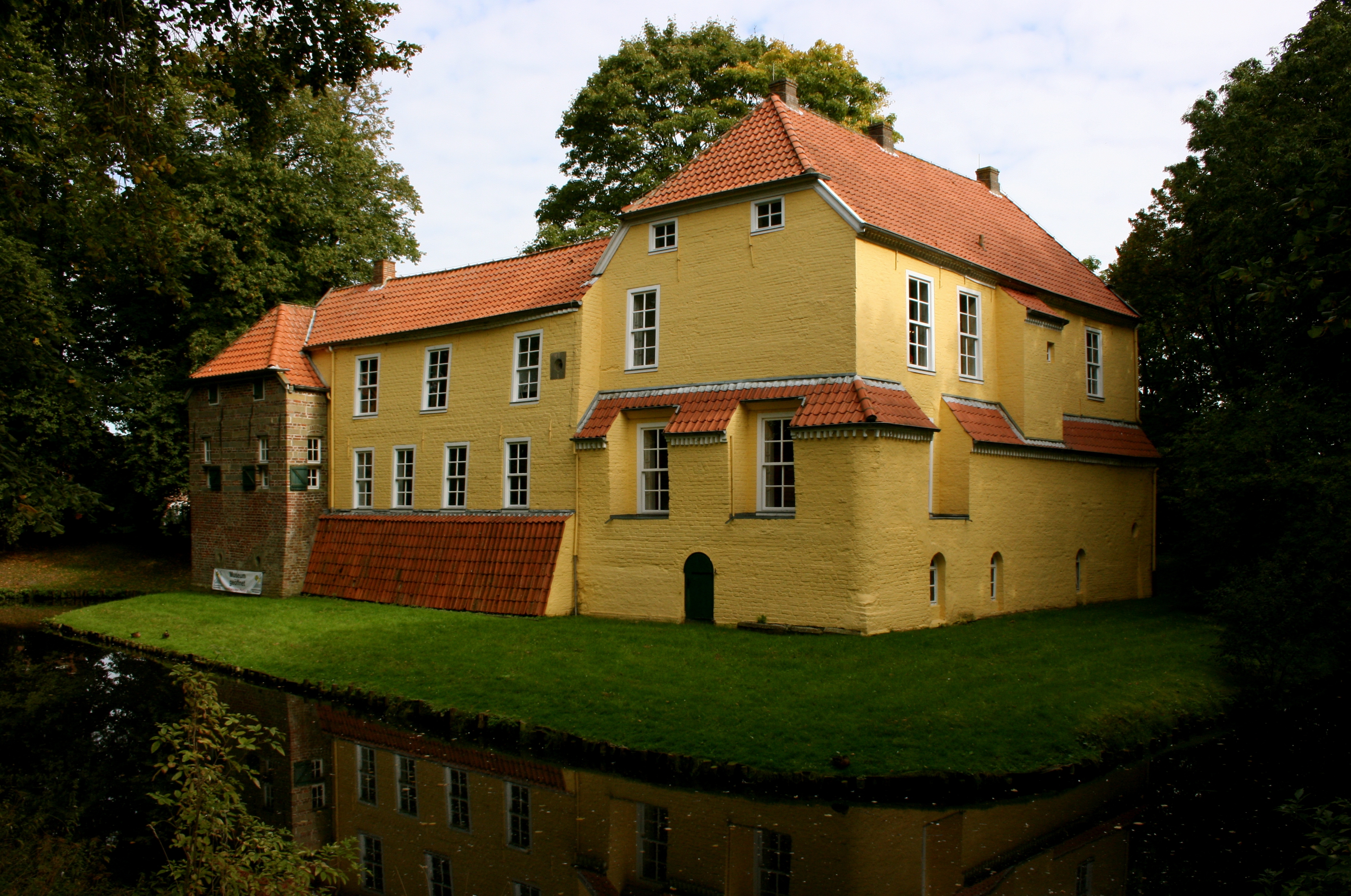
Pewsum was first mentioned in 945 AD as the seat of the Manninga clan, one of the East Frisian chieftain families that filled the political vacuum where there was no king. From the Manningas, the castle passed in 1565 to the Cirksena dynasty - the Counts who would weld East Frisia together. The Manningaburg drew a remarkable cast over the centuries. Dodo von Knyphausen, a Swedish marshal who served Gustavus Adolphus in the Thirty Years' War, lived here. So did General Peter Ernst II von Mansfeld, one of the conflict's most notorious mercenary commanders. The Great Elector of Brandenburg, Friedrich Wilhelm, also resided here. By the 18th century the castle had decayed; parts were demolished and sold. What survives now sits inside the East Frisian Open Air Museum - the Ostfriesisches Freilichtmuseum - the bones of an old chieftain seat reframed as a heritage site.
A Lutheran Island
The municipality of Krummhörn is overwhelmingly Evangelical Reformed - the Calvinist tradition the Dutch refugees brought up the Ems centuries ago. Pewsum is the exception, what locals call a Lutheran island in the Reformed sea. The St. Nikolai-Kirche dates to the 14th century, though a major renovation in 1862 wrapped its medieval bones in a new brick façade. The Catholic chapel of St. Hedwig is a much later arrival: built in 1959 on a private plot by refugees from Germany's former eastern territories, the displaced who landed in this far northwest corner after the war. Two religious histories - one medieval, one mid-20th century - sit a few streets apart. Add to those the Pewsum Brethren, who converted an old kindergarten into a community centre, and the village punches above its weight in denominational diversity.
The Mill on the Skyline
The emblem of Pewsum is the Manningaburg, the chieftains' castle built in 1458 that still defines the village skyline. Alongside it stands a three-storey tower mill in the Galerieholländer style - a Dutch-tradition mill with a gallery balcony where the miller could turn the cap to face the wind. It now houses the Pewsum Mill Museum, the village's quiet pride. The other thing the village will tell you about is the railway it lost. The Emden-Pewsum-Greetsiel Light Railway, a metre-gauge line, used to thread the Krummhörn villages together and out to Emden. It closed in 1963, replaced by buses, the way so many of these tiny regional lines went. Today the L2 and L3 state roads carry Pewsum's traffic toward Emden and the A31 motorway. In 1972 the village lost its independence too, absorbed into the new parish of Krummhörn - though it kept the administrative headquarters as a consolation prize. Today around 3,400 people live where the Manningas once held court.
From the Air
53.4353 N, 7.0972 E, in the flat Krummhörn west of Emden. The tower mill is the visual landmark, rising above flat marshland. Nearest airport is Emden (EDWE), about 10 km southeast. Bremen (EDDW) is the closest larger field. Coastal weather - bring extra fuel for North Sea low cloud days.