Phaung Daw U Pagoda
Five small Buddha images sit in the central shrine of Phaung Daw U Pagoda, and not one of them looks like a Buddha anymore. Generations of devotees have pressed gold leaf onto these figures with such persistence that the statues have swollen into shapeless golden lumps, their features buried under centuries of accumulated devotion. Old photographs on the monastery walls show what the images once looked like, but those forms are gone now, consumed by the very reverence that was meant to honor them. This is the paradox at the heart of Phaung Daw U: the most sacred objects on Inle Lake are sacred precisely because they have been transformed beyond recognition by faith.
Gold Beyond Recognition
The pagoda stands in the village of Ywama, on the waters of Inle Lake in Myanmar's Shan State. Its five gilded Buddha images are the spiritual center of the lake's communities, and the ritual of applying gold leaf was, until a ban was imposed, a deeply personal act of merit-making. Only men were permitted to press the thin sheets of gold onto the images, layer after layer, year after year, until the mass of accumulated metal became so great that gold had to be periodically removed just to keep the figures manageable. Pilgrims also drape small robes called thingan around the images, then carry these cloths home to place on their household altars, creating a physical connection between the pagoda's sanctity and their daily lives. The images have become reliquaries of collective devotion, their value measured not in the gold itself but in the millions of individual gestures that put it there.
The Voyage of the Golden Barge
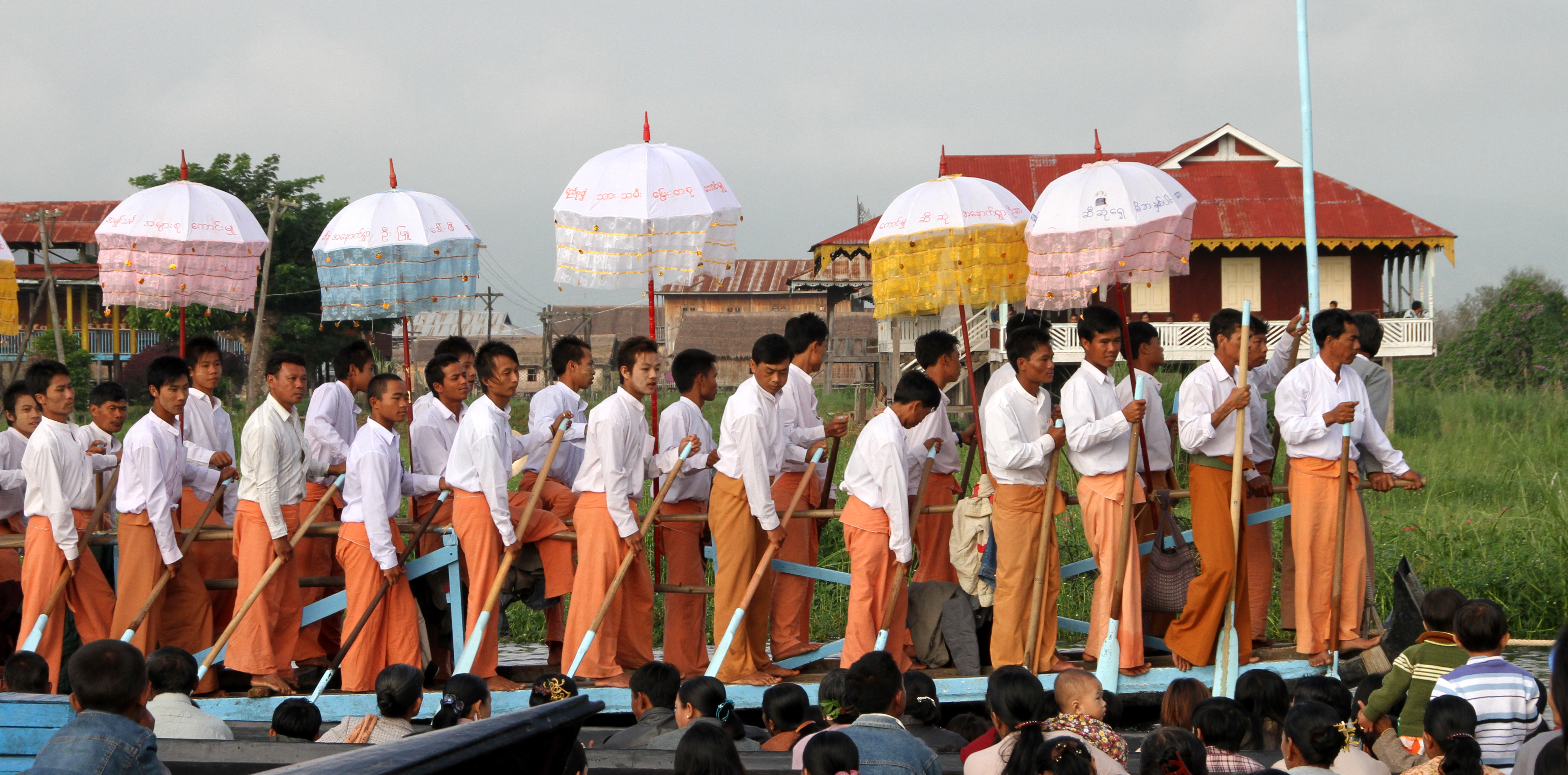
Each autumn, during the Burmese month of Thadingyut, four of the five images leave their shrine for an 18-day journey across Inle Lake. They travel aboard a replica royal barge shaped like a hintha, the mythical bird that is one of Buddhism's most recognizable symbols. One image always remains behind at the pagoda. The elaborately decorated barge is towed by boats of leg-rowers pulling in synchronized rhythm, accompanied by a flotilla that turns the procession into one of Myanmar's most spectacular water festivals. The barge moves clockwise from village to village along the lakeshore, and the four images spend each night at the main monastery of whatever village the procession has reached. Traditional boat races pit teams of leg-rowers in Shan dress against each other, and these competitions are among the most anticipated events of the festival season.
The Miracle of the Missing Image
The festival's most famous story involves a disaster. Sometime in the 1960s, during a day of high winds and rough waves, the barge carrying the images capsized, sending all four figures tumbling into the murky water. Recovery efforts retrieved three of the images, but the fourth could not be found despite extensive searching. When the distraught monks and villagers returned to the pagoda, they discovered the missing image sitting in its usual place inside the shrine, as though it had never left. The story is told and retold across the lake communities as a matter of settled fact, not legend. Whether one accepts the miraculous explanation or suspects a more earthly one, the tale has become inseparable from the pagoda's identity. It reinforces what the community already believes: these images possess a power that transcends their physical form.
The Saopha's Welcome
The climax of the festival arrives when the barge reaches Nyaung Shwe, the main town at the lake's northern end. Historically, the Saopha, the hereditary Shan prince of Yawnghwe, would personally welcome the images. The statues were carried in grand procession from the barge to the palace, entering through the eastern gate of the prayer hall where the public was invited to pay respects before the images continued to the main temple. This royal ceremony connected Buddhist devotion to the political authority of the Shan princes, weaving spiritual and secular power into a single ritual. Since the mid-1960s, after Myanmar's military government marginalized the traditional Shan aristocracy, the images bypass the palace and proceed directly to the temple. A government official now takes the Saopha's place. The procession continues, but the relationship between faith and power that it once embodied has shifted beneath the surface, like so much else in Myanmar.
From the Air
Located at 20.47N, 96.89E in the village of Ywama on Inle Lake, Shan State, Myanmar. The pagoda sits on the lake's western shore and is visible as part of the stilt village complex. Nearest airport is Heho (VYHE), approximately 35 km northwest. The lake itself is the primary visual landmark, a long north-south water body at 2,900 feet elevation in the Shan Hills. Best viewed at low altitude where stilt structures and boat traffic are distinguishable.