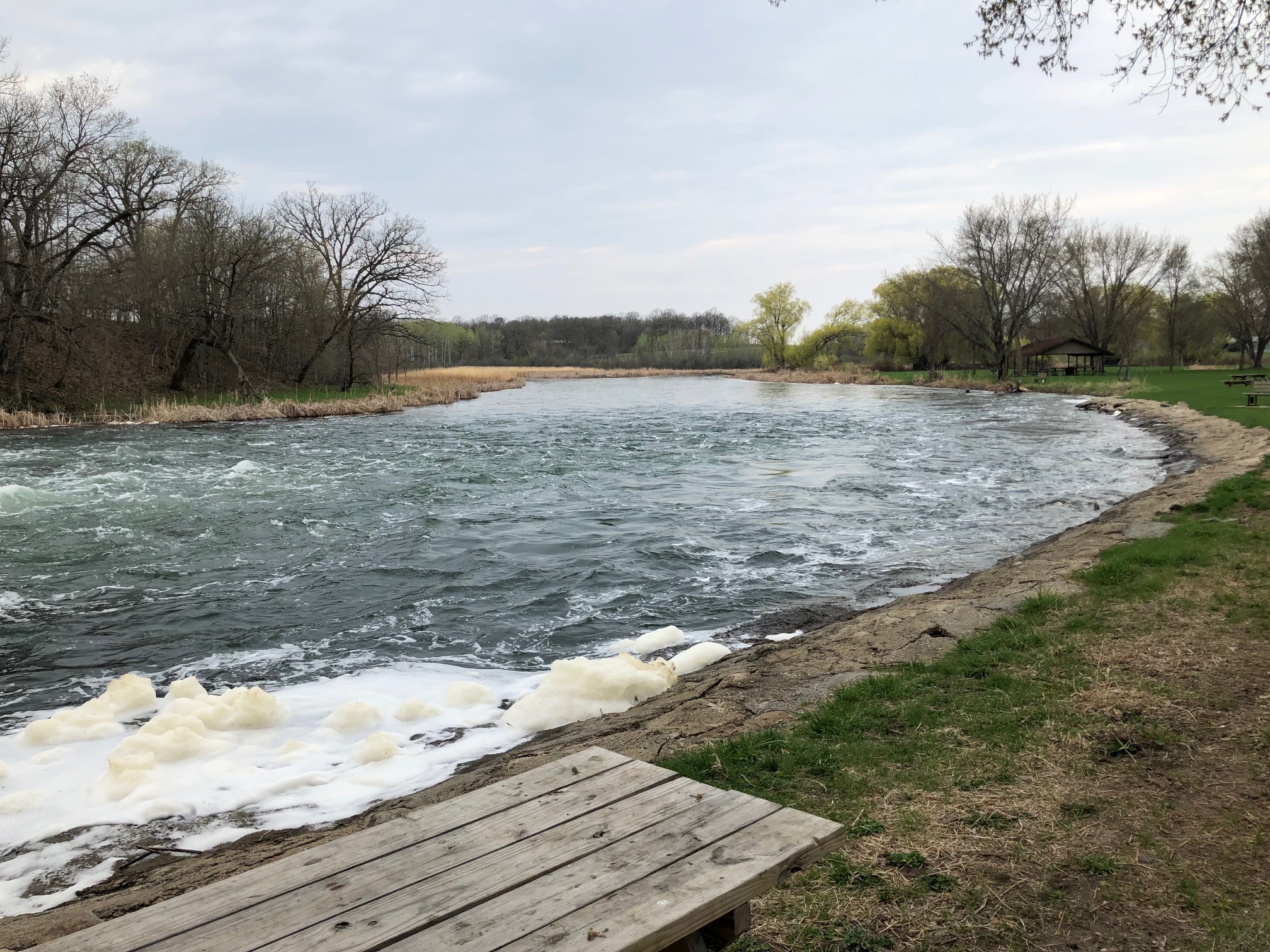
Phelps Mill
Royal Powers never marked the lumber he was cutting. The carpenter who framed Phelps Mill in 1888-1889 kept the entire plan in his head -- every beam, every joint, every angle of the three-story structure that would rise above the Otter Tail River in rural Otter Tail County, Minnesota. No blueprints, no sketches on paper. Just a man, his tools, and a spatial intelligence that seems almost impossible at this scale. The mill he built would grind wheat into flour for half a century, outlive the era that created it, and survive into the twenty-first century as one of Minnesota's most intact monuments to the age when nearly a thousand flour mills operated across the state.
A Thousand Mills on the Prairie
William E. Thomas was a flour and feed merchant in Fergus Falls who saw opportunity in the wheat boom of the 1880s. Minnesota's prairies were producing wheat at a staggering pace, and nearly a thousand flour mills were grinding that harvest across the state. Thomas chose a site on the Otter Tail River where falling water could power millstones, and in the spring of 1888 he began constructing a wooden dam. The dam was trouble from the start -- prone to leakage, it had to be constantly reinforced with sandbags, dirt, gravel, and whatever else could plug its gaps. But the mill itself, framed by Powers without a single blueprint, was solid. It opened in October 1889, designed to produce 60 to 75 barrels of flour per day. The operation was successful enough that by 1895 Thomas added capacity for grinding buckwheat and rye alongside the wheat that was the mill's bread and butter.
The Village That Grew Around the Wheel
A working flour mill in the late nineteenth century was not just an industrial building -- it was the nucleus of a community. Thomas built a bunkhouse where overnight guests could stay, and a barn for stabling the horses that hauled grain to the mill and flour away from it. A general store opened nearby, serving the farmers and workers who orbited the operation. That general store still stands and still operates, one of the few commercial survivors from an era when rural Minnesota was dotted with self-contained milling hamlets. The Phelps Mill community was never large, but it was complete: you could bring your grain, stable your horse, buy your supplies, sleep overnight, and head home the next morning with flour in your wagon.
Steam, Rail, and the End of Water Power
The twentieth century arrived with technologies that made water-powered mills obsolete. Electricity, gasoline engines, and steam power could drive millstones more reliably than a leaky dam on a prairie river. More decisive still was the railroad, which made it cheaper to haul raw grain to the giant roller mills of Minneapolis-St. Paul than to process it at small rural sites. The economics reversed: what had once been efficient -- milling grain close to the farm -- became a disadvantage compared to the scale and speed of industrial milling. Thomas sold the mill in 1919. The next owner sold again in 1928, and the mill fell silent for good in 1939, its waterwheel still, its stones cold.
Geneva Tweten's Campaign
The mill might have rotted into the riverbank if not for Geneva Tweten. The local resident and activist saw in the abandoned structure something more than decaying timbers -- she saw a symbol of the rural life that had built Otter Tail County. Tweten led a campaign to preserve the mill, arguing that its survival mattered not just as architecture but as memory. Her advocacy succeeded. Otter Tail County purchased the site in 1965, beginning the long process of stabilization and interpretation. In 1975, Phelps Mill was listed on the National Register of Historic Places. Today it anchors the Phelps Mill Historic District, which includes the original general store and an Italianate miller's house -- a pocket of nineteenth-century rural Minnesota preserved along a bend in the Otter Tail River. Every July, the Phelps Mill Festival brings the grounds alive with craft vendors, music, and crowds who come to stand inside a building that one man framed entirely from memory.
From the Air
Located at 46.381N, 95.821W on the Otter Tail River in rural Otter Tail County, Minnesota. The mill site is a small cluster of historic buildings along the river, visible from low altitude as a clearing with structures near a dam site. The Otter Tail River winds through rolling agricultural land and lake country. Fergus Falls Municipal Airport (KFFM) is approximately 15 miles to the southwest. From 2,000-3,000 feet AGL, the river corridor and adjacent farmland provide the best perspective on the mill's relationship to the landscape. The area is characteristic of Minnesota's western lake-and-prairie region.